
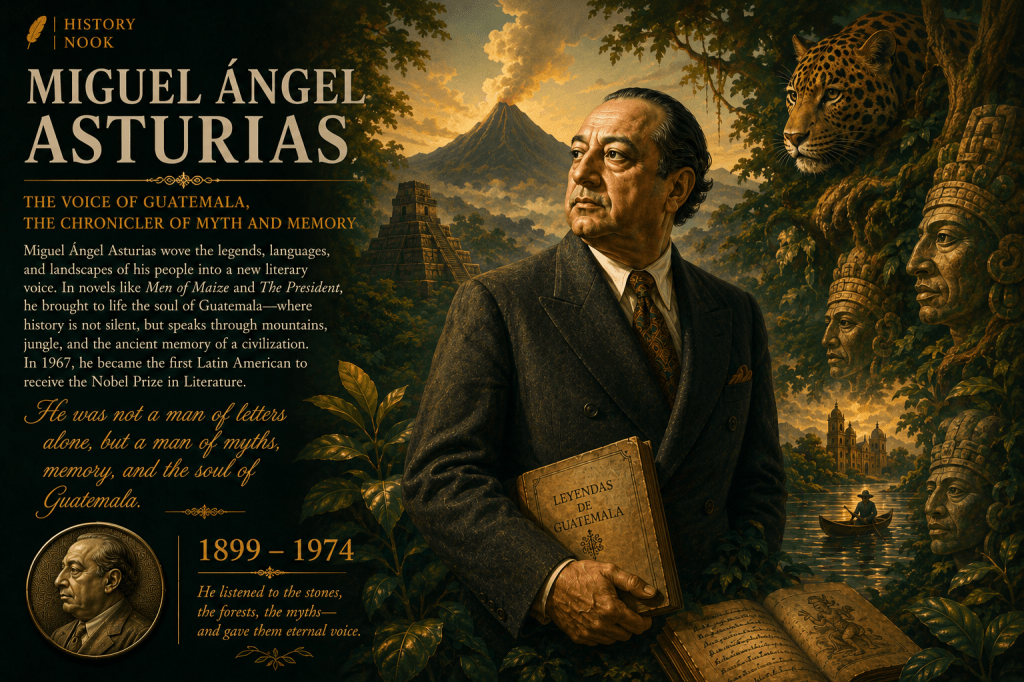
June 9, 1974
When One of Latin America’s Most Influential Writers Left a Global Literary Legacy
On June 9, 1974, Miguel Ángel Asturias died after a career that helped transform twentieth-century literature. Awarded the Nobel Prize in Literature in 1967, Asturias became one of the leading voices of Latin American writing, blending indigenous traditions, mythology, political commentary, and experimental narrative techniques.
Through translation and international literary exchange, his work influenced readers, scholars, and writers throughout the English-speaking world. Long before the Latin American Boom reached its greatest international visibility, Asturias helped demonstrate that stories rooted in local cultures could reshape global literature.
His influence traveled far beyond the language in which he wrote.
Expanding the Horizons of English Literary Culture
Asturias introduced many English-speaking readers to literary traditions they had rarely encountered before.
His novels brought indigenous cultures, mythologies, historical experiences, and social realities into international circulation. Through translation, readers gained access to perspectives that expanded conventional understandings of history, identity, and cultural memory.
World literature became more visible within English literary culture.
English-speaking readers encountered new ways of imagining both the past and the present.
Blending Myth and Modern Narrative
One of Asturias’s most distinctive achievements was his ability to merge folklore, mythology, and contemporary storytelling.
Dreamlike imagery, symbolic structures, oral traditions, and political realities coexist within his fiction, creating narratives that operate simultaneously on multiple levels. This approach demonstrated how local cultural traditions could generate innovative literary forms.
His work expanded the possibilities of narrative technique.
Reality itself became something literature could reinterpret through myth and imagination.
Strengthening the Place of Translation
The international success of Miguel Ángel Asturias helped increase interest in Latin American literature among English-speaking publishers, scholars, and readers.
His work contributed to a growing appreciation for translated literature as a source of artistic innovation rather than merely cultural curiosity. Literary exchange increasingly became a central feature of modern English-language literary culture.
Translation became a bridge between traditions.
English literature grew through contact with voices from beyond its own borders.
Exploring Literature as Social Commentary
Many of Asturias’s works examined power, authority, inequality, cultural identity, and historical memory.
His fiction demonstrated that literature could engage deeply with political and moral questions without sacrificing artistic complexity. Readers encountered narratives that challenged institutions, explored injustice, and reflected on the relationship between culture and power.
Storytelling became a form of social inquiry.
His work helped strengthen global traditions of politically engaged literature.
Why It Matters
The death of Miguel Ángel Asturias in 1974 marks the legacy of a writer whose influence extended far beyond Guatemala.
Through innovative storytelling, cultural exploration, and internationally celebrated fiction, he helped expand the range of literary traditions available to English-speaking readers. His work encouraged deeper engagement with translation, world literature, and cross-cultural exchange.
English literary culture became richer through its encounter with voices, myths, and experiences from beyond the English-speaking world.
Key Shifts in English Through Asturias’s Influence
- English literary culture became more engaged with world literature
- Translation gained greater prominence as a source of literary innovation
- Mythology and folklore influenced modern narrative experimentation
- Latin American literature reached wider English-speaking audiences
- Literature strengthened its role as a vehicle for cultural and political reflection
Some writers speak for a nation.
Miguel Ángel Asturias helped literature
speak across nations.
Also on this day!
If this moment still speaks, there is more to uncover.

 What Happened on This Day?
Leave a comment