
January 3, 1521
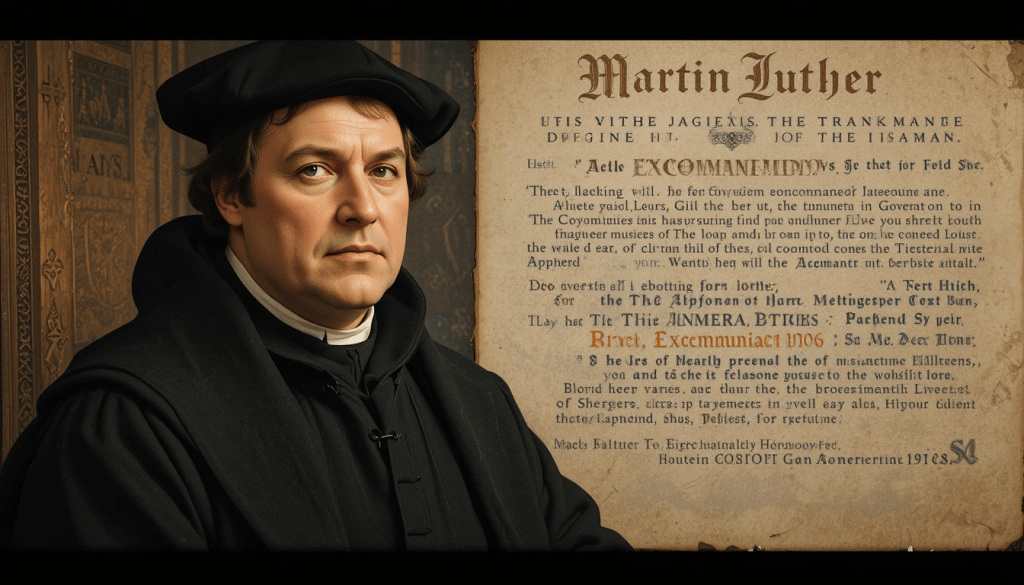
Martin Luther and the Historic Act of Excommunication
On January 3, 1521, Pope Leo X issued the papal bull Decet Romanum Pontificem, formally excommunicating Martin Luther from the Catholic Church. This act was not just a condemnation of a single man but a reflection of the growing unrest and demands for reform within Christendom. Luther’s theological challenges to Church practices, particularly his denouncement of indulgences and his call for a return to biblical authority, had already sparked a revolution. His excommunication marked a symbolic turning point in the Protestant Reformation, a movement that would profoundly alter the religious, cultural, and linguistic landscape of Europe and the English-speaking world.
Luther’s defiance of the Church’s authority was both theological and linguistic. Through his writing and speeches, Luther brought complex religious debates to the forefront of public discourse, inspiring a new era of critical thinking and individual inquiry. His excommunication only fueled his resolve, leading to some of the most significant works of his career, including his German translation of the Bible. The Protestant Reformation that he spearheaded was not just a religious movement but a linguistic and cultural awakening, which left an indelible impact on the English language and its speakers.
Luther’s Role in the Vernacular Revolution and its Impact on English
A key legacy of Martin Luther’s efforts was his groundbreaking insistence on using vernacular languages—the everyday languages of ordinary people—instead of Latin for religious texts and worship. His belief that individuals should directly engage with scripture led him to translate the Bible into German, completed in 1534. This translation was revolutionary, making sacred texts accessible to a much broader audience and catalyzing literacy and education among the laity.
- Inspiration for English Bible Translations:
Luther’s work inspired similar endeavors in the English-speaking world. In particular, William Tyndale, influenced by Luther’s ideas, created the first English translation of the New Testament from the original Greek in 1526. Though Tyndale was later executed for heresy, his work laid the foundation for the King James Version (1611) and other English Bibles that followed. These translations brought countless new phrases, idioms, and expressions into the English language:- Biblical Idioms in English: Common expressions like “by the skin of one’s teeth” (Job 19:20), “the powers that be” (Romans 13:1), and “the writing on the wall” (Daniel 5:5-31) owe their popularity to the accessibility of the Bible in English.
- Religious Terminology: Words like “atonement,” “justification,” “grace,” and “faith alone” became part of the English lexicon, shaping the vocabulary of religious discourse.
- Standardization of English:
The use of vernacular languages in religious texts helped to standardize and develop those languages. In the case of English, Tyndale’s and later translators’ works significantly influenced grammar, vocabulary, and spelling. The widespread reading of these translations also encouraged literacy, fostering a closer connection between language and individual empowerment.
The Reformation’s Influence on English Religious and Cultural Language
The Protestant Reformation, ignited by Luther’s defiance, introduced new theological ideas and vocabulary to English-speaking societies, which permeated not just religious discourse but also political, cultural, and social thought.
- New Vocabulary Reflecting Theological Concepts:
The Reformation introduced or popularized terms in English that reflected the shifting religious and intellectual landscape:- “Reformation”: Denoting the broader movement to reform the Church.
- “Heresy” and “heretic”: Words used to describe those challenging Catholic orthodoxy, which took on new resonance in the English-speaking world.
- “Protestant”: Originally referring to those who protested against Catholic authority.
- “Scripture”: The Reformation emphasized direct engagement with scripture, making this word central to religious discussions.
- Religious and Political Thought:
Luther’s emphasis on individual faith and conscience laid the groundwork for broader discussions of liberty of conscience and freedom of religion, concepts that became central to English political thought during the Enlightenment and later influenced documents like the U.S. Constitution. These ideas challenged the notion of absolute authority, whether religious or political, and helped shape the modern English-speaking world’s emphasis on individual rights and freedoms. - Cultural Resonance in English Literature and Art:
The Reformation’s themes of personal struggle, divine grace, and moral responsibility echoed in the works of English writers such as John Milton, whose Paradise Lost wrestled with the complexities of sin and redemption, and William Blake, who critiqued institutionalized religion in favor of personal spirituality. These themes enriched the English literary tradition and expanded its vocabulary and imagery.
Martin Luther’s Rhetoric and Global Influence on English
Luther was not only a theologian but also a master of rhetoric. His writings and speeches combined logic, passion, and accessibility, making complex theological arguments understandable to the common person. This style influenced how persuasive language was used in English:
- The Power of Simplicity and Clarity:
Luther’s approach to communication emphasized the importance of clear and direct language, a principle that shaped the rhetorical style of later English-speaking leaders, including Puritan preachers and reformers. - Phrases of Defiance and Authority:
Phrases attributed to Luther, such as “Here I stand, I can do no other” (from the Diet of Worms, 1521), became iconic expressions of courage and conviction. These types of phrases resonated in English-speaking cultures, influencing the language of protest, reform, and individual determination.
Martin Luther’s Excommunication: A Revolution in Language and Faith
The excommunication of Martin Luther on January 3, 1521, was more than a punitive act; it was the catalyst for a cultural and linguistic revolution that reverberated across Europe and into the English-speaking world. Luther’s insistence on the use of vernacular languages for religious texts and his translation of the Bible into German inspired a wave of similar efforts, including the translation of the Bible into English by William Tyndale and others.
The Reformation introduced a wealth of theological, cultural, and philosophical vocabulary into English, shaping the way English speakers thought, wrote, and communicated about religion and society. It democratized access to religious knowledge, fostering literacy and a spirit of inquiry that transformed both language and thought.
Through his defiance, Martin Luther left a legacy that continues to echo in the English language—ensuring that the ideas of faith, reform, and individual conscience remain central to how we speak, write, and understand the world today. His excommunication was not the end of his influence; rather, it was the beginning of a linguistic and cultural transformation that changed the course of history.
From Excommunication to Revolution: How Luther’s Defiance Redefined Language and Faith!
Originally published on January 3, 2025, on The-English-Nook.com.
 What Happened on This Day?
Leave a comment