
January 23, 1571
The Birth of Modern Commerce
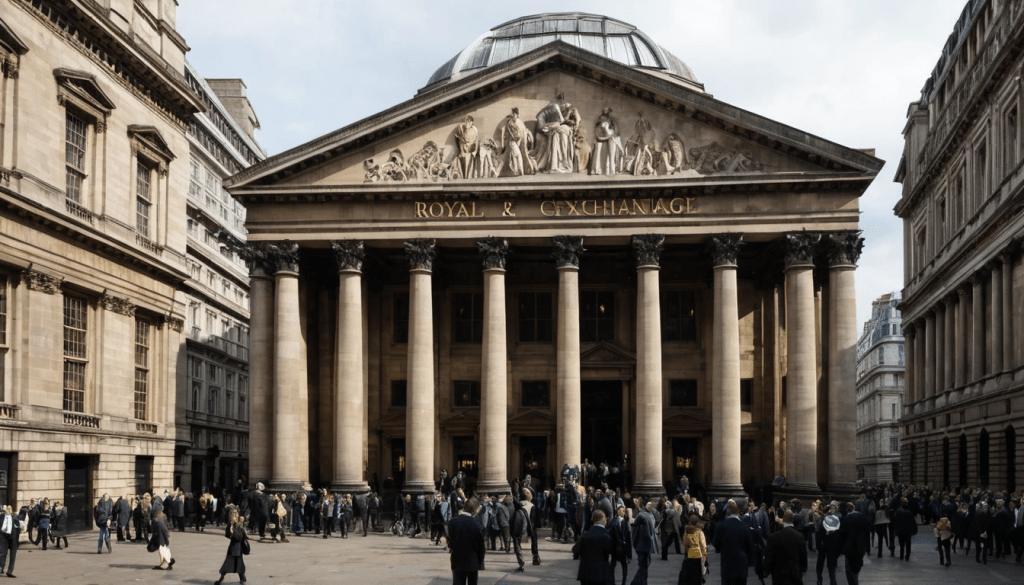
On January 23, 1571, Queen Elizabeth I officially opened the Royal Exchange in London, a pioneering institution in the history of global commerce. Founded by Thomas Gresham, a prominent financier and merchant, the Royal Exchange became a hub for trade, business, and financial innovation. Beyond its role in shaping the economy, the institution also profoundly influenced the English language, introducing key financial terms and concepts that remain essential to modern discourse.
The Royal Exchange: A Revolution in Commerce
The Royal Exchange was modeled after European trading centers such as Antwerp’s Bourse, but its opening marked a uniquely English innovation in formalized commerce. Designed to facilitate the buying and selling of goods, investments, and financial instruments, it became the beating heart of London’s economic activity. The institution fostered interactions between merchants, financiers, and brokers, creating a marketplace where deals were struck and fortunes were made.
Vocabulary and Phrases Introduced or Popularized
Financial and Commercial Terms
- Broker: Referring to an intermediary who facilitates deals between buyers and sellers, the term became widely recognized through the practices established at the Royal Exchange.
- Stock: Originally used to describe goods or merchandise, the term evolved at the Royal Exchange to signify shares of ownership in a company—a revolutionary concept that underpins modern capitalism.
- Exchange: Denoting a marketplace for trading goods and financial instruments, this word became synonymous with institutions facilitating commerce and investment.
- Dividend: A term for a portion of a company’s profits distributed to shareholders, it gained prominence as the idea of shared ownership spread from the Royal Exchange to the English-speaking world.
- Merchant: Although already in use, the term took on new prestige as merchants became central figures in the thriving economy centered at the Royal Exchange.
Business-Related Concepts
- Capital: This term, used to describe financial resources for investment, gained broader usage as the Exchange emphasized the importance of funding for commercial ventures.
- Investment: As individuals and groups pooled resources to fund trade expeditions, the concept of investment solidified as a cornerstone of financial activity.
- Trade winds: Though a geographic term, its frequent use in discussions of overseas trade became tied to the logistics and risks of global commerce.
Linguistic and Cultural Impact
Shaping Economic Discourse
The Royal Exchange revolutionized how English speakers thought and spoke about trade and finance. Terms like broker, stock, and exchange became part of everyday language, symbolizing the growing influence of commerce on society. These words also reflected broader shifts in economic thinking, as England transitioned from a feudal society to a market-driven economy.
From Commerce to Metaphor
Many of the terms popularized by the Royal Exchange took on metaphorical meanings:
- “Broker a deal” evolved to describe mediating agreements in various contexts beyond finance.
- “Stock” became a metaphor for resources or value, as in “human stock” or “stock of ideas.”
- “Exchange” extended its reach to describe intellectual and cultural interactions, such as the “exchange of ideas.”
Global Influence on Language
As the British Empire expanded, so did the language of commerce. The terms coined or popularized at the Royal Exchange were exported to colonies and trading partners worldwide, embedding themselves in the global lexicon of business and finance. Today, terms like stock market and dividend are universally understood, transcending their English origins.
The Royal Exchange and Modern English
The legacy of the Royal Exchange is evident not only in its architectural grandeur but also in the language of commerce it left behind. Its establishment marked a turning point in economic history, transitioning England into a financial powerhouse. The words and ideas fostered in its bustling halls helped shape the financial systems and vocabularies of modern economies, embedding themselves in the everyday language of trade, business, and investment.
Enduring Linguistic Legacy
The opening of the Royal Exchange did more than revolutionize commerce; it transformed the English language. Terms like broker, stock, and dividend remain indispensable, reflecting the enduring influence of this 16th-century institution on how we think, speak, and operate in the financial world today.
From deals to dividends, the Royal Exchange coined the language of global finance!
Originally published on January 23, 2025, on The-English-Nook.com.
 What Happened on This Day?
Leave a comment