

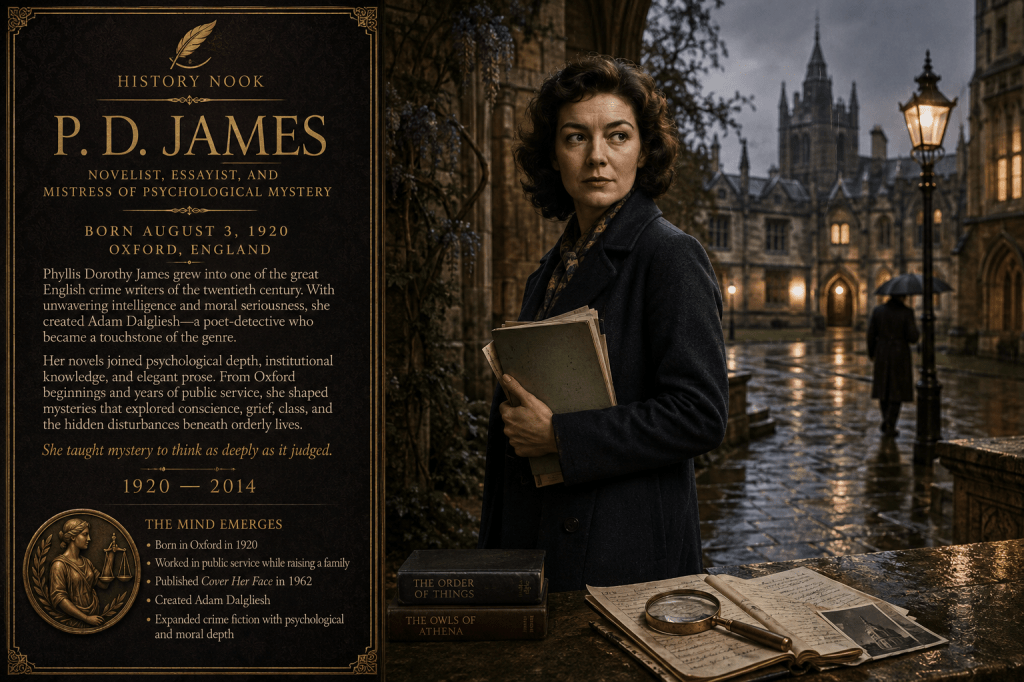
August 3, 1920
The Novelist Who Made Detection a Study of Order, Conscience, Institutions, and English Society
Phyllis Dorothy James, known to readers as P. D. James, was born in Oxford, England, on August 3, 1920. She became one of the most respected crime novelists in English, best known for her long series featuring the poet-detective Adam Dalgliesh.
James did not treat the detective novel as a lesser form. She believed the structure of crime fiction could hold serious questions: guilt, justice, privacy, class, ambition, professional duty, faith, grief, and the moral atmosphere of institutions.
Her mysteries are not merely puzzles.
They are ordered investigations into disorder.
In James’s fiction, a murder does not simply interrupt a plot. It exposes a community, a workplace, a family, a hospital, a publishing house, a church, a legal system, or a closed professional world already carrying pressure beneath its surface.
Born into Discipline and Constraint
James’s early life did not lead directly into literary comfort. She left school young and entered working life, later drawing upon experience in public administration, hospitals, and government service. Those worlds gave her fiction an unusual institutional authority.
She understood offices, procedures, records, hierarchies, professional codes, and the quiet emotional force of duty.
Key foundations include:
- a life shaped by work before literary fame
- familiarity with hospitals, administration, and public institutions
- attention to procedure, hierarchy, and professional language
- interest in private conscience within public systems
- a late-blooming literary career built on discipline rather than glamour
That background mattered. James’s fictional worlds feel inhabited by people with jobs, routines, secrets, responsibilities, and official roles. Her crimes occur inside structures that already have rules.
The murder reveals where those rules fail.
Creating Adam Dalgliesh
James introduced Adam Dalgliesh in Cover Her Face, published in 1962. Dalgliesh was a detective, but also a poet: reserved, intelligent, solitary, emotionally controlled, and unusually reflective for the genre.
He brought a different tone to English crime fiction.
Important developments include:
- a detective shaped by introspection as much as procedure
- investigations grounded in atmosphere and moral attention
- crimes unfolding inside carefully observed communities
- a balance between classic detection and psychological realism
- prose that gave the whodunnit greater emotional weight
Dalgliesh allowed James to preserve the satisfactions of detective fiction while deepening its seriousness. The reader still seeks the murderer, but the investigation also asks what kind of society made the crime possible.
The solution matters.
So does the world exposed on the way to it.
Making Genre Serious
P. D. James inherited a tradition shaped by writers such as Agatha Christie, Dorothy L. Sayers, and Margery Allingham, but she brought it into a later, more morally unsettled England.
Her novels often unfold in places where order should be strongest: hospitals, churches, publishing houses, forensic laboratories, legal chambers, and elite institutions. These settings become enclosed worlds where professional language can hide ambition, resentment, loneliness, fear, and corruption.
Key impacts include:
- strengthening the literary reputation of crime fiction
- making institutional settings central to mystery structure
- using setting as moral atmosphere, not decoration
- joining classic detection to social and psychological depth
- proving that genre could carry serious prose and ethical inquiry
James’s importance lies partly in refusing to apologise for the detective form. She showed that a murder mystery could be elegant, disciplined, popular, and morally intelligent at the same time.
Beyond the Detective Novel
Although James is most strongly associated with crime fiction, her range was wider. The Children of Men, published in 1992, imagined a future without children and later became the basis for Alfonso Cuarón’s 2006 film adaptation.
That novel confirmed that James’s real subject was not only murder, but social order under threat.
Long-term legacy includes:
- Adam Dalgliesh as one of modern crime fiction’s major detectives
- a body of work linking mystery to moral seriousness
- institutional English preserved through procedure, rank, and professional speech
- crime fiction strengthened as a literary form
- dystopian fiction that extended her interest in fragile civilisation
James’s best work asks the same question in different forms: what happens when the structures meant to preserve order become unable to protect human life?
Why It Matters
The birth of P. D. James on August 3, 1920, marks the arrival of a writer who helped give modern English crime fiction greater moral and institutional depth.
She did not abandon the pleasures of the detective story. She used them carefully: the body, the suspects, the clues, the enclosed setting, the trained investigator, the final disclosure. But around that structure she built a darker and richer world of duty, class, memory, professional speech, grief, and conscience.
For the history of English, James matters because she showed how genre can preserve forms of social language. Her novels listen to doctors, nurses, lawyers, priests, publishers, police officers, civil servants, and private citizens speaking within systems that both protect and constrain them.
In her fiction, detection becomes more than solving a death.
It becomes a way of reading society.
Key Shifts in English
- Crime fiction gained greater literary and moral authority.
- The detective novel became a study of institutions as well as individuals.
- Adam Dalgliesh added introspection, poetry, and restraint to the figure of the detective.
- Professional language became part of the texture of mystery writing.
- Enclosed settings became moral systems under pressure.
- Genre fiction proved capable of serious social and ethical inquiry.
- The Children of Men extended James’s interest in order, collapse, and human continuity.
- English crime fiction inherited a sharper language of duty, secrecy, conscience, and procedure.
P. D. James was born into a century of disorder, and gave crime fiction the architecture to examine what order costs, conceals, and sometimes fails to save.
Also on this day


 What Happened on This Day?
Leave a comment