
December 1, 1955
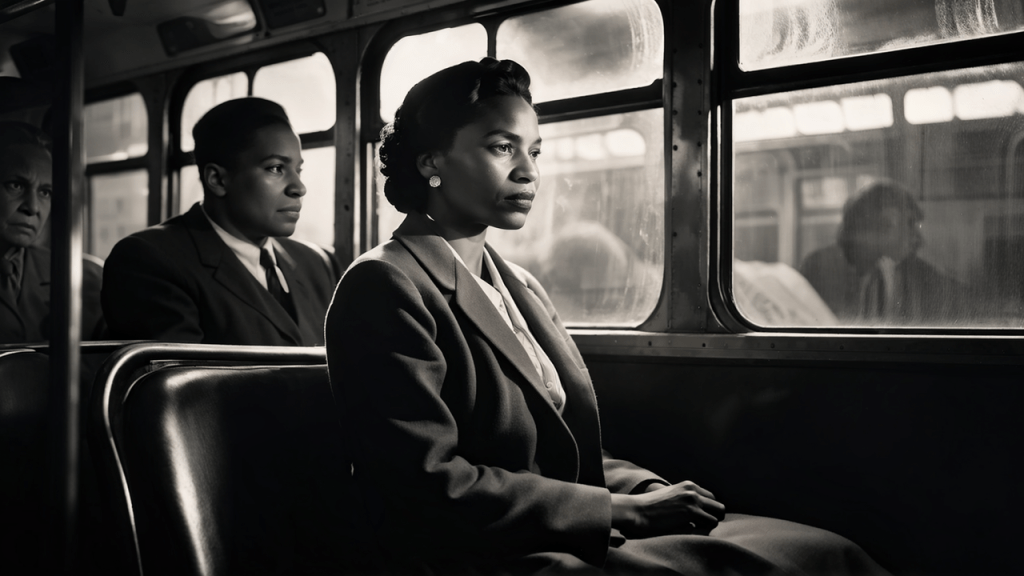
On December 1, 1955, Rosa Parks made history in Montgomery, Alabama, by refusing to give up her seat to a white passenger on a segregated bus. This seemingly small act of defiance sparked the Montgomery Bus Boycott, one of the most significant events in the American Civil Rights Movement. Parks’ courage not only helped dismantle institutionalized segregation but also left an indelible mark on the English language, embedding terms and concepts that continue to frame discussions on equality, justice, and nonviolent resistance.
Key Vocabulary Introduced or Popularized
The Civil Rights Movement, galvanized by Parks’ act of defiance, expanded the English lexicon with terms that encapsulate the struggle for racial equality and social justice.
Civil Rights Terminology
- “Civil rights”: Although the phrase existed earlier, it gained widespread prominence during the Civil Rights Movement, coming to symbolize the fight for equal protection under the law, particularly regarding race, gender, and other marginalized identities.
- “Segregation”: A central term in the movement, referring to the enforced separation of racial groups. Its negative connotations became a rallying point for activists striving for integration and equality.
- “Boycott”: The Montgomery Bus Boycott gave new life to this term, which describes the collective refusal to use or purchase goods and services as a form of protest. The boycott became a powerful symbol of economic resistance.
Terms of Nonviolent Protest
- “Nonviolent resistance”: Parks’ action epitomized this philosophy, popularized by leaders like Martin Luther King Jr. It refers to the use of peaceful tactics to oppose injustice and oppression.
- “Civil disobedience”: A key concept in the movement, this term describes the deliberate and nonviolent violation of unjust laws to prompt social change.
- “Sit-in”: Inspired by acts like Parks’, this term emerged to describe peaceful protests where individuals occupy a space, refusing to leave until their demands for justice are addressed.
Historical and Cultural Terms
- “Jim Crow laws”: A term used to describe the system of racial segregation and disenfranchisement in the U.S. South, under which Parks was arrested. The movement against these laws redefined how this term was perceived in history and discourse.
- “The Montgomery Bus Boycott”: This phrase became shorthand for collective action and the power of community organizing to challenge systemic injustice.
Impact on the English Language and Social Discourse
Parks’ defiance and the broader Civil Rights Movement reshaped how English speakers discuss freedom, equality, and justice, embedding new terms and concepts into everyday language.
Elevating the Language of Equality
The movement helped redefine core democratic ideals, embedding them in terms like:
- “Equality” and “justice” became central to the national conversation, often paired with “for all” to emphasize inclusivity.
- “Civil liberties” and “human rights” gained traction as global movements drew inspiration from the American struggle.
Popularizing Protest Terminology
The success of the Montgomery Bus Boycott highlighted the power of economic protest, making “boycott” synonymous with effective resistance. Subsequent movements, from labor rights to environmental activism, adopted similar strategies, enriching the language of protest:
- “To boycott” evolved into a versatile verb used in diverse contexts, from consumer activism to political campaigns.
- “Picket” and “march” became staples of protest vocabulary, emphasizing collective action in the pursuit of justice.
Reframing the Narrative of Resistance
The language of resistance was further shaped by the integration of terms like:
- “Nonviolent resistance” as a cornerstone of moral and strategic activism, influencing movements worldwide, including those led by Nelson Mandela and Mahatma Gandhi.
- “Civil disobedience” as a legitimate and powerful tool for challenging oppressive laws, with Parks’ story serving as a defining example.
Broader Cultural and Linguistic Impact
The Civil Rights Movement, spearheaded by figures like Rosa Parks, had a lasting impact on English, shaping both its vocabulary and its rhetorical frameworks.
Shaping Political and Social Rhetoric
The language of civil rights activism permeated political discourse, influencing how English speakers frame discussions of injustice:
- Terms like “systemic racism” and “institutional discrimination” entered the lexicon, enabling nuanced discussions of societal inequalities.
- “Justice delayed is justice denied” became a powerful maxim, underscoring the urgency of addressing civil rights issues.
Inspiring Global Movements
The linguistic legacy of Parks and the Civil Rights Movement transcended U.S. borders, influencing global struggles for freedom and equality:
- Movements in South Africa, India, and beyond adopted terms like “nonviolent resistance” and “civil disobedience” as they fought against colonialism, apartheid, and other forms of oppression.
Cultural Contributions
The movement’s linguistic influence extended into the arts, literature, and media:
- Music, poetry, and speeches from the era popularized phrases like “We shall overcome” and “I have a dream,” embedding them in English as symbols of hope and determination.
- Parks’ legacy continues to inspire works that explore themes of resistance and justice, ensuring the preservation of this powerful vocabulary.
A Linguistic Legacy of Courage and Justice
Rosa Parks’ refusal to give up her bus seat on December 1, 1955, was a defining moment in the fight for civil rights, and her legacy endures in the language we use to discuss equality and resistance. By embedding terms like “boycott,” “nonviolent resistance,” and “civil disobedience” into English, her actions and the movement she helped ignite have provided a linguistic framework for addressing oppression and advocating for justice.
The vocabulary of the Civil Rights Movement remains a powerful testament to the enduring struggle for human dignity and the transformative power of language in shaping history and inspiring change.
Originally published on December 1, 2024, on The-English-Nook.com.
 What Happened on This Day?
Leave a comment