
December 31, 1600
The Historic Charter and the Rise of the East India Company
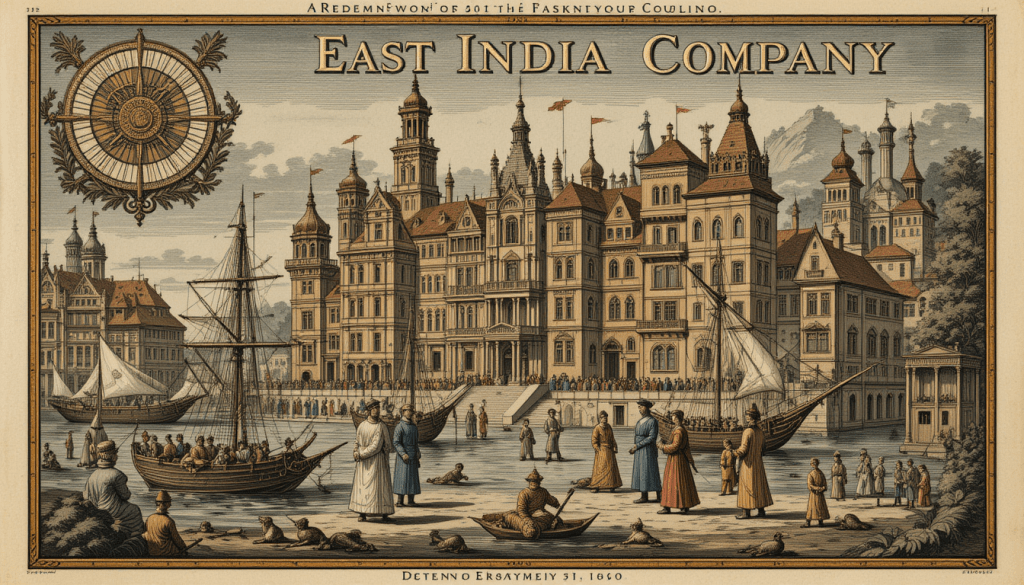
On December 31, 1600, Queen Elizabeth I granted a royal charter to the East India Company, marking the official establishment of one of the most powerful trading entities in history. This charter authorized English merchants to trade in the East Indies, eventually leading to the company’s dominant role in commerce and colonial expansion across South Asia.
The East India Company’s activities spanned more than two centuries, profoundly impacting global trade, geopolitics, and cultural exchanges. Its rise marked the beginning of English colonialism in India, reshaping the relationship between the two regions and leaving a legacy that continues to influence global history and the English language today.
Impact on the English Language
The East India Company’s presence in India catalyzed a profound linguistic exchange between English and Indian languages, particularly Hindi, Bengali, Tamil, and Persian. As British traders, administrators, and soldiers interacted with Indian societies, they borrowed numerous words and phrases, enriching the English lexicon with new terms that reflected the cultural and environmental realities of the subcontinent.
- Everyday Words from Indian Origins: The integration of Indian words into English gave rise to terms that are still widely used today:
- “Bungalow”: Derived from the Hindi word bangla, meaning a single-story house styled after Bengali architecture.
- “Jungle”: From the Hindi word jangal, meaning forest or wilderness.
- “Pajamas”: Adapted from the Hindi and Urdu term payjama, meaning loose-fitting trousers.
- “Shampoo”: Originating from the Hindi word champna, meaning to knead or massage.
- “Loot”: Borrowed from the Hindi word lut, meaning plunder, often used in the context of colonial conquest.
These words, among many others, demonstrate how English absorbed the cultural and linguistic nuances of India, adding diversity and richness to the language.
- Cultural Expressions and Culinary Terms: Beyond everyday words, the English language also incorporated phrases and culinary terms that reflected the fusion of cultures:
- “Curry”: Though an anglicized term, its roots lie in the Tamil word kari, meaning a spiced dish.
- “Chutney”: Derived from the Hindi word chatni, describing a tangy, spiced condiment.
- “Thug”: From the Hindi and Urdu term thag, referring to a bandit or trickster, which gained notoriety during British accounts of Indian criminal organizations.
- Administrative and Military Vocabulary: As the East India Company established its governance and military presence, it introduced terms related to administration and hierarchy:
- “Sepoy”: From the Persian word sipahi, meaning soldier, referring to Indian soldiers serving in British armies.
- “Zamindar”: Borrowed from Persian and Hindi, denoting a landowner or tax collector.
Cultural and Linguistic Exchange
The relationship between England and India during the East India Company’s rule was not merely one-sided; it was marked by a complex cultural and linguistic exchange. While Indian words entered English, British practices and language also influenced the Indian subcontinent. English became a medium of administration, education, and commerce in colonial India, shaping its role as a global lingua franca.
Indian literature, philosophy, and art influenced British intellectual circles, inspiring works that reflected the richness of Indian traditions. Figures such as William Jones and other members of the Asiatic Society explored Indian languages and texts, translating Sanskrit and Persian works into English and fostering a deeper cultural dialogue.
Legacy of the East India Company on Modern English
The linguistic legacy of the East India Company endures in modern English. Words and phrases of Indian origin are now so ingrained in the language that their origins are often overlooked. They reflect the historical entanglement of British and Indian histories, carrying the weight of colonialism while also highlighting the dynamic evolution of language through cultural interactions.
In addition, the narratives and records of the East India Company influenced English prose, as administrative reports, travelogues, and memoirs from company officials shaped British perceptions of India. These texts introduced English audiences to the landscapes, peoples, and cultures of the subcontinent, further embedding Indian-inspired vocabulary into the language.
The East India Company: Commerce, Colonialism, and the Enrichment of English
The chartering of the East India Company on December 31, 1600, marked the beginning of a transformative era in global trade and cultural exchange. While the company’s legacy is marred by the exploitative practices of colonialism, its role in fostering linguistic exchange is undeniable. Words like “bungalow,” “loot,” and “shampoo” stand as linguistic artifacts of a complex history, demonstrating how English has been shaped by its encounters with the diverse cultures of the Indian subcontinent. This evolution of language underscores the power of trade and interaction to expand and enrich the ways we communicate, even as it serves as a reminder of the historical contexts in which such exchanges occur.
Originally published on December 31, 2024, on The-English-Nook.com.
 What Happened on This Day?
Leave a comment