

April 12, 1961
The First Human in Space
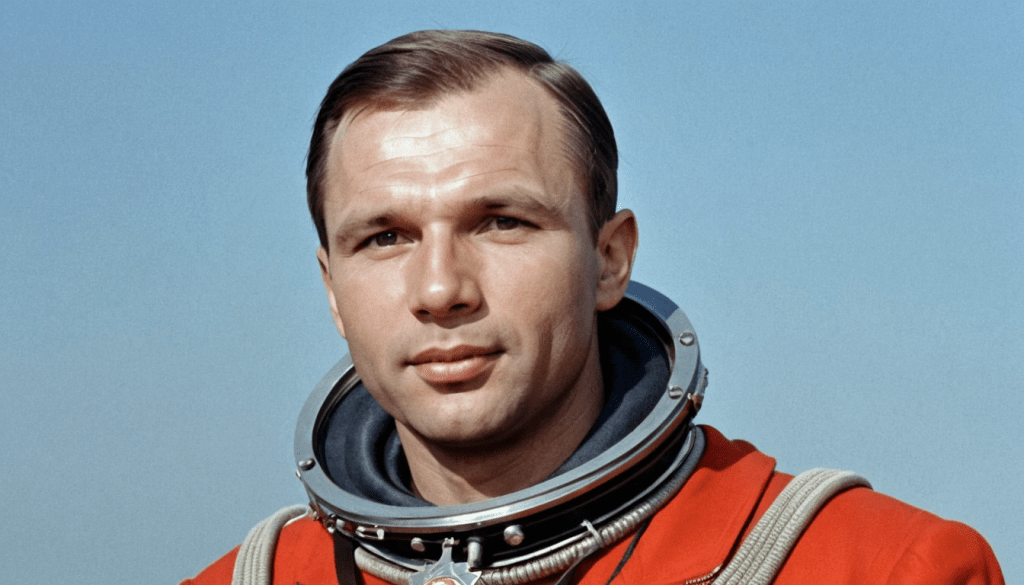
On April 12, 1961, Soviet cosmonaut Yuri Gagarin became the first human to travel into outer space aboard the Vostok 1 spacecraft. His historic 108-minute orbital flight marked a pivotal moment in human history and ushered in the Space Age. As the Cold War space race intensified between the Soviet Union and the United States, Gagarin’s achievement not only represented a technological triumph but also left an enduring impact on language, particularly in English.
New Words for a New Frontier
Gagarin’s journey and the broader context of space exploration introduced a wave of terminology into the English language. These words captured the imagination of the public, defined new scientific disciplines, and expanded the vocabulary of technology, aviation, and futurism.
“Cosmonaut”
Derived from the Russian kosmonavt, meaning “space sailor,” this term entered English through media reports of Gagarin’s flight. Although later largely replaced by “astronaut” in English-speaking countries, “cosmonaut” remains an important term used to distinguish Soviet and Russian space travelers.
“Spaceflight”
The word “spaceflight” gained prominence with Gagarin’s mission, describing the act of traveling through outer space. It quickly entered both scientific literature and public discourse, often paired with terms like “manned” or “crewed” spaceflight.
“Orbit”
While technically in use prior to 1961, “orbit” took on a more vivid cultural and scientific resonance after Gagarin successfully orbited the Earth. It became not only a technical term but also a metaphor for progress, motion, and exploration.
“Launch,” “Liftoff,” and “Blastoff”
Though already present in rocketry, these terms became symbolic markers of a new era. Used in both literal and figurative senses, “liftoff” entered everyday English as a metaphor for beginning ambitious projects or initiatives.
Cultural Influence and the Lexicon of the Space Race
The space race between the U.S. and USSR accelerated the growth of space-related vocabulary in English. Gagarin’s flight catalyzed this transformation, influencing language across multiple domains—from journalism and education to literature and entertainment.
- “Space Age” – This term became widely used after 1961 to describe the era of rapid technological advancement sparked by human space travel.
- “Zero gravity” / “Weightlessness” – Gagarin’s descriptions of floating inside his capsule popularized concepts of zero gravity, adding vivid, experiential terms to the English lexicon.
- “Capsule,” “module,” and “spacecraft” – These terms became standard as English adapted to describe the complex components of space travel.
- “Outer space” – Once mostly poetic or speculative, this phrase gained scientific clarity and became a staple of modern vocabulary after Vostok 1.
Yuri Gagarin’s Name as a Symbol
Yuri Gagarin’s name itself became part of English-language symbolism. His legacy is often evoked in phrases like:
- “Gagarin moment” – Used metaphorically to describe a bold, pioneering leap into the unknown.
- “The Gagarin effect” – A term sometimes used in educational or motivational contexts to refer to the inspiration derived from Gagarin’s courage and achievement.
Lasting Impact on English Expressions and Imagination
Gagarin’s spaceflight ignited not only scientific curiosity but also a rich metaphorical field. Terms born or popularized in this era evolved into expressive tools used in various disciplines:
- In business: “launch a product,” “skyrocket sales,” or “orbiting a market niche.”
- In literature: metaphors of escape, transcendence, or cosmic solitude often borrow from spaceflight vocabulary.
- In everyday speech: terms like “out of this world,” “shoot for the stars,” or “in orbit” gained traction, reflecting the influence of early space exploration.
A Linguistic Liftoff
The events of April 12, 1961, launched more than a spacecraft—they launched a new era of linguistic exploration. Gagarin’s journey added precision, scope, and imagination to English vocabulary, reshaping how people speak about science, ambition, and the universe.
From “cosmonaut” to “liftoff,” the words born or popularized by Gagarin’s orbit continue to echo in the language, reminding us that as our understanding of the universe grows, so too does our capacity to express it.
He went to space—and launched a universe of words.
Originally published on April 12, 2025, on The-English-Nook.com.
Visit my page to find out ‘What Happened on this Day?‘ and learn ‘The Word of the Day‘—you’ll find it here first and all in one place!
If you’re a language enthusiast, you’ll have access to a variety of resources, including short stories in English and Spanish, interesting readings, vocabulary, and much more—not just for English, but also for Spanish. Come check it out!
 What Happened on This Day?
Leave a comment