
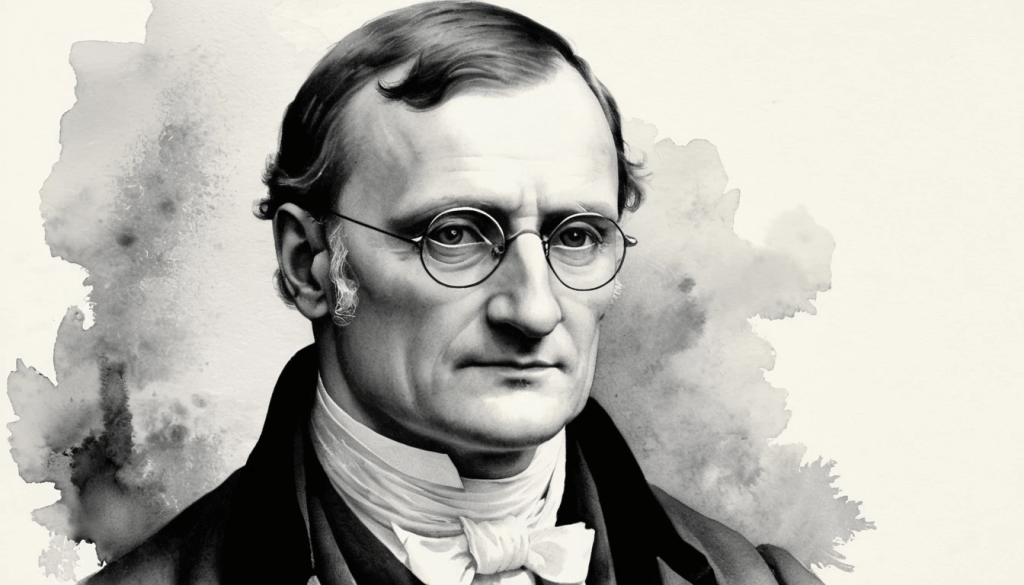
September 6, 1766
The Vocabulary Architect of Modern Atomic Science
On September 6, 1766, John Dalton, the English chemist, physicist, and natural philosopher, was born. His pioneering work laid the foundations of modern atomic theory, but equally significant was the terminology and conceptual language his theories introduced into scientific English. Dalton’s legacy is preserved not only in laboratories and textbooks but also in the lexicon of chemistry, physics, and science education, where his terms remain embedded today.
1. Atomic Vocabulary in English
Dalton’s formulation of atomic theory (1803–1808) provided the English-speaking world with a stable linguistic framework for understanding matter:
- “Atomic model” – the first systematic phrase to describe matter as built of indivisible units.
- “Dalton’s atomic theory” – the standard term in English science history, synonymous with the beginning of modern chemistry.
- “Atomic weight” – Dalton introduced this terminology, defining it as the relative weight of atoms, a phrase still central to chemistry.
- “Atomic symbols” – he was among the first to create symbolic notation for elements, influencing English-language chemistry textbooks.
- “Chemical atomism” – the English phrase that described his radical departure from alchemy to a measurable scientific worldview.
2. Dalton’s Laws and Scientific Naming
Dalton’s name is immortalized in several English-language scientific terms, ensuring that his contributions became part of the permanent vocabulary of science:
- “Dalton’s Law of Partial Pressures” – coined in English scientific discourse to describe how gases exert pressure independently in mixtures.
- “Dalton’s Law” – a shorter form, used colloquially in laboratories and classrooms.
- “Dalton (unit)” – adopted later in biochemistry to describe atomic and molecular masses (often shortened to Da).
- “Daltonian vision” – a nineteenth-century expression for his studies on color blindness.
- “Daltonism” – an enduring medical term in English for red-green color blindness, named after his own condition.
3. Expanding the Chemical Lexicon
Dalton helped shift English from the alchemy-influenced vocabulary of the early modern era to a more precise, quantitative language of chemistry:
- “Compound atom” – an early Daltonian phrase for molecules, marking the bridge to modern molecular theory.
- “Mole concept” – though developed later, was rooted in Dalton’s insistence on proportional numbers of atoms. The English term owes its conceptual lineage to Dalton.
- “Chemical combination by weight” – the phrase that reframed reactions in measurable, empirical English.
- “Atomic constitution of matter” – became a standard expression in English philosophical and scientific discourse, directly from Dalton’s framework.
4. Everyday English Extensions
Dalton’s theories did more than stay in laboratories—they helped form popular English expressions about science and matter:
- “Atomic structure” – used widely beyond science in metaphorical English, e.g., “atomic structure of society.”
- “Atomic model” – adapted by fields like sociology and linguistics to describe building blocks of systems.
- “Daltonian blindness” – figuratively used in Victorian English writing to mean failing to perceive essential differences.
- “Atomistic worldview” – became a philosophical idiom in English, meaning a perspective focused on the smallest constituents of existence.
5. Vocabulary List: Dalton’s Enduring Lexical Legacy
- Atomic theory
- Dalton’s law (of partial pressures)
- Atomic weight
- Dalton (unit)
- Daltonism / Daltonian vision
- Compound atom
- Atomic constitution of matter
- Atomistic worldview
Each of these expressions is not just a technical term but also a linguistic bridge that carried scientific ideas into English-language culture, education, and philosophy.
The Lexical Atom-Splitter
The birth of John Dalton on September 6, 1766 represents a turning point not only in science but in the history of English vocabulary. He provided a terminological scaffolding that still underpins the way we talk about matter, energy, and even vision. Words like “atomic theory,” “Dalton’s law,” “atomic weight,” and “Daltonism” continue to remind us that language itself evolves alongside scientific revolutions.
Dalton’s genius was not only in conceiving atoms but also in naming them, defining them, and embedding them into the very words we use to describe the world. His contribution makes him one of the great language-makers of science.
He didn’t just discover atoms—he gave them words.
Curious about what happened today in history? Want to learn a new word every day?
You’ll find it all—first and in one place—at The-English-Nook.com!
If you love languages, this is your space.
Enjoy bilingual short stories, fun readings, useful vocabulary, and so much more in both English and Spanish.
Come explore!
 What Happened on This Day?
Leave a comment