
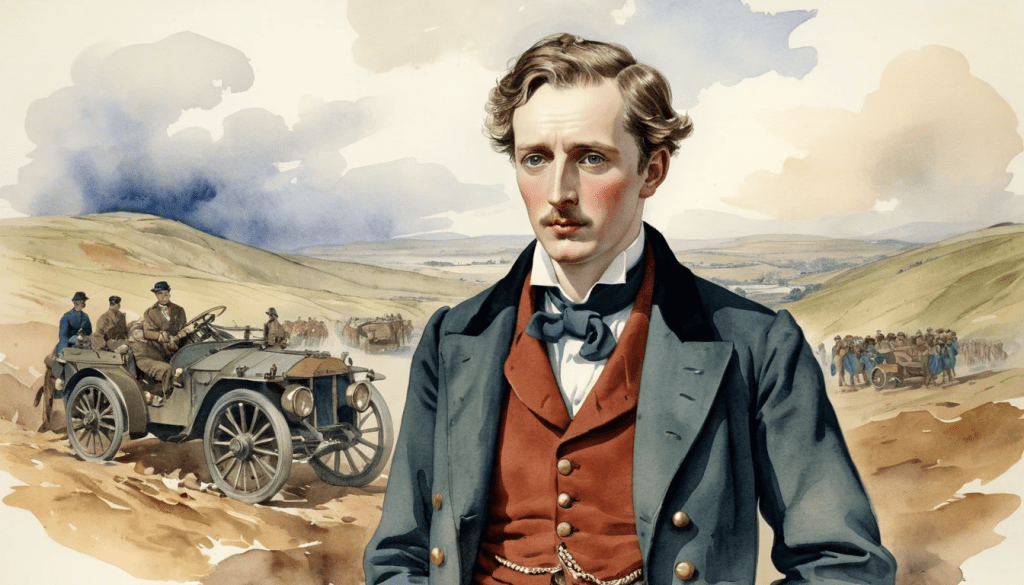
September 22, 1916
The Young Poet Whose Silence Became Part of English’s Language of Loss
On September 22, 1916, Edward Wyndham Tennant, an aristocratic English war poet, was killed in action during the Battle of the Somme. Only nineteen years old, Tennant belonged to the generation of young men whose promise was cut short by the First World War. His death, alongside those of fellow poets Rupert Brooke, Wilfred Owen, and Charles Sorley, came to symbolize the “Lost Generation” — a phrase that entered English as both a historical marker and a cultural idiom.
Though Tennant’s poetic output was modest compared to Owen or Sassoon, his fate itself became a metaphor. His short life stands for the thousands of unwritten poems, silenced voices, and broken futures of a generation. In this way, Tennant contributed not only words but also a language of absence, one that reshaped English poetry and public remembrance.
1. The “Lost Generation” as a Cultural Idiom
Tennant’s death helped give English one of its most haunting collective phrases: “the Lost Generation.”
- First applied to the millions of young men killed or disillusioned by the war, it has since entered English to describe any generation whose potential is destroyed by historical catastrophe.
- In literature, journalism, and cultural commentary, “Lost Generation” remains shorthand for wasted promise, youth undone, and dreams abandoned.
- Tennant, as one of the youngest and most symbolic figures, embodies this idiom in English memory.
2. The Vocabulary of Trench Experience
The war poets, Tennant among them, brought into English a new vocabulary of mud, trenches, and desolation.
- Words like “no man’s land,” “dugout,” and “over the top” entered not just military slang but also poetic diction.
- Tennant’s verse, though less widely read, participated in this lexical transformation — English absorbed a new language of mechanized horror and landscape of ruin.
- These terms, once literal, became enduring metaphors of alienation and futility in English cultural discourse.
3. Youth, Elegy, and the Broken Flower of Promise
Tennant’s death at nineteen gave English poetry a recurring image: the flower of youth cut down.
- His life, often described in elegiac tones by his contemporaries, reinforced the botanical metaphors of loss — youth as a bloom destroyed before full flowering.
- The phrase “the boys of 1914” became a generational label, used in English to describe the innocent schoolboys who marched to war and never returned.
- Tennant’s privileged background made the irony sharper: the heir of promise turned into fodder for the trenches. This contrast enriched English poetry with a new mode of tragic irony.
4. The Shift to Modernist Poetics
The Great War, and Tennant’s death within it, accelerated the shift of English poetry into modernism.
- The diction became stark, pared down, unornamented, rejecting Victorian lyricism.
- Themes of futility, irony, and bitterness replaced heroic and patriotic strains.
- Even the idea of Tennant’s “unwritten poems” entered English cultural thought: the notion that absence itself can be a poetic form, that silence is a text. His death gave English poetry a language of the unfinished.
5. Legacy in English Remembrance
Though Tennant is less celebrated than Owen or Sassoon, his name endures as part of the choir of lost voices.
- In anthologies of war poetry, he appears as a reminder of the breadth of sacrifice — not just major poets but also promising minor voices silenced.
- English classrooms and memorial ceremonies use his figure to evoke the cost of war in lost creativity.
- His story exemplifies how English absorbed not only poems but also the silence left behind, turning absence itself into a linguistic presence.
Glossary of Enduring Expressions from Tennant and His Generation
- Lost Generation — phrase for youth destroyed by war, later extended to other eras of disillusionment.
- No Man’s Land — enduring metaphor for desolation, danger, and liminality.
- Flowers of youth cut down — poetic image of innocence destroyed before maturity.
- The boys of 1914 — shorthand for the young men of WWI, used in poetry, memorials, and cultural commentary.
- War elegy — a modern poetic form defined by stark mourning, born in the trenches.
Tennant’s Poetic Legacy
When Edward Tennant died on September 22, 1916, English poetry lost not only a young voice but also gained a permanent symbol of silence. His fate reinforced the idioms of the Lost Generation, the vocabulary of trench warfare, and the elegiac mode of youth undone. By dying, Tennant entered English not as a canonical poet but as a metaphor of absence, a reminder of how war reshaped the very language of poetry.
One lost youth, one broken promise, one enduring silence — Tennant gave English its language of the Lost Generation.
Curious about what happened today in history? Want to learn a new word every day?
You’ll find it all—first and in one place—at The-English-Nook.com!
If you love languages, this is your space.
Enjoy bilingual short stories, fun readings, useful vocabulary, and so much more in both English and Spanish.
Come explore!
 What Happened on This Day?
Leave a comment