
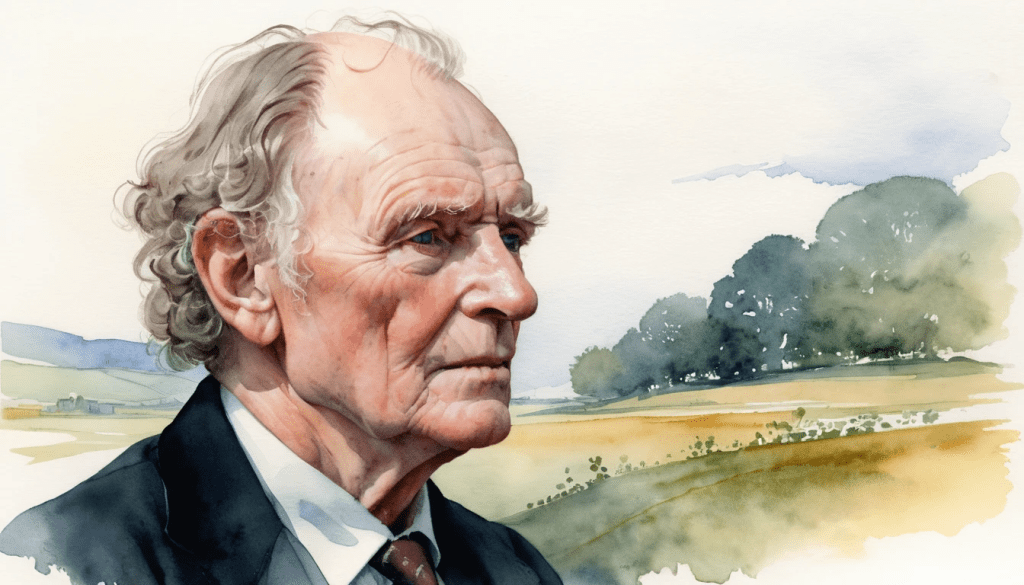
September 25, 2000
The Priest-Poet Who Brought a Welsh Sensibility into English Verse
On September 25, 2000, Ronald Stuart Thomas, better known as R. S. Thomas, died at the age of eighty-seven. A Welsh poet and Anglican clergyman, Thomas became one of the most distinctive literary voices of the twentieth century. Though he wrote primarily in English, his work carried a profoundly Welsh sensibility — rooted in the rural landscapes, cultural tensions, and spiritual depth of Wales.
Thomas’s spare, uncompromising style offered English poetry a new austerity of diction and a new moral seriousness. His poems gave voice to the struggles of Welsh identity, the harshness of farming life, and the silence of God. In doing so, Thomas reshaped the texture of English-language poetry in Britain, fusing the cadence of Welsh tradition with the idiom of modern English verse.
1. A Welsh Accent in English
Thomas infused English poetry with Welsh themes, rhythms, and landscapes.
- Words like “chapel,” “farm,” “hill country” became central poetic symbols in his work, carrying the spirit of Welsh rural life into English literature.
- His poetry made English readers hear a Welsh voice — stark, rooted, proud, and wounded — within the medium of English.
- Through him, English poetry gained a Welsh inflection, reminding readers of the language’s capacity to absorb and reflect cultural difference.
2. The Poetics of Spareness and Precision
Thomas championed a style of austerity that left its mark on English verse.
- His diction was stripped of ornament, often monosyllabic, echoing the harsh simplicity of the lives he described.
- English poetry gained from him a model of clarity without sentimentality, a vocabulary of restraint that stood apart from romantic flourish.
- His influence can be seen in later poets who adopted the stark, minimal line as a mode of moral and aesthetic seriousness.
3. Faith, Doubt, and the Vocabulary of Silence
As both clergyman and poet, Thomas gave English a new way of writing about God.
- He spoke of divine absence, of silence more than presence, enriching English religious poetry with a vocabulary of austere faith and doubt.
- Phrases like “the silence of God” and “the empty heavens” became idioms in theological and literary discussions.
- His voice helped shift English devotional poetry from piety toward existential questioning.
4. National Identity and English Expression
Thomas gave English readers a sense of Welsh nationalism and cultural tension.
- His poems often used English to critique the anglicization of Wales, embedding irony and resistance into the very language.
- This gave English literary culture new terms of self-reflection, highlighting how language can be both tool and oppressor.
- In this way, his poetry enriched English with a bilingual consciousness, where identity and language clash and converge.
5. Legacy in English and Beyond
By the time of his death in 2000, Thomas had become one of the most important Anglophone poets of the late twentieth century.
- His voice gave English poetry a distinctive Welsh accent of austerity and resistance.
- His idioms of silence, doubt, and rural harshness remain part of modern English poetic vocabulary.
- He stands as a reminder that English poetry is not monolithic but shaped by the many cultures that write within it.
Glossary of Enduring Expressions from R. S. Thomas
- The silence of God — idiom for divine absence and existential faith.
- Welsh voice in English — a mode of poetry marked by cultural tension and rooted identity.
- Austerity of diction — stripped, monosyllabic English as a moral style.
- Hill country / chapel — symbols of rural Wales embedded into English poetic imagination.
- Thomasian austerity — descriptive phrase for his stark, uncompromising style.
Thomas’s Stark Language
When R. S. Thomas died on September 25, 2000, English poetry lost one of its most uncompromising voices. He gave English not just words, but a tone: severe, rural, spiritual, and Welsh. By infusing English with Welsh rhythms, a vocabulary of silence, and a morality of restraint, he expanded its poetic range.
One hill, one chapel, one enduring silence — Thomas gave English its language of austerity and faith in doubt.
Curious about what happened today in history? Want to learn a new word every day?
You’ll find it all—first and in one place—at The-English-Nook.com!
If you love languages, this is your space.
Enjoy bilingual short stories, fun readings, useful vocabulary, and so much more in both English and Spanish.
Come explore!
 What Happened on This Day?
Leave a comment