
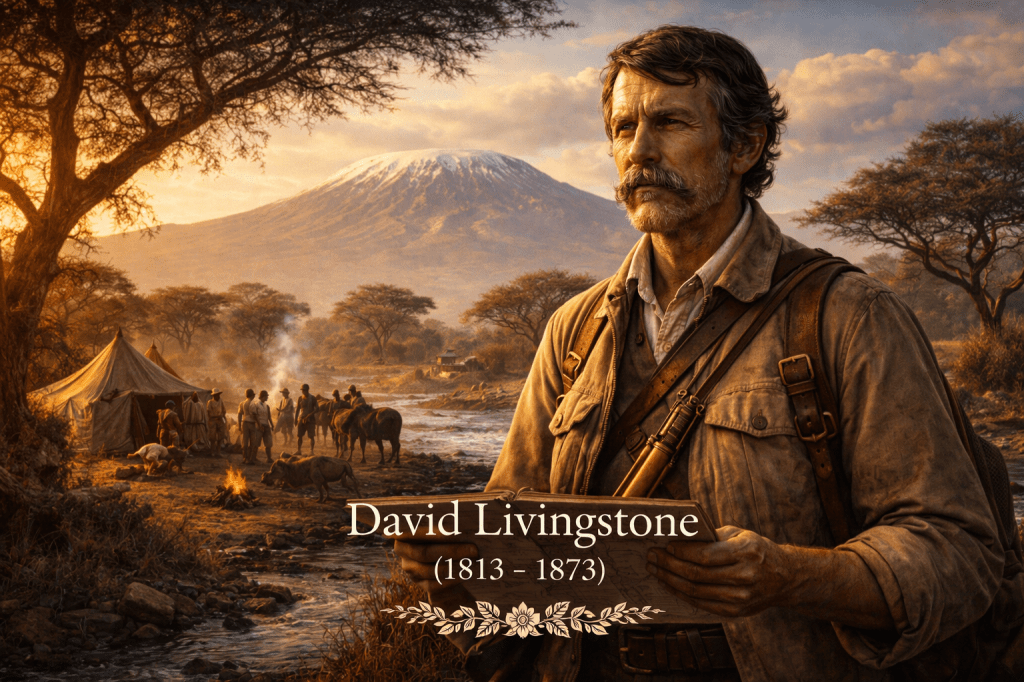
March 19, 1813
When Exploration Writing Helped Globalize English
Born on March 19, 1813, David Livingstone became one of the most influential explorer-writers of the nineteenth century. A Scottish missionary, physician, and traveler, he journeyed extensively through southern and central Africa, documenting his experiences in widely read English-language works such as Missionary Travels and Researches in South Africa (1857). His writings reached large audiences in Britain and beyond, helping to spread not only geographic knowledge but also the use of English as a language of exploration, administration, and cross-cultural contact.
1. Expanding English Through Exploration Narrative
Livingstone’s travel writing brought distant regions into the English-reading world. His detailed accounts combined observation, description, and moral reflection, helping to define the genre of nineteenth-century exploration prose.
Linguistic contributions include:
- vivid descriptive language for landscapes, rivers, and unfamiliar environments
- integration of geographical terminology into popular English reading
- narrative structures blending travel, science, and personal testimony
- introduction of African place names and cultural references into English texts
- expansion of vocabulary related to exploration and mapping
His books helped make English a key language for describing and interpreting the non-European world.
2. Promoting English as a Medium of Missionary and Administrative Communication
As both a missionary and a representative of British interests, Livingstone contributed to the spread of English in regions where it had not previously been dominant.
Broader linguistic effects:
- reinforcement of English as a language of religious instruction and translation
- use of English in colonial administration and reporting
- expansion of bilingual communication between English speakers and local populations
- encouragement of written record-keeping in English within missionary contexts
- association of English with education, governance, and institutional authority
These developments contributed to the long-term establishment of English in parts of Africa.
3. Shaping the Tone of Imperial and Humanitarian Prose
Livingstone’s writing combined scientific observation with moral and humanitarian concerns, particularly his opposition to the slave trade. This blend influenced the tone of later English prose dealing with empire and reform.
Stylistic and rhetorical features:
- moral urgency expressed through persuasive narrative
- blending of empirical observation with ethical argument
- portrayal of exploration as both scientific and humanitarian mission
- development of a narrative voice combining authority with empathy
- use of firsthand testimony to support political and social causes
This style became common in nineteenth-century English nonfiction writing about global affairs.
4. A Lasting Influence on Global English
Livingstone’s writings reached a wide readership and contributed to the growing global presence of English during the height of the British Empire.
Long-term linguistic impact:
- strengthening English as a language of global travel writing
- contributing to its role in colonial education systems
- influencing later exploration narratives and geographic literature
- helping position English as a lingua franca in international contexts
- embedding English in cross-cultural communication networks
While closely tied to the history of empire, this expansion also laid groundwork for the modern global use of English.
Final Thoughts
David Livingstone’s birth in 1813 marks the arrival of a figure whose writings helped carry English far beyond its European origins. Through exploration narratives, missionary work, and widely read publications, he contributed to the spread of English as a global language of description, administration, and cultural exchange.
His legacy reflects both the literary power of travel writing and the complex historical forces through which English became a worldwide language.
He didn’t just map the world—he helped English travel it.
 What Happened on This Day?
Leave a comment