
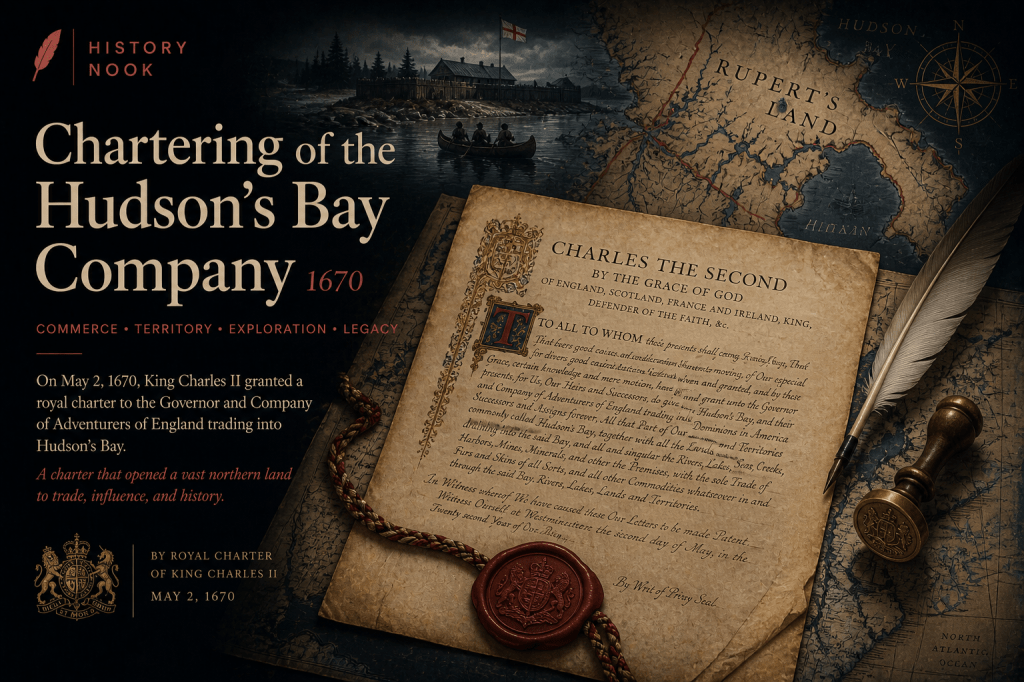
May 2, 1670
When Commerce Expanded the Reach of English
On May 2, 1670, King Charles II granted a royal charter to the Hudson’s Bay Company, establishing one of the most influential trading enterprises in North American history. More than a commercial institution, the company became a vehicle through which English spread across vast territories—through trade routes, records, maps, and administration.
Its influence was not literary, but practical. English moved with commerce, and commerce moved far.
Trade as a Language System
The Hudson’s Bay Company helped extend English into regions where it had not previously functioned as a daily administrative language.
Trade required records, contracts, inventories, correspondence, and negotiation. With that came a practical expansion of English—less as literature, more as system. English became the language of exchange, logistics, and institutional control across large parts of northern North America.
This gave English a wider territorial reach and a more practical administrative role.
Contact Changed Vocabulary
As English moved through unfamiliar environments, it encountered new landscapes, materials, and systems of knowledge.
That contact reshaped vocabulary. English absorbed place-names, environmental terms, and descriptive language shaped by Indigenous knowledge and North American realities. Not all of these borrowings were formal, but many entered maps, trade records, and everyday usage.
English did not simply spread outward. It changed through contact.
Mapping a Larger English
The company’s records helped turn geography into language.
Rivers, coasts, routes, settlements, and trading posts were named, recorded, and circulated in English. In this process, English became increasingly tied to cartography, classification, and territorial description. The language expanded not only by speaking, but by naming.
This helped reinforce one of English’s enduring strengths: its ability to absorb geography into vocabulary.
Expansion and Power
The spread of English through the Hudson’s Bay Company was not neutral.
Language moved through systems of trade, but also through monopoly, territorial control, and colonial power. The company’s charter granted sweeping authority over Rupert’s Land while disregarding existing Indigenous sovereignty.
That matters because the spread of English here was not only linguistic. It was institutional.
English expanded not just as a language of exchange, but as a language of authority.
Why It Matters
The chartering of the Hudson’s Bay Company in 1670 marks a moment when trade became one of the great engines of English expansion.
As English moved through routes of commerce, mapping, and contact, it became broader in vocabulary, wider in reach, and more deeply tied to systems of power.
Through this process, English became not only a language of trade—but a language of territory, record, and rule.
Key Shifts in English Through the Hudson’s Bay Company
- Trade expanded English — commerce carried the language across northern North America
- English became administrative — records and contracts widened its practical use
- Vocabulary grew through contact — Indigenous knowledge shaped naming and description
- Geography entered language — maps and place-names expanded English reference
- English became institutional — trade strengthened its role in governance and control
- Expansion carried power — English spread through systems of commerce and empire
Some languages spread through books.
Others spread by learning
how to name a continent.
Also on this day!
If this moment still speaks, there is more to uncover.

 What Happened on This Day?
Leave a comment