
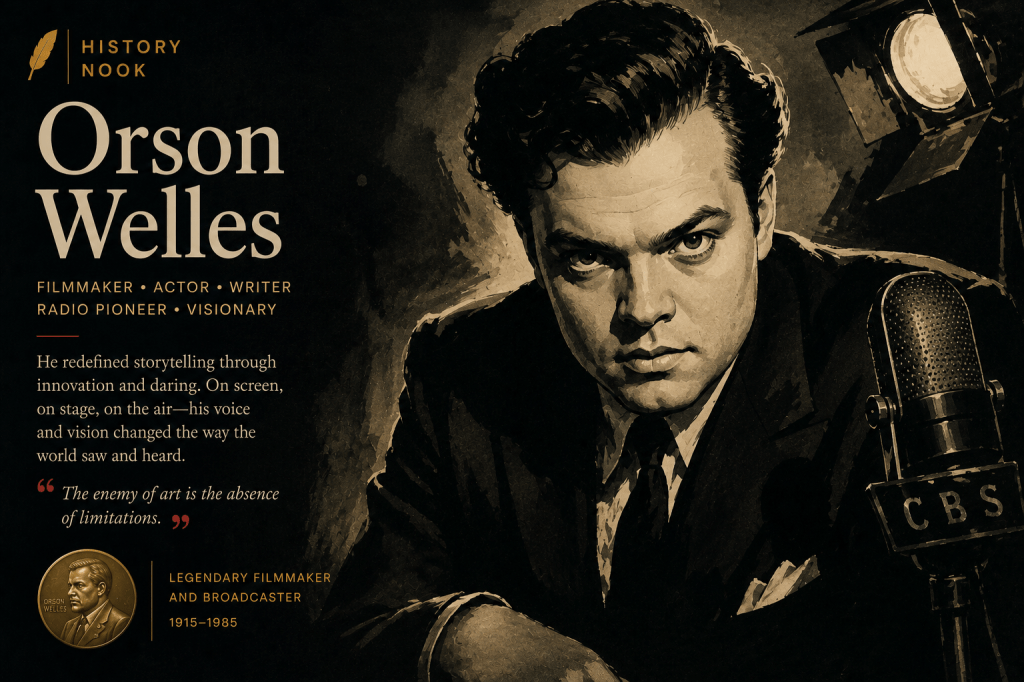
May 6, 1915
When Language Was Meant to Be Heard
Born on May 6, 1915, Orson Welles became one of the most influential figures in modern storytelling—not only for what he created, but for how he made English sound.
Through radio, theatre, and film, Welles helped reshape English as a spoken medium. His work demonstrated that language does not exist only on the page. It lives in voice—in rhythm, pause, emphasis, and silence. In broadcasts such as The War of the Worlds, he showed how spoken English could create immersion, urgency, and belief through sound alone.
With Welles, English became something performed.
Building Worlds Through Voice
Radio forced language to do more with less.
Without images, Welles relied on voice to construct entire scenes. Tone, pacing, and delivery became structural elements, not just stylistic ones. The listener did not read meaning. They heard it unfold.
This strengthened a form of English in which sound itself carries narrative weight.
When Delivery Became Meaning
Welles also demonstrated that how something is said can matter as much as what is said.
His performances used variation—shifts in intensity, tempo, and silence—to shape interpretation. A pause could create tension. A change in tone could alter meaning. Language became dynamic, not fixed.
In this, Welles helped expand English beyond text into performance.
Writing for the Ear
His influence extended to how scripts were written.
Dialogue began to follow speech more closely, shaped by rhythm and natural flow rather than literary structure alone. Writing adapted to performance, becoming more responsive to breath, timing, and voice.
This helped align written English more closely with how it is actually spoken.
Expanding the Reach of Spoken English
Broadcast media carried this form of English to wide audiences.
Welles helped shape expectations for narration, acting, and storytelling across radio and later television and film. His influence can be heard in voice acting, audiobooks, and modern audio storytelling, where voice remains central.
He helped establish spoken English as a primary medium of narrative experience.
Why It Matters
The birth of Orson Welles in 1915 marks a turning point in how English is experienced.
Through performance, he showed that language is not only read—it is heard, felt, and shaped in real time. Voice became part of meaning, not just a vehicle for it.
In doing so, English became not only a written system—but a living, audible form of storytelling.
Key Shifts in English Through Welles
- English became performative — language gained meaning through delivery
- Voice carried narrative — tone and pacing shaped storytelling
- Radio transformed language use — English adapted to sound-based media
- Scripts became more spoken — writing aligned with natural speech patterns
- Audience experience shifted — listeners engaged through sound, not text
- Spoken English expanded culturally — performance shaped modern media language
Some writers shape what language says.
Orson Welles helped shape
how it sounds.
Also on this day!
If this moment still speaks, there is more to uncover.
 What Happened on This Day?
Leave a comment