

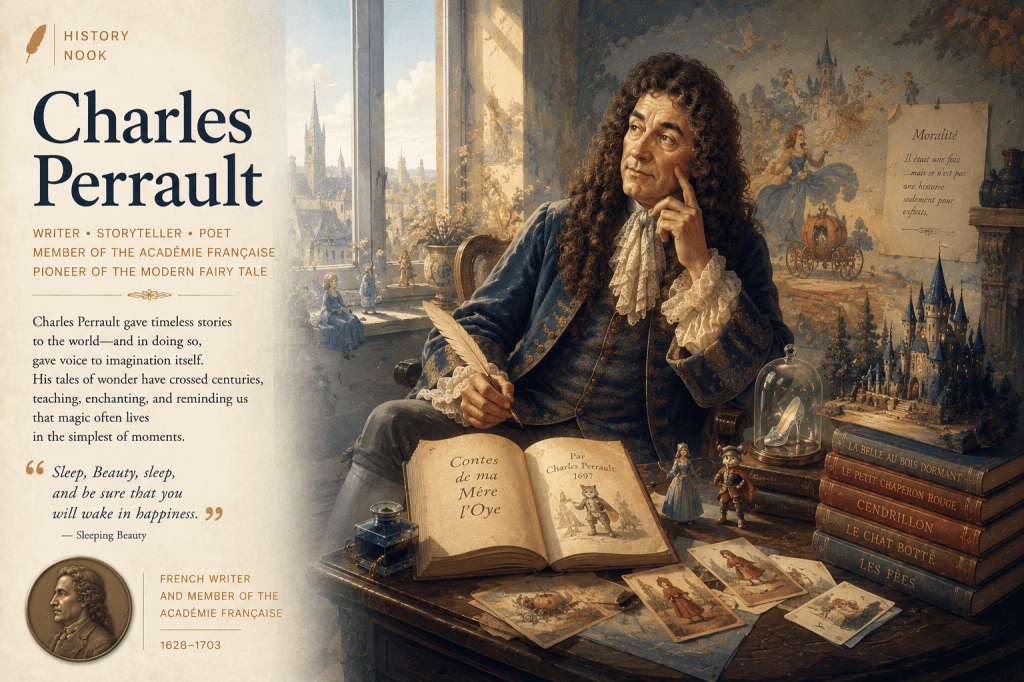
May 16, 1703
When Storytelling Became Mythic
On May 16, 1703, Charles Perrault died, leaving behind stories that would permanently shape literary culture far beyond France itself. Though he wrote in French, tales such as Cinderella, Sleeping Beauty, and Little Red Riding Hood became deeply embedded in English-speaking storytelling through translation, adaptation, and retelling across generations.
Perrault helped establish many of the narrative patterns, symbolic figures, and tonal rhythms now associated with the fairy tale itself. Through him, English inherited not only stories, but an imaginative language of enchantment, transformation, danger, and wonder.
He helped shape how English tells stories children remember for life.
Creating the Language of Fairy Tales
Perrault’s tales helped define the recognizable tone and structure of fairy-tale storytelling.
Magical transformations, symbolic objects, archetypal characters, repeated patterns, and moral undercurrents became part of a shared literary vocabulary. His stories helped establish narrative formulas that remain immediately recognizable in English centuries later.
In this way, fairy tales became not merely stories, but a linguistic tradition.
Simplicity with Symbolic Power
One of Perrault’s enduring strengths lies in simplicity.
His prose is often direct, clear, and deceptively light, yet beneath that simplicity lie powerful symbolic structures involving innocence, danger, morality, desire, and transformation. This balance helped shape a storytelling style in which accessible language carries deep cultural resonance.
He showed that literary depth does not always require complexity.
Translation as Cultural Inheritance
Perrault’s influence entered English through translation and retelling rather than original composition.
But over time, these stories ceased to feel foreign. They became absorbed into nursery traditions, children’s literature, oral storytelling, school reading, theatre, and eventually global popular culture. Translation transformed his narratives into part of everyday English imagination itself.
English inherited not only the tales, but the narrative habits they created.
The Foundations of Modern Fantasy
Perrault’s influence extends far beyond the classic fairy tale.
His narrative structures helped shape later fantasy literature, children’s fiction, folklore adaptation, and even modern film storytelling. Writers from Andersen onward inherited patterns of symbolic storytelling that Perrault helped formalize.
He contributed to a form of English narrative where imagination operates through recognizable mythic language.
Why It Matters
The death of Charles Perrault in 1703 marks the lasting influence of a writer who transformed English storytelling without writing in English.
Through fairy tales, symbolic simplicity, and memorable narrative structures, he helped shape how English imagines wonder, morality, danger, and transformation.
He helped make English not only a language of realism and reason—but also one of enchantment.
Key Shifts in English Through Perrault
- Fairy-tale language became standardized — recurring motifs and formulas entered literary English
- Symbolic storytelling strengthened — simple narratives carried deeper cultural meaning
- Translation shaped literary culture — French tales became part of English imagination
- Children’s literature expanded — storytelling gained broader emotional and literary richness
- Narrative archetypes spread widely — magical figures and patterns became culturally universal
- English embraced mythic storytelling — fantasy and wonder gained enduring literary legitimacy
Some writers create stories.
Charles Perrault helped create
the language of once upon a time.
Also on this day!
If this moment still speaks, there is more to uncover.
 What Happened on This Day?
Leave a comment