

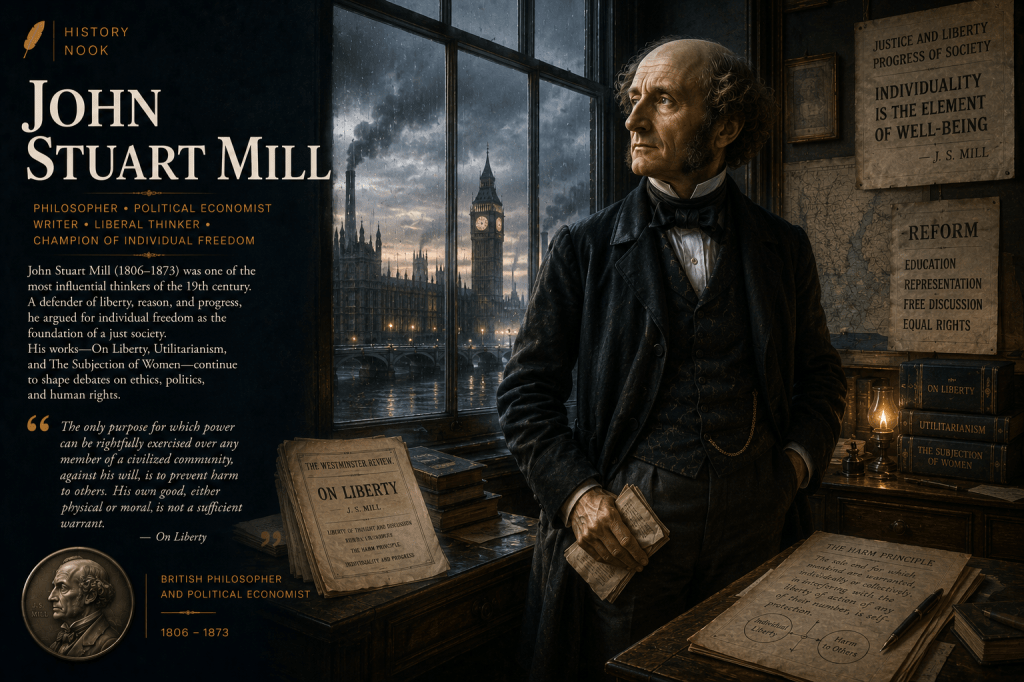
May 20, 1806
When Philosophical English Became Clear, Analytical, and Public
Born on May 20, 1806, John Stuart Mill became one of the defining prose voices of modern intellectual English. Through works such as On Liberty and A System of Logic, he helped shape philosophical essay writing, political vocabulary, and analytical prose for an increasingly modern public world.
His writing established a model of nonfiction that was rigorous without becoming inaccessible—directed not only toward scholars, but toward civic discussion itself.
Making Philosophy Readable
Before writers like Mill, philosophical prose often remained dense, abstract, or narrowly academic.
Mill helped redefine intellectual writing through clarity, balance, and carefully structured reasoning. Arguments unfolded progressively, concepts were defined with precision, and difficult ideas were expressed without deliberate obscurity.
He demonstrated that philosophical complexity did not require linguistic opacity.
In doing so, he helped establish many of the expectations now associated with modern analytical prose in English.
Giving Public Debate a New Language
Mill also helped expand the vocabulary of political and civic thought.
His writings refined the language surrounding liberty, individuality, representation, rights, and social responsibility at a moment when democratic debate was rapidly evolving across the English-speaking world.
Logic, evidence, and rational inquiry became central rhetorical tools within public argument rather than purely academic philosophy.
English increasingly became a language not only of governance and literature, but of systematic modern reasoning.
The Essay as Civic Engagement
For Mill, the essay was never simply a literary exercise.
It became a form of public participation—a way to shape political discussion, ethical reflection, and social reform through prose accessible to educated readers beyond universities.
This helped strengthen a style of nonfiction that informed while persuading: intellectually disciplined, yet publicly engaged.
His influence can still be felt in journalism, criticism, political commentary, and modern argumentative writing.
Shaping the Language of Modern Intellectual Life
Mill’s prose style extended far beyond philosophy itself.
Economists, political theorists, educators, legal writers, and essayists inherited a model of English built around clarity, structure, and rational progression of thought.
His work helped reinforce English as one of the major languages of modern intellectual discourse—capable of combining accessibility with conceptual precision.
Why It Matters
The birth of John Stuart Mill in 1806 marks the emergence of a writer who helped redefine how ideas could be communicated in English.
Through clarity, logic, and civic engagement, he transformed philosophical prose into something rigorous yet publicly readable—helping shape the language of modern debate itself.
Key Shifts in English Through Mill
- Philosophical prose became clearer and more publicly accessible
- Analytical writing gained stronger logical structure and conceptual precision
- Political vocabulary surrounding liberty and individual rights expanded
- Essays evolved into major instruments of civic and intellectual debate
- English strengthened its role as a language of modern reasoning and public discourse
Some writers shape stories.
John Stuart Mill helped shape
how English organizes thought itself.
Also on this day!
If this moment still speaks, there is more to uncover.


 What Happened on This Day?
Leave a comment