
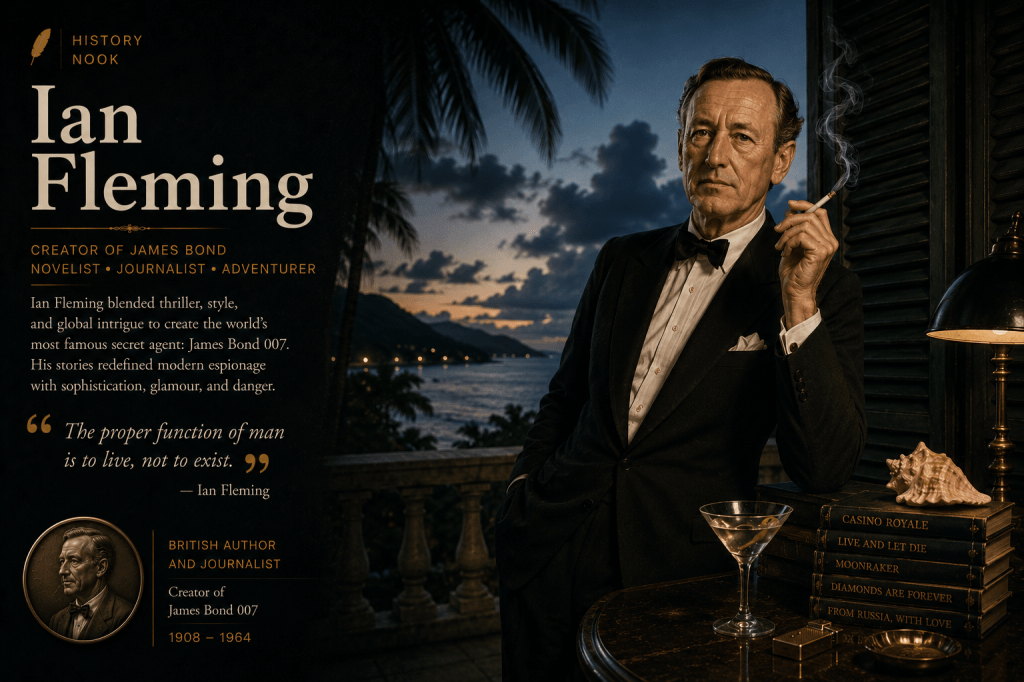
May 28, 1908
When Espionage Became a Global Style of English Storytelling
Born on May 28, 1908, Ian Fleming became one of the most influential popular fiction writers of the twentieth century. Through the James Bond novels, he transformed modern English prose with clipped action narration, espionage terminology, technological detail, and a glamorous international atmosphere shaped by the Cold War era.
His writing reshaped how English expresses danger, sophistication, surveillance, and global intrigue.
Modern spy fiction—and much of modern blockbuster storytelling—would emerge from that linguistic world.
Giving English the Language of Espionage
Fleming helped popularize the vocabulary of intelligence operations far beyond military or governmental circles.
Terms associated with agents, missions, surveillance, covert operations, gadgets, and international intelligence entered mainstream cultural English through the popularity of Bond fiction. Espionage language became recognizable even to readers with no connection to real intelligence work.
The spy thriller transformed secrecy into a shared cultural vocabulary.
English increasingly became associated with the rhetoric of global intrigue and hidden power.
Making Action Prose Faster and Sharper
One of Fleming’s defining stylistic features was narrative speed.
Action sequences relied on short sentences, rapid transitions, visual movement, and tightly controlled pacing. Description remained vivid but economical, creating prose that felt cinematic long before many of the stories reached film adaptation.
The reader moved through danger rather than observing it from distance.
This helped shape a modern thriller style built around immediacy, efficiency, and forward momentum.
Creating a Glamorous International English
The Bond novels also presented English as cosmopolitan, mobile, and globally connected.
Luxury brands, foreign locations, technical terminology, elite social rituals, and international political tension blended into a prose style that linked English with sophistication and modernity. British identity became intertwined with international movement and Cold War-era global presence.
English became a language not only of narration, but of style itself.
Adventure fiction acquired a distinctly international rhythm and vocabulary.
Shaping Modern Thriller Culture
The influence of Ian Fleming extended far beyond literature.
Spy fiction, action cinema, serialized storytelling, and modern thrillers inherited his pacing, dialogue style, suspense structure, and atmosphere of technological intrigue. Countless writers and screenwriters adopted variations of the narrative formula he helped establish.
His prose helped define the sound of modern popular suspense.
Even today, much of espionage fiction still speaks in a language shaped by Fleming’s world.
Why It Matters
The birth of Ian Fleming in 1908 marks the emergence of a writer who transformed the language of modern popular fiction.
Through espionage vocabulary, clipped prose, cinematic pacing, and glamorous international settings, he reshaped how English expresses action, sophistication, and modern danger.
English became not only a language of storytelling—but one capable of moving with the speed, tension, and style of the modern world itself.
Key Shifts in English Through Ian Fleming
- Espionage terminology entered mainstream cultural English
- Action prose became faster, sharper, and more cinematic
- Thriller fiction adopted streamlined suspense-driven narration
- English gained a more international and cosmopolitan fictional identity
- Spy fiction helped shape modern popular storytelling language
Some writers create heroes.
Ian Fleming helped create
the modern language of espionage itself.
Also on this day!
If this moment still speaks, there is more to uncover.
 What Happened on This Day?
Leave a comment