
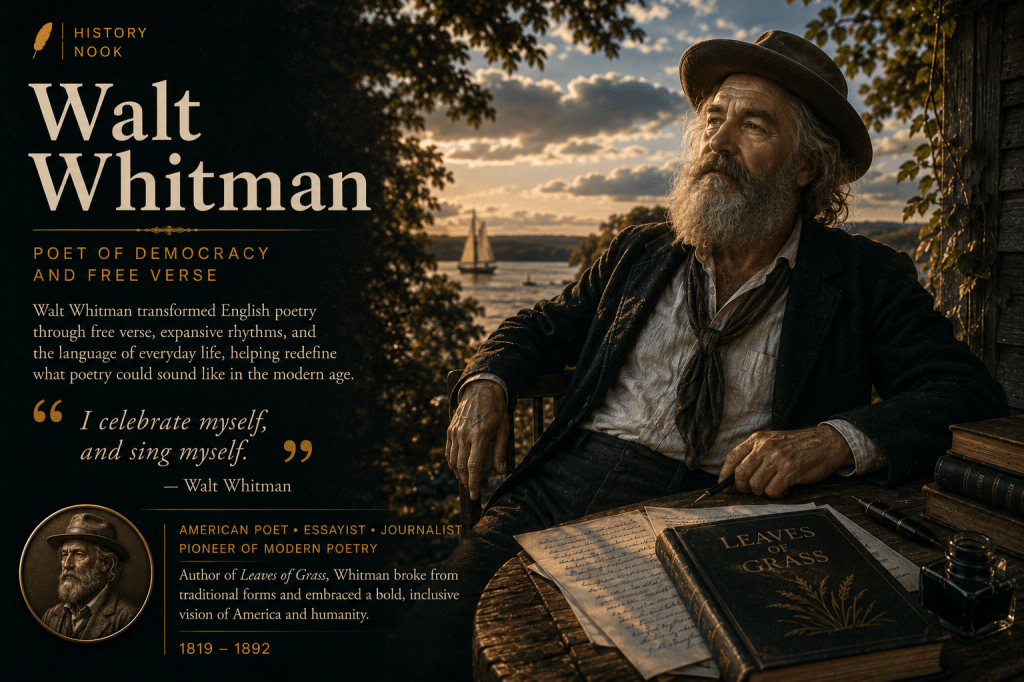
May 31, 1819
When English Poetry Found a New Voice
Born on May 31, 1819, Walt Whitman became one of the most transformative figures in the history of English literature. Through his landmark collection Leaves of Grass, he challenged centuries of poetic convention and introduced a radically different vision of what English verse could be.
His poetry embraced free verse, conversational language, expansive rhythms, and a democratic view of human experience. In doing so, he reshaped not only American poetry, but the future sound of English itself.
Few writers have altered the possibilities of poetic language so completely.
Breaking the Rules of Verse
For centuries, English poetry had largely been defined by established patterns of meter, rhyme, and formal structure.
Whitman moved in another direction. His lines expanded beyond traditional constraints, relying on rhythm, repetition, accumulation, and natural speech rather than strict poetic architecture. The result was a style that felt simultaneously spontaneous and monumental.
Poetry no longer needed to follow inherited forms in order to achieve literary power.
Free verse emerged as one of the defining possibilities of modern English poetry.
Bringing Everyday English into Literature
Whitman also transformed the relationship between poetry and ordinary language.
Rather than separating poetic diction from everyday speech, he embraced the vocabulary, rhythms, and voices of daily life. Workers, sailors, laborers, travelers, and ordinary citizens entered poetry in ways rarely seen before.
The language of common experience became worthy of literary celebration.
English poetry grew closer to the language people actually spoke.
Creating a Democratic Poetic Voice
One of Whitman’s most enduring achievements was expanding who could appear within poetry.
His work celebrated diversity, individuality, collective identity, and the vast range of American life. Places, professions, bodies, emotions, and experiences all became part of a poetic landscape that rejected narrow definitions of literary importance.
The scope of poetic English widened dramatically.
Poetry became a space where an entire society could find representation.
Changing the Rhythm of Modern Poetry
Whitman’s long flowing lines introduced a new musicality into English verse.
His rhythms often resemble speech, prayer, or public oratory more than traditional poetic meter. This innovation influenced generations of writers, including T. S. Eliot, Ezra Pound, and countless modern and contemporary poets.
The effects extended into free verse, prose poetry, performance poetry, and experimental literary forms.
His rhythms continue to echo throughout English-language literature today.
Why It Matters
The birth of Walt Whitman in 1819 marks the emergence of a writer who fundamentally reimagined the possibilities of English poetry.
Through free verse, conversational language, democratic diction, and expansive rhythms, he transformed both the sound and structure of modern poetic expression.
English became not only a language of inherited forms—but one capable of limitless poetic freedom.
Key Shifts in English Through Walt Whitman
- Free verse became a major literary form in English poetry
- Everyday spoken language gained greater poetic legitimacy
- Poetry expanded to include a broader range of voices and experiences
- Rhythmic freedom increasingly replaced strict formal constraints
- Modern English poetry developed a more democratic and inclusive voice
Some poets mastered tradition.
Walt Whitman helped English discover
how much beauty existed beyond it.
Also on this day!
If this moment still speaks, there is more to uncover.
 What Happened on This Day?
Leave a comment