
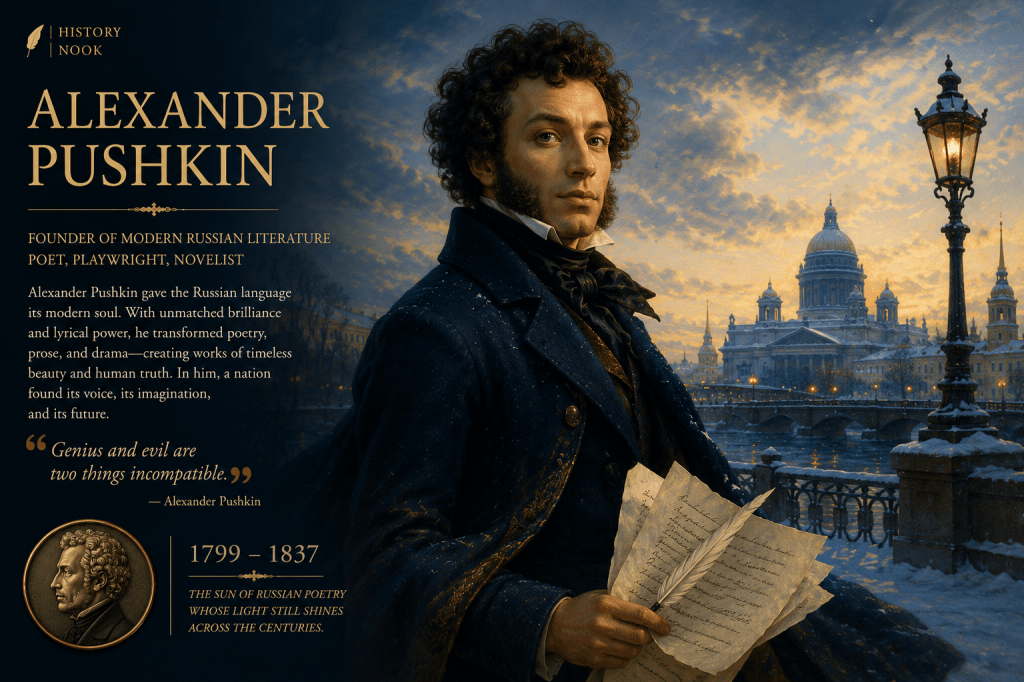
June 6, 1799
When the Founder of Modern Russian Literature Reached the English-Speaking World
Born on June 6, 1799, Alexander Pushkin became one of the most influential figures in world literature. Often regarded as the founder of modern Russian literature, Pushkin transformed poetry, prose, and narrative style in his own language. Through translation and his immense influence on later writers, his work eventually left a lasting mark on English literary culture as well.
His innovations in storytelling, characterization, and literary economy helped shape traditions that would later influence generations of English-speaking readers and writers.
Few authors have exerted such broad influence across linguistic boundaries.
Expanding the Possibilities of Narrative Poetry
Pushkin helped redefine what poetry could accomplish as a storytelling form.
Rather than treating poetry primarily as lyric expression, he demonstrated that verse could sustain complex narratives, vivid characters, and emotional development without losing musicality or elegance. Works such as Eugene Onegin showed how storytelling and poetry could operate together with remarkable flexibility.
His approach expanded later ideas about narrative verse throughout Europe and beyond.
Poetry became a space not only for emotion, but for fully realized human stories.
Shaping the Language of Modern Prose
Pushkin’s prose style helped establish qualities later associated with modern fiction.
His writing favored clarity, balance, precision, and narrative economy. Rather than relying on excessive ornamentation, he often achieved depth through careful observation and concise expression.
This approach influenced generations of writers who helped shape the development of the modern novel.
His style demonstrated that literary sophistication could emerge through restraint as much as through complexity.
Bringing Greater Psychological Depth to Literature
One of Pushkin’s most enduring contributions lies in characterization.
His characters often possess emotional ambiguity, conflicting motivations, and an inner life that feels strikingly modern. Human behavior is portrayed with nuance rather than simple moral certainty, allowing readers to engage with characters as individuals rather than symbols.
This helped advance the development of psychological realism.
Literature moved closer to the complexity of real human experience.
Influencing English Literature Through Translation
The influence of Alexander Pushkin reached English largely through translation and literary inheritance.
English-speaking writers encountered his techniques directly through translated works and indirectly through later Russian authors influenced by him. The global impact of Russian literature in the nineteenth and twentieth centuries carried many of Pushkin’s innovations into English literary culture.
His influence became part of a larger international exchange of ideas, styles, and narrative techniques.
English literature grew richer through contact with traditions beyond its own borders.
Why It Matters
The birth of Alexander Pushkin in 1799 marks the emergence of a writer whose influence extended far beyond Russian literature.
Through narrative innovation, psychological realism, and literary economy, he helped shape traditions that would later enrich English fiction and poetry through translation and literary influence.
English literature gained new models of storytelling, characterization, and artistic precision—demonstrating how the evolution of one language can profoundly influence the development of another.
Key Shifts in English Through Pushkin’s Influence
- Narrative poetry expanded its capacity for complex storytelling
- Literary prose embraced greater clarity, balance, and economy
- Psychological realism gained influence within modern fiction
- Translation strengthened the international exchange of literary techniques
- English literature absorbed important innovations from Russian literary culture
Some writers transform a language.
Alexander Pushkin helped transform
the conversation between languages themselves.
Also on this day!
If this moment still speaks, there is more to uncover.

 What Happened on This Day?
Leave a comment