
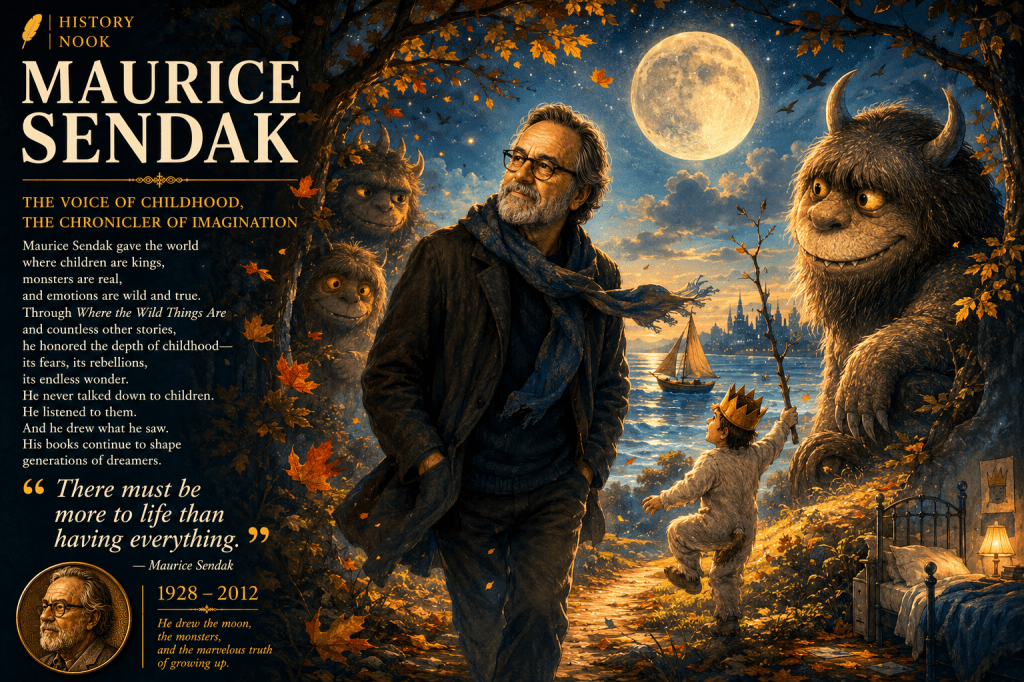
June 10, 1928
When Childhood Became More Honest in English Literature
Born on June 10, 1928, Maurice Sendak became one of the most influential figures in modern children’s literature. Best known for Where the Wild Things Are, Sendak helped redefine what books for young readers could accomplish. Through imaginative storytelling, emotional honesty, and literary sophistication, he transformed English-language children’s publishing and influenced generations of writers, educators, illustrators, and readers.
His work challenged the idea that children’s literature should avoid difficult emotions or simplify childhood experience.
Instead, he showed that young readers were capable of engaging with stories of remarkable emotional depth.
Expanding the Emotional World of Children’s Literature
Before Sendak, many children’s books presented childhood as a largely idealized experience.
His stories acknowledged fear, anger, loneliness, frustration, imagination, and uncertainty as natural parts of growing up. Rather than protecting children from difficult feelings, he treated those emotions as worthy subjects for literature.
This helped transform expectations about what children’s books could discuss.
Childhood became more psychologically realistic within English-language storytelling.
Giving Imagination a Richer Language
One of Sendak’s greatest strengths was his ability to combine simplicity with literary richness.
His prose is accessible to young readers, yet filled with rhythm, memorable phrasing, and symbolic power. Everyday language merges naturally with fantasy, allowing imaginative worlds to feel emotionally real.
His work demonstrated that children’s literature could be both approachable and artistically sophisticated.
Simple language did not have to mean simple ideas.
Elevating Children’s Literature as an Art Form
Sendak helped change how children’s books were viewed by critics, publishers, educators, and readers.
His success encouraged greater attention to characterization, narrative structure, emotional complexity, and artistic quality. Books for children increasingly gained recognition as serious creative works rather than merely educational tools.
The standards of children’s publishing rose accordingly.
Children’s literature became a respected part of literary culture in its own right.
Shaping Modern Children’s Storytelling
The influence of Maurice Sendak continues throughout contemporary children’s literature.
Writers and illustrators across the English-speaking world have drawn upon his emphasis on emotional authenticity, imaginative freedom, and respect for young readers. Many features now considered standard in children’s publishing reflect innovations he helped popularize.
His work changed not only individual books.
It changed expectations about what children’s literature could be.
Why It Matters
The birth of Maurice Sendak in 1928 marks the arrival of a creator who transformed English-language children’s literature.
Through imaginative language, emotional honesty, and literary sophistication, he expanded what children’s books could accomplish and how young readers could be addressed.
English children’s literature became not only more imaginative—but also more truthful about the realities of childhood itself.
Key Shifts in English Through Maurice Sendak
- Children’s literature embraced greater emotional realism
- Imaginative storytelling gained deeper psychological complexity
- Simple language became a vehicle for sophisticated themes
- Literary standards in children’s publishing rose significantly
- Young readers were increasingly treated as emotionally intelligent audiences
Some writers teach children how to read.
Maurice Sendak helped literature
understand what childhood feels like.
Also on this day!
If this moment still speaks, there is more to uncover.


 What Happened on This Day?
Leave a comment