
June 19, 1608
(baptism)
When Wit, History, and Memorable Language Met in English Prose
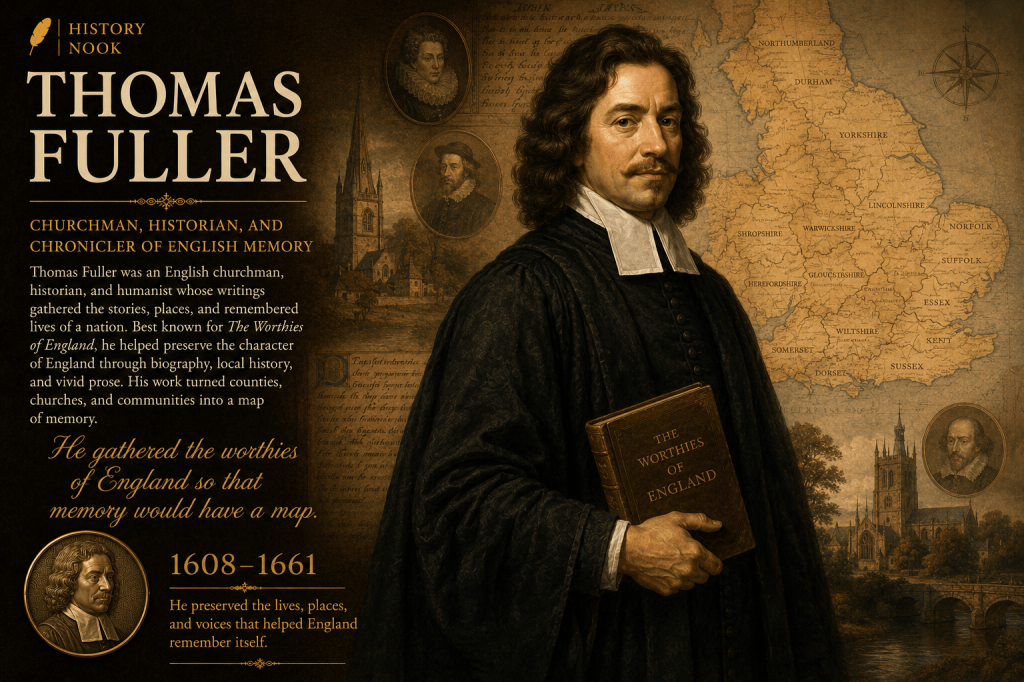
Traditionally associated with June 19, 1608—the date of his baptism—Thomas Fuller emerged as one of the most distinctive prose writers of seventeenth-century England. Historian, biographer, preacher, and master of concise expression, Fuller occupied an important place in the development of English nonfiction during the period between Shakespeare and Samuel Johnson.
Through his vivid prose, historical writings, character sketches, and celebrated aphorisms, Fuller helped shape traditions of English literary nonfiction that would influence readers and writers for centuries.
Advancing the Development of English Prose
Fuller wrote during a formative period in the evolution of English literary style.
His prose demonstrated the growing flexibility and richness of English as a language of learning and literature. Combining scholarship with accessibility, he developed a style notable for its clarity, wit, and readability.
Rather than separating knowledge from entertainment, Fuller brought them together.
English prose became both intellectually serious and engaging to read.
Cultivating the Art of the Aphorism
Fuller became renowned for his memorable observations and concise expressions.
Throughout his works, he crafted striking maxims that distilled complex ideas into brief, memorable statements. His writing helped strengthen the English tradition of the aphorism, demonstrating the enduring power of concise prose.
Many of his sayings remained in circulation long after his lifetime.
He showed that a few carefully chosen words could carry remarkable wisdom.
Enriching Biography and Historical Writing
Fuller also contributed significantly to the development of English biography and history.
His historical works combined factual scholarship with vivid narrative, while his character sketches brought historical figures to life through lively description and insight. In doing so, he helped make history more accessible and appealing to general readers.
Facts became stories.
History acquired a more human voice.
Bridging Literary Eras
Fuller occupies an important place in the continuity of English literary culture.
His work linked Renaissance traditions of rhetoric and learning with the more polished prose styles that would flourish during the Enlightenment. Later essayists, historians, and moral writers inherited techniques and traditions that Fuller helped cultivate.
He stands among the writers who shaped the transition toward modern English nonfiction.
The evolution of English prose did not happen suddenly; Fuller was one of its architects.
Why It Matters
The baptism of Thomas Fuller in 1608 marks the emergence of a writer who helped shape the character of English prose during one of its most important periods of growth.
Through historical writing, biography, and memorable aphorisms, he demonstrated that English could be used with learning, wit, clarity, and literary grace.
In doing so, Fuller contributed to the development of nonfiction writing and strengthened a tradition of expressive prose that would influence English literature for centuries.
Key Shifts in English Through Thomas Fuller
- English prose became more flexible, witty, and readable
- The tradition of the aphorism gained greater prominence
- Biography and historical writing became more literary and engaging
- Scholarship increasingly reached broader reading audiences
- English nonfiction matured as a major literary form
Some writers fill pages with knowledge.
Thomas Fuller showed that wisdom can sometimes be remembered in a single sentence.
Also on this day!
If this moment still speaks, there is more to uncover.
 What Happened on This Day?
Leave a comment