

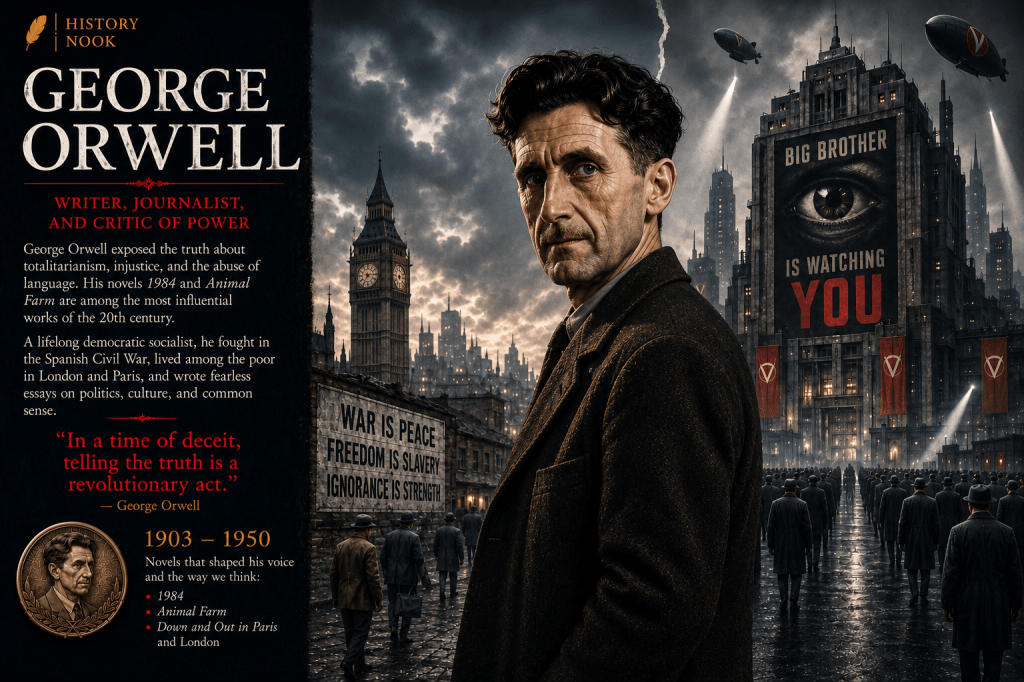
June 25, 1903
When One Writer Changed How English Thinks About Language
Born on June 25, 1903, George Orwell became one of the most influential writers in the history of modern English. Novelist, essayist, journalist, and literary critic, Orwell transformed not only English prose but also the vocabulary through which millions of people discuss politics, truth, freedom, and language itself.
Through works such as Nineteen Eighty-Four, Animal Farm, and the essay Politics and the English Language, he reshaped modern writing while introducing concepts that became permanent parts of the English language.
Few twentieth-century authors have left a deeper linguistic legacy.
Establishing a Model of Clear and Direct Prose
Orwell believed that good writing should make ideas clearer rather than more impressive.
His prose rejected unnecessary ornament, inflated rhetoric, and bureaucratic complexity in favor of clarity, precision, and honesty. He argued that unclear language often leads to unclear thinking, making style not merely an artistic choice but an ethical one.
His essays became enduring models for journalists, students, editors, and nonfiction writers.
Good English, in Orwell’s view, was inseparable from clear thought.
Changing How English Thinks About Language
Among Orwell’s greatest contributions was his analysis of the relationship between language and power.
In Politics and the English Language, he argued that vague, pretentious, or manipulative language can obscure reality and weaken public thought. His criticism of clichés, euphemisms, and empty political rhetoric continues to shape discussions of writing and communication.
Few essays have influenced English style so profoundly.
More than seventy years later, writers still return to Orwell’s principles.
Giving English New Words for Modern Reality
Few authors have contributed so many lasting expressions to everyday English.
Through Nineteen Eighty-Four, Orwell introduced concepts that quickly escaped the boundaries of fiction and entered public discourse.
Among them are:
- Orwellian, describing systems associated with surveillance, authoritarianism, or manipulation
- Newspeak, referring to language designed to restrict or control thought
- doublethink, the ability to accept contradictory ideas simultaneously
- thoughtcrime, the notion that certain ideas themselves can become punishable
These words are now used throughout journalism, politics, education, and everyday conversation.
They have become part of the living vocabulary of English.
Influencing Literature, Journalism, and Public Discourse
Orwell’s influence extends far beyond literature.
His commitment to clear prose helped shape standards in journalism, political commentary, essay writing, and public communication. His ideas continue to inform debates about censorship, propaganda, freedom of expression, and the responsibilities of writers.
Few modern authors remain as frequently quoted in discussions about language itself.
His works continue to influence not only how English is written, but how it is understood.
Why It Matters
The birth of George Orwell in 1903 marks the arrival of a writer whose influence reached into the very structure of modern English.
Through clear prose, linguistic criticism, and the unforgettable vocabulary of Nineteen Eighty-Four, he transformed how English speakers write, communicate, and discuss ideas. His work demonstrated that language is never merely a tool for expressing thought—it also shapes how thought itself develops.
English gained not only one of its greatest prose stylists, but also one of its most influential defenders of clarity, precision, and intellectual honesty.
Key Shifts in English Through George Orwell
- Modern prose increasingly valued clarity over ornamentation
- Discussions of language and political power became central to public discourse
- Words such as Orwellian, Newspeak, doublethink, and thoughtcrime entered everyday English
- Journalism and nonfiction adopted stronger standards of direct expression
- English speakers became more conscious of how language shapes thought itself
Some writers enrich a language.
George Orwell changed the words people use
to defend truth, question power, and understand the world.
Also on this day!
If this moment still speaks, there is more to uncover.

 What Happened on This Day?
Leave a comment