

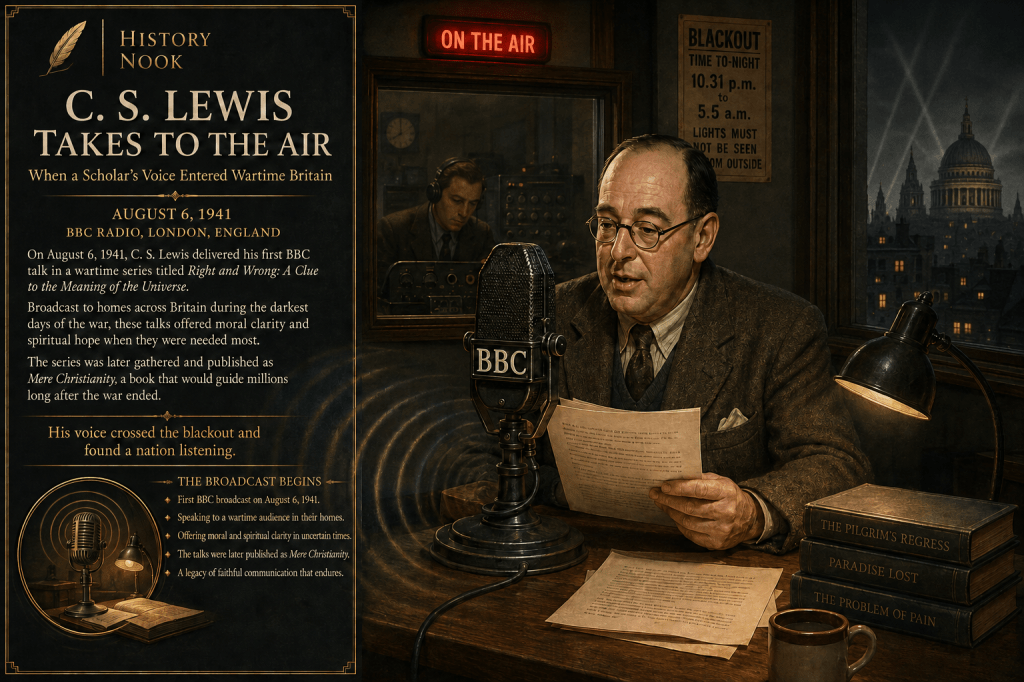
August 6, 1941
How a Fifteen-Minute BBC Broadcast Carried Philosophy, Morality, and Carefully Spoken English from an Oxford Scholar into Homes Across Wartime Britain
At 7:45 p.m. on August 6, 1941, C. S. Lewis gave his first BBC radio talk. The fifteen-minute programme began a series titled “Right and Wrong: A Clue to the Meaning of the Universe.” What followed, through later broadcasts and revisions, would eventually become part of Mere Christianity.
The historical importance of the evening lies not only in the famous book that came later. Lewis was attempting something difficult: to present philosophical and religious reasoning in language clear enough for a broad radio audience, serious enough not to insult that audience, and vivid enough to hold attention without images, footnotes, or the possibility of rereading a sentence.
His task was shaped by the medium.
Radio required thought to become voice.
Britain Listening in Wartime
Lewis’s first series was broadcast during the Second World War, when radio had become one of Britain’s most important instruments of news, information, morale, education, and shared national experience. A radio audience was not the same as a university audience. It could include factory workers, soldiers, families, civil servants, clergy, sceptics, believers, tired workers, anxious parents, and people listening under the pressure of bombing, loss, and uncertainty.
Lewis could not assume specialised philosophical training. Nor could he rely on a lecture hall’s gestures, blackboard, footnotes, or immediate questions. He had to make the argument audible, which meant shaping sentences for the ear: clear enough to follow once, ordered enough to guide a listener through difficulty, and memorable enough to survive after the broadcast ended.
The talks therefore belong to the history of public English as much as to religious history. They show what happens when intellectual prose is redesigned for listening.
Turning Abstraction into Ordinary Speech
The opening series examined the human sense that some actions are right and others wrong, and that people appeal to standards of conduct even when they fail to follow them. Lewis’s method was conversational rather than technical. Instead of beginning with specialist vocabulary, he began with recognisable situations: people quarrelling, someone claiming unfair treatment, promises being broken, excuses being offered, and one person appealing to a standard that another person is expected to recognise.
This movement was central to his effectiveness. Lewis often led the audience from ordinary speech toward abstraction. He did not begin by announcing a complete philosophical system. He asked listeners to notice what their own words seemed to imply. An accusation such as “That is not fair” does more than express dislike; it appeals to some idea of fairness that the speaker expects another person to understand.
Whether one accepts Lewis’s conclusion or not, the rhetorical craft is clear. He turned familiar verbal behaviour into evidence for a larger argument.
Writing for a Voice Rather Than a Page
Radio changed Lewis’s style. Written prose allows the reader to stop, return, compare, or consult a note. A broadcast disappears as it is spoken. A difficult sentence may be lost before the listener understands its first clause.
Lewis therefore relied on direct address, imagined objections, concrete analogies, deliberate repetition, transitional phrases, and mild humour. His broadcasts often create the impression that the speaker has heard the objection before the listener has voiced it. The effect is not merely explanatory. It creates companionship inside argument.
The audience is not only receiving conclusions. It is being invited to walk through the reasoning with the speaker.
That is why the talks still matter as examples of spoken English. Their clarity is not the result of thinning the subject down. It comes from controlling the order in which difficulty appears.
From Broadcast to Book
The talks did not pass unchanged into Mere Christianity. Lewis delivered several BBC series between 1941 and 1944. Their material was revised and published in three shorter books: Broadcast Talks, Christian Behaviour, and Beyond Personality. These were later gathered and revised as Mere Christianity in 1952.
This publication history matters because a radio talk and a printed chapter are not the same form. Broadcasting gave the argument immediacy and reach. Print gave it permanence, organisation, and international circulation. The familiar book was not simply written at a desk and then read aloud; it grew from public speech designed for a particular historical audience.
The idea changed shape as it changed medium.
Why It Matters
August 6, 1941, matters because it marks the beginning of one of the twentieth century’s most influential transformations of scholarly argument into public language. Lewis did not make his subject accessible by pretending it was simple. He made it accessible by guiding listeners toward complexity without demanding that they begin inside it.
The broadcasts also remind us that rhetoric depends on circumstance. Wartime Britain shaped the audience’s questions about suffering, duty, courage, death, justice, and hope. Lewis’s theological conclusions have always attracted agreement, disagreement, criticism, and reinterpretation. This article’s central concern is not to settle those debates, but to notice the form of expression.
Lewis demonstrated that serious argument could travel through ordinary speech, that radio could serve as a classroom without walls, and that a voice speaking for fifteen minutes could begin the life of a book that outlasted the broadcast itself.
Key Shifts in English
- Academic and philosophical argument entered mass radio culture.
- Spoken English became an important vehicle for public intellectual life.
- Abstract ideas were explained through ordinary quarrels, promises, excuses, and choices.
- Direct address created a more intimate relationship between speaker and audience.
- Imagined objections allowed radio arguments to resemble dialogue.
- Repetition became a tool of clarity rather than mere emphasis.
- Wartime broadcasting joined education, morale, ethics, and public reflection.
- Material composed for the ear was later reorganised for the printed page.
- Accessible prose was distinguished from intellectually diluted prose.
- The BBC helped create a shared national space for serious spoken argument.
The first broadcast lasted only fifteen minutes, but it showed how far an idea could travel once it had learned to speak in a human voice.
Also on this day

 What Happened on This Day?
Leave a comment