
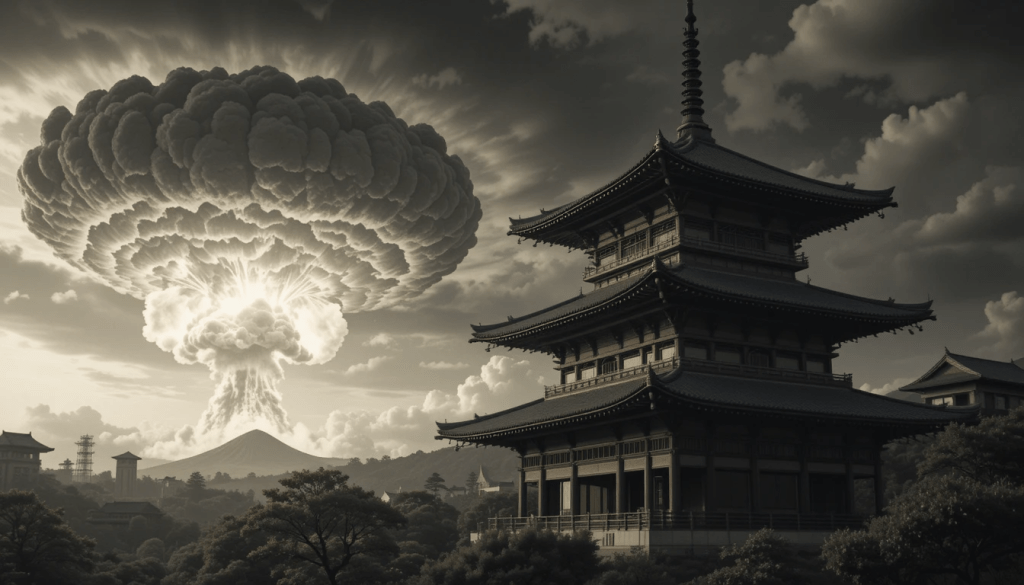
August 6, 1945
The Birth of the Nuclear Age and Its Profound Linguistic Legacy in English
On August 6, 1945, the United States dropped the world’s first atomic bomb used in warfare—“Little Boy”—on the city of Hiroshima, Japan. The blast instantly killed tens of thousands of civilians and eventually claimed the lives of over 140,000 people due to radiation exposure and injuries. This event not only marked the beginning of the Atomic Age but also triggered a seismic shift in global political dialogue, ethical debates, and the English language itself.
Key Linguistic and Conceptual Contributions to English
1. “Atomic Age” / “Nuclear Age”
- The bombing inaugurated what English-speaking media and scholars began calling the “Atomic Age”—a phrase denoting a new historical era characterized by the threat of nuclear warfare, scientific advancement, and ethical uncertainty.
- Closely linked terms include:
- “Nuclear Age”
- “Post-Hiroshima world”
- “Atomic future”
- These expressions quickly became standard in English journalism, historiography, and philosophical writing, symbolizing both technological progress and existential danger.
2. “Hiroshima” as a Symbol and Metaphor
- The name “Hiroshima” entered English as a powerful metaphorical shorthand for unspeakable destruction and moral reckoning.
- Phrases like “a Hiroshima-scale event” or “a Hiroshima moment” now evoke imagery of catastrophe and irreversible consequences.
- Writers and commentators across the English-speaking world use “Hiroshima” as an emotional, ethical, and rhetorical anchor when discussing war, genocide, or apocalyptic scenarios.
3. New Technical and Conceptual Vocabulary
The event introduced or accelerated the adoption of technical and conceptual terms into everyday English:
- “Ground zero” – originally referring to the point directly beneath the detonation; later used metaphorically for the origin of any crisis (e.g., “9/11 ground zero”).
- “Fallout” – initially describing radioactive particles, it now carries broader meanings (e.g., “political fallout,” “emotional fallout”).
- “Radiation sickness,” “mushroom cloud,” “megaton bomb” – all terms that entered English through reports and analyses of Hiroshima and subsequent tests.
- “Nuclear winter,” “total war,” and “civil defense” became embedded in Cold War and post-Cold War English geopolitical vocabulary.
4. Shaping Political and Ethical Discourse
- The bombing forced English-speaking nations to develop new moral and political language:
- “Weapons of mass destruction (WMDs)”
- “Mutually assured destruction (MAD)”
- “Nuclear deterrence”
- “Strategic arms limitation”
- These terms became essential to Cold War diplomacy, international treaties, and political science education in English-speaking countries.
5. “Peace Activism,” “Anti-Nuclear Movement,” and Commemorative Vocabulary
- In the decades following 1945, the bombing helped birth new vocabulary within activism and remembrance:
- “Hiroshima Day” – observed globally each August 6 to promote peace and nuclear disarmament.
- “Peace education,” “anti-nuclear protest,” “never again rhetoric” – phrases solidified in activist English during the 20th century.
- Terms like “survivor testimony,” “nuclear taboo,” and “global conscience” gained traction in English-language ethics and human rights discourse.
6. Impact on English Literature and Journalism
- English-language writers and journalists used Hiroshima as a lens through which to grapple with modernity, morality, and survival.
- John Hersey’s seminal work, Hiroshima (1946), serialized in The New Yorker, brought terms like “hibakusha” (bomb survivor) and “radiation shadow” into literary and journalistic English.
- Post-Hiroshima literature often adopted a tone and vocabulary steeped in themes of annihilation, trauma, and apocalypse, influencing genres like dystopian fiction and nuclear noir.
Enduring Global Influence in English
Even today, the language shaped by the Hiroshima bombing reverberates in English-speaking discourse:
- News reports use Hiroshima-based metaphors when discussing war or weapons escalation.
- Peace movements continually reference Hiroshima as a moral milestone.
- Scientific ethics in English are still anchored by the post-Hiroshima vocabulary of risk, catastrophe, and containment.
The bombing didn’t just change history—it fundamentally transformed how English speakers talk about power, morality, science, and peace.
When the bomb dropped, the language of the world changed forever.
 What Happened on This Day?
Leave a comment