
November 8, 1895
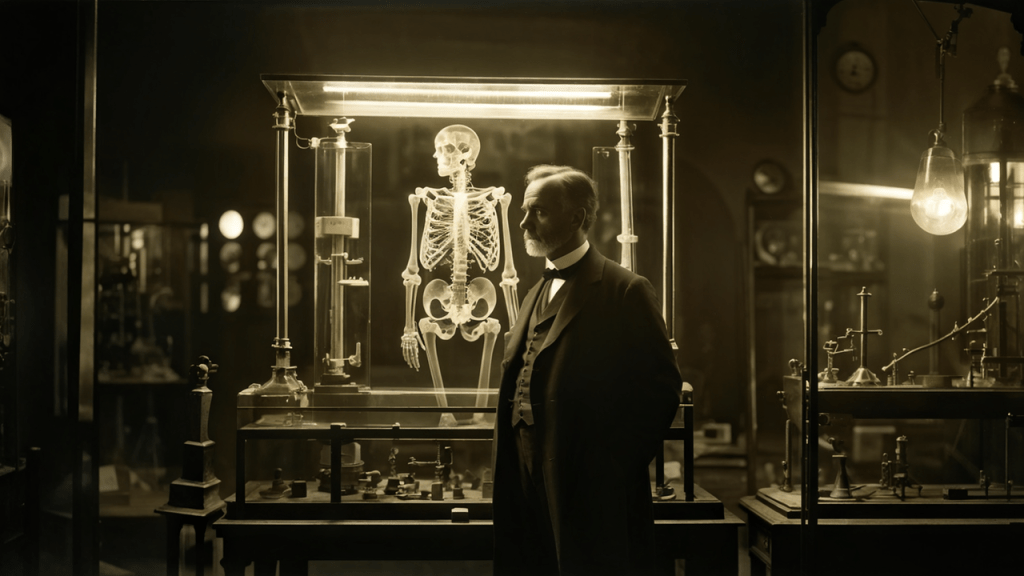
On November 8, 1895, Wilhelm Röntgen’s discovery of X-rays marked a breakthrough in medical and scientific fields, introducing transformative vocabulary into the English language. As Röntgen’s work revealed the ability of X-rays to visualize the interior of the human body, terms such as “X-ray,” “radiology,” and “imaging” became essential to medicine, physics, and public knowledge. This discovery paved the way for a new understanding of diagnostic medicine, influencing both professional and everyday language in discussing health, technology, and the sciences.
Introducing Key Terms to Medicine and Science
Röntgen’s discovery brought foundational terms into English that would shape diagnostic and treatment language in healthcare. The word “X-ray” quickly became a universally recognized term to describe this revolutionary imaging process, derived from the symbol “X” to represent the unknown nature of the rays when they were first identified. In addition to “X-ray,” terms such as “radiation,” “radiograph,” and “radiology” entered scientific vocabulary, establishing a language around the study and application of radiation in medicine.
The invention of the X-ray spurred the creation of new fields, including “radiology” as the branch of medicine focused on imaging and diagnostics. As X-rays were applied in hospitals, words like “scan,” “imaging,” and “film” were adopted to describe the processes and materials used. These terms quickly became part of medical education and practice, enabling professionals to discuss and develop diagnostic procedures with greater clarity.
Shaping Everyday Vocabulary and Public Understanding of Health
The advent of X-rays didn’t just impact medical language; it also reshaped how the public discussed and understood health and technology. Terms like “X-ray” soon entered everyday language, becoming synonymous with examining or seeing through otherwise hidden things. The phrase “to X-ray” something came to mean analyzing or scrutinizing deeply, showing the word’s expansion beyond the technical realm into metaphorical usage. People began to associate the term with health diagnostics, leading to a greater public awareness of medical imaging as a key part of healthcare.
The success of X-ray technology also introduced “imaging” and “scan” as standard terms in English, making it possible for people to discuss diagnostics with greater understanding and accuracy. As the technology advanced, terms such as “CAT scan” (Computed Axial Tomography scan) and later “MRI” (Magnetic Resonance Imaging) joined the vocabulary of diagnostic medicine, all influenced by the pioneering concepts established by X-rays.
Influencing Language in Science, Technology, and Media
Beyond its impact on medicine, Röntgen’s discovery broadened English vocabulary within the fields of physics and technology. Scientific discussions of “radiation” and “wave” theory became more common as researchers explored X-rays’ properties and uses. In popular media, terms associated with X-rays appeared in books, newspapers, and advertisements, emphasizing how technology could reveal the unseen. This exposure made words like “radiology” and “scan” widely recognizable, creating a shared language that linked medical technology with scientific progress.
The discovery of X-rays highlighted the intersection between health and technology, fueling a language of innovation that has continued into modern advancements like digital imaging and 3D scans. As newer diagnostic tools emerged, the foundational language established by X-rays provided a linguistic framework that allowed for rapid adaptation of new terms and applications.
Lasting Impact on English Language and Medical Communication
Röntgen’s discovery fundamentally changed medical and scientific vocabulary, creating a new lexicon that would drive advancements in health, physics, and technology. The terms established in the late 19th century by X-ray technology set a standard for how medical innovations are discussed, explained, and integrated into public awareness. Today, words like “X-ray” and “imaging” are central to medical practice, illustrating how scientific discoveries can influence language as they revolutionize understanding and treatment.
The lasting impact of Röntgen’s work on November 8, 1895, is evident in the language of modern diagnostics and patient care. The discovery of X-rays not only transformed English medical vocabulary but also enriched the language of science, creating terms that continue to define how we talk about health and technology in everyday life.
Originally published on November 8, 2024, on The-English-Nook.com.
 What Happened on This Day?
Leave a comment