
December 10, 1948
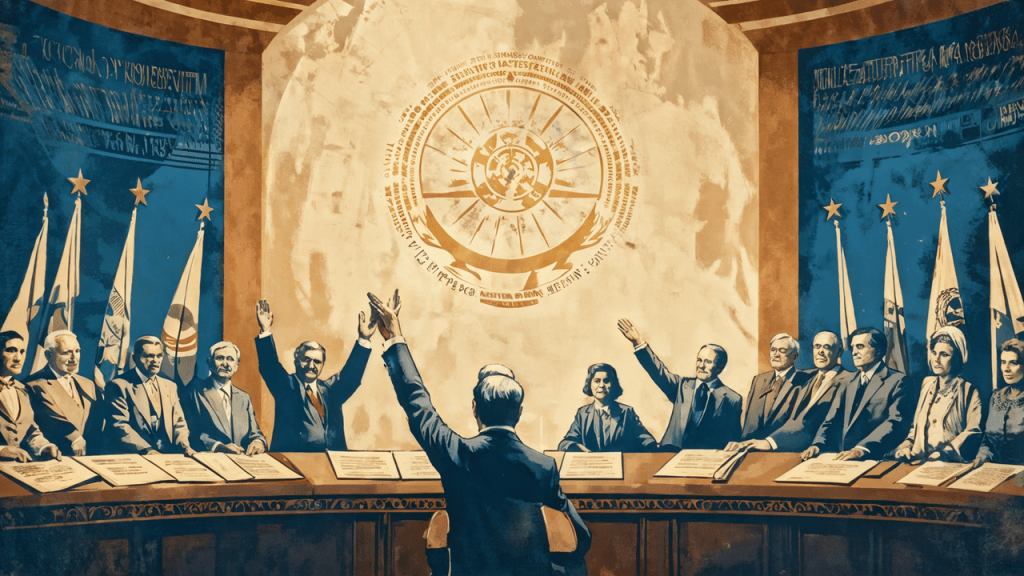
On December 10, 1948, the United Nations General Assembly adopted the Universal Declaration of Human Rights (UDHR), a landmark document that became the foundation of modern human rights dialogue. Drafted in the aftermath of World War II, the UDHR articulated a vision of universal equality and freedom. Its language has profoundly shaped the vocabulary of justice, dignity, and rights, influencing legal frameworks, political rhetoric, and international relations in English-speaking societies and beyond.
Language of the UDHR: Transforming English Discourse
The adoption of the UDHR popularized a lexicon of justice and equality, embedding new terms and concepts into English that continue to resonate in discussions of human rights.
Key Terms Introduced or Popularized
- “Human dignity”
- Central to the UDHR, this phrase underscores the inherent worth of every individual. It has since become a cornerstone of rights-based discourse.
- Example: “Policies must respect human dignity above all else.”
- “Inalienable rights”
- A powerful concept indicating rights that cannot be transferred or revoked, reinforcing the universality of freedoms such as life, liberty, and security.
- “Freedom of expression”
- Popularized as a formalized right, this term captures the ability to share ideas, opinions, and beliefs without fear of censorship or retaliation.
- “Equality before the law”
- This phrase enshrines the principle that all individuals, regardless of status, are entitled to equal protection under legal frameworks.
- “Right to asylum”
- Reflecting the post-war reality of displaced persons, this term became central to discussions of refugee rights and international protection.
- “Social and economic rights”
- Emphasizing the importance of adequate living standards, education, and healthcare, this term expanded the language of human rights beyond political and civil liberties.
- “Universal rights”
- This phrase reinforced the idea that fundamental rights apply to all people, irrespective of nationality, race, or creed.
Impact on English Language and Global Discourse
The UDHR introduced a standardized vocabulary for discussing justice, equality, and freedom, transforming the way English speakers frame these values.
Shaping Legal Language
The UDHR’s precise and aspirational phrasing laid the groundwork for numerous national constitutions and international treaties:
- Terms like “inalienable rights” became benchmarks for legal arguments, grounding principles of justice and fairness in legislative texts.
- The phrase “human dignity” became integral to court rulings on equality, anti-discrimination, and personal autonomy.
Expanding Political Rhetoric
The document’s universalist language influenced political speeches and advocacy:
- Leaders worldwide invoke the UDHR to justify actions and policies aimed at improving human rights.
- Terms like “freedom of expression” and “equality before the law” have become rallying cries in movements for democracy and social justice.
Cultural and Educational Influence
- The UDHR has become a core text in discussions of morality and ethics, shaping curricula and fostering a shared vocabulary for addressing human challenges.
- Phrases like “universal rights” inspire artists, writers, and activists, embedding the language of human rights in literature, media, and art.
Modern Usage and Evolving Meanings
Broadening the Term “Human Rights”
The UDHR’s emphasis on economic and social rights, alongside traditional civil liberties, expanded the scope of “human rights”:
- Today, discussions of climate justice, healthcare, and gender equality invoke the UDHR’s principles, adding depth to the term.
Universal Ideals in Advocacy
The universalist language of the UDHR facilitates global solidarity:
- Activists use its terminology to emphasize the interconnectedness of struggles for justice, whether addressing racial inequality, LGBTQ+ rights, or worker protections.
A Linguistic Legacy of Justice and Equality
The adoption of the Universal Declaration of Human Rights on December 10, 1948, marked a transformative moment in the history of language and law. Its carefully crafted phrases, from “human dignity” to “inalienable rights,” provided a universal vocabulary for addressing issues of justice, freedom, and equality.
This linguistic framework has empowered individuals, movements, and nations to articulate their aspirations for a fairer world. By embedding a language of compassion and universality into English, the UDHR continues to shape the discourse of human rights, ensuring its relevance and power for generations to come.
Originally published on December 10, 2024, on The-English-Nook.com.
 What Happened on This Day?
Leave a comment