
December 12, 1901
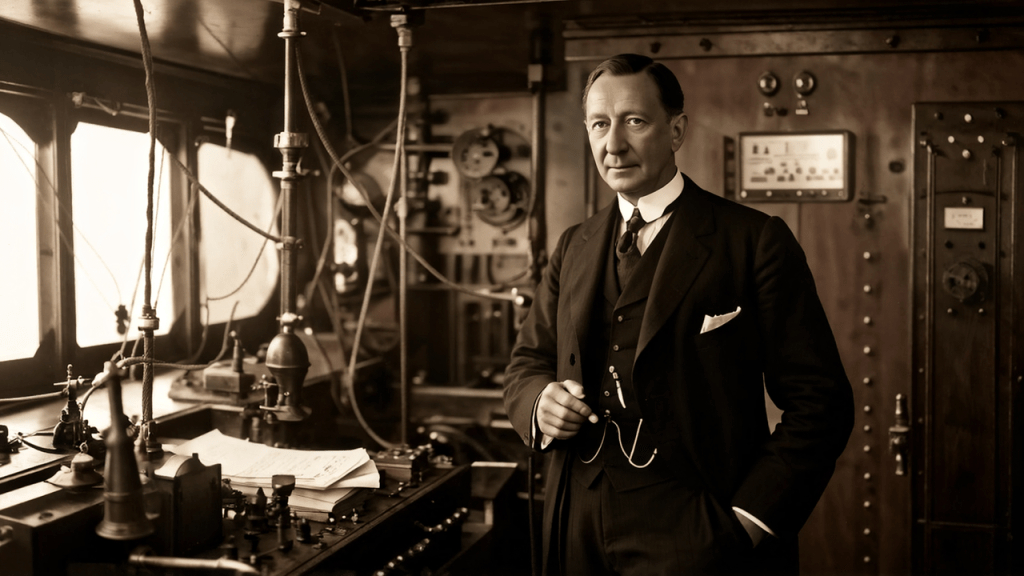
On December 12, 1901, Italian inventor Guglielmo Marconi achieved a groundbreaking feat by successfully transmitting the first transatlantic radio signal from Poldhu, Cornwall, England, to Signal Hill, St. John’s, Newfoundland, Canada. This technological milestone marked the beginning of a new era in global communication, breaking physical boundaries and forever altering how people connected across vast distances. The achievement not only transformed the world but also enriched the English language with a lexicon of terms and concepts that remain integral to discussions of technology, media, and communication.
Language Born from the Waves: Key Terms and Their Evolution
Marconi’s transatlantic radio transmission introduced and popularized terms that have since become foundational to English technological and cultural vocabulary.
Technical Terms
- “Wireless communication”
- Originally referring to communication without physical wires, this term became synonymous with the burgeoning field of radio transmission and later extended to cellular and internet technologies.
- Example: “Wireless communication revolutionized how people connect over long distances.”
- “Radio wave”
- A term describing the electromagnetic waves used to transmit information, essential to the understanding of radio technology.
- Example: “Marconi’s experiments with radio waves paved the way for modern broadcasting.”
- “Broadcasting”
- Initially used to describe the dissemination of radio signals, this term evolved to encompass television, internet, and multimedia content delivery.
- Example: “The concept of broadcasting began with the first radio transmissions.”
- “Morse code”
- A system of dots and dashes used for early wireless communication, critical to Marconi’s success and the development of long-distance messaging.
- Example: “Marconi utilized Morse code to send the first transatlantic signal.”
- “Telegraphy”
- A precursor to wireless communication, this term became part of the dialogue as radio technology extended the capabilities of wired telegraphy.
- Example: “Wireless telegraphy marked a new chapter in communication history.”
Impact on English Discourse and Communication Culture
The success of Marconi’s transatlantic signal transformed not only technology but also the way English speakers discussed connection, innovation, and global interaction.
Transforming the Language of Technology
- “Radio communication” became a cornerstone of technological vocabulary, influencing discussions of subsequent innovations like television, radar, and satellite communication.
- Example: “Radio communication bridged continents for the first time in human history.”
- Terms like “frequency,” “signal strength,” and “transmission” entered everyday English, providing a framework for discussing electronic communication.
Popularizing the Concept of Global Connectivity
- Marconi’s achievement underscored the idea of a “connected world”, inspiring phrases like “shrinking the globe” and fostering a lexicon that reflected the newfound immediacy of communication.
- Example: “The first transatlantic signal was a testament to the shrinking of global distances.”
Creating a Media-Centric Vocabulary
- The success of wireless communication laid the groundwork for the emergence of the media industry, introducing words like “live broadcast”, “news bulletin”, and “radio station.”
- Example: “Radio stations became a central hub for information and entertainment.”
Broader Cultural and Linguistic Influence
The first transatlantic radio signal not only revolutionized communication but also enriched the cultural and metaphorical dimensions of English.
A Metaphor for Connectivity
- “Breaking barriers” became a metaphorical phrase linked to Marconi’s achievement, symbolizing the overcoming of physical and technological limitations.
- Example: “Marconi’s success was a moment of breaking barriers in human history.”
- “Sending signals” evolved into an idiom, now used in interpersonal and societal contexts to describe conveying intentions or messages subtly.
- Example: “Her actions were sending signals of approval to the team.”
Influence on Modern Media and Entertainment
- The foundation of radio technology gave rise to terms like “radio drama”, “airwaves”, and “radio personality.”
- Example: “The golden age of radio introduced the world to radio personalities who became household names.”
Legacy in Space and Digital Communication
- The concepts pioneered by Marconi influenced the terminology of later technologies, from “satellite communication” to “wireless internet.”
A Linguistic and Technological Legacy
Marconi’s first transatlantic radio signal on December 12, 1901, represents a watershed moment in human history, one that reshaped communication, culture, and language. By introducing terms like “wireless communication”, “radio wave”, and “broadcasting”, Marconi’s achievement laid the linguistic and technological groundwork for innovations that continue to connect the world today. His work expanded not only the horizons of communication but also the vocabulary we use to describe our ever-evolving relationship with technology and each other.
Originally published on December 12, 2024, on The-English-Nook.com.
 What Happened on This Day?
Leave a comment