
January 7, 1610
Galileo’s Historic Discovery
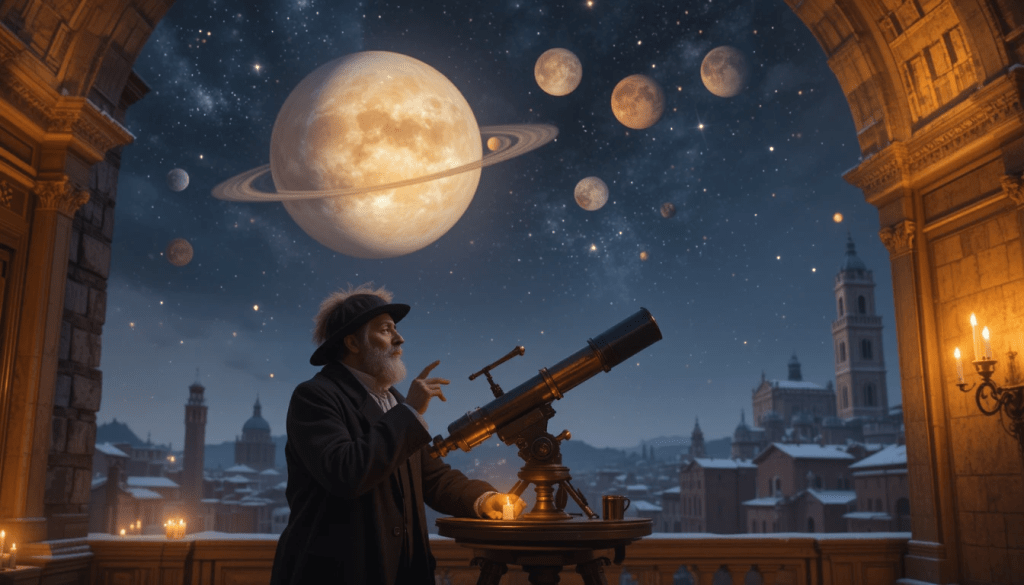
On January 7, 1610, Galileo Galilei, using his recently improved telescope, observed four celestial bodies orbiting Jupiter. These moons—later named Io, Europa, Ganymede, and Callisto, collectively known as the Galilean moons—represented a monumental discovery that challenged long-held beliefs about the structure of the cosmos. Until this point, the prevailing geocentric model, which placed Earth at the center of the universe, had dominated European thought for centuries, supported by both Aristotelian philosophy and Ptolemaic astronomy.
Galileo’s observation provided critical evidence for the heliocentric model proposed by Copernicus, which posited that the planets, including Earth, revolve around the sun. The discovery of Jupiter’s moons demonstrated that not all celestial objects orbited Earth, offering undeniable proof that the geocentric model was flawed. This breakthrough was not only a pivotal moment in the history of science but also a catalyst for linguistic innovation, as new concepts and discoveries necessitated the creation and popularization of scientific terminology in English.
Expanding the English Lexicon: Scientific Vocabulary
Galileo’s discoveries, and the scientific revolution they helped ignite, introduced and popularized a host of terms that remain central to scientific discourse today. These linguistic contributions reflect the profound impact of astronomy on the evolution of modern English:
- “Satellite”:
While the word satellite originates from the Latin satelles (meaning “attendant” or “companion”), its use in an astronomical context was popularized following Galileo’s discovery. The term initially referred to celestial bodies orbiting a planet, such as Jupiter’s moons, and later expanded to include artificial satellites launched into orbit around Earth. - “Orbit”:
Although orbit existed in English before Galileo’s time, its scientific usage—describing the path of a celestial body around another—gained prominence as heliocentric theories and astronomical observations became more widely accepted. - “Heliocentric”:
Derived from the Greek words helios (sun) and kentron (center), the term heliocentric entered English to describe the sun-centered model of the solar system. Galileo’s work brought this concept into mainstream scientific and public discourse, solidifying its place in the English lexicon. - “Telescope”:
While Galileo did not invent the telescope, he was among the first to use it systematically for astronomical observations. The word telescope itself, derived from the Greek tele (far) and skopein (to look or examine), gained prominence as a result of Galileo’s discoveries and subsequent writings. - “Jovian”:
Galileo’s focus on Jupiter led to the adoption of the term Jovian (from the Latin name for Jupiter, Jovis) to describe phenomena related to the gas giant, including its moons, atmosphere, and magnetic field.
Impact on Scientific English
Galileo’s discoveries and writings were instrumental in shaping the language of science, not just in Italian but across Europe, including England. His work popularized the use of precise, observational terminology to describe natural phenomena, setting a precedent for future scientific communication. This linguistic clarity helped standardize scientific English, allowing scholars to share ideas more effectively and paving the way for the rapid advancement of knowledge.
Additionally, the adoption of Latin and Greek roots for new terms (as seen in words like heliocentric and satellite) established a tradition that continues to define scientific nomenclature. By grounding new vocabulary in classical languages, scientists created a shared linguistic framework that transcended national and linguistic boundaries, facilitating the global exchange of ideas.
Galileo’s Broader Influence on Language and Culture
Beyond its immediate impact on scientific vocabulary, Galileo’s work also enriched the metaphorical and cultural use of language in English. His observations of the heavens inspired poetic and philosophical expressions that linked celestial phenomena to human experiences. For example:
- The term “revolution”, initially describing the motion of celestial bodies, came to symbolize profound social and intellectual change, as exemplified by the term “scientific revolution”, which describes the transformative period initiated by thinkers like Galileo, Copernicus, and Kepler.
- The phrase “a new world”, often associated with Galileo’s discoveries, entered popular usage to describe groundbreaking advancements and uncharted possibilities.
Galileo’s legacy also influenced literary works in English. Writers such as John Milton drew on his discoveries to explore themes of knowledge, faith, and the cosmos. In Paradise Lost, Milton references Galileo’s telescope and observations, underscoring the cultural resonance of Galileo’s achievements.
A Legacy of Inquiry and Innovation
The discovery of Jupiter’s moons on January 7, 1610, represents far more than an astronomical milestone—it was a watershed moment in human history that forever changed our understanding of the universe and our place within it. This discovery demonstrated the power of empirical observation to challenge entrenched beliefs, laying the foundation for modern science and inspiring generations of thinkers to question, explore, and innovate.
Galileo’s observations also reinforced the idea that language evolves alongside knowledge. The scientific terms popularized in the wake of his discoveries remain vital components of English today, reflecting the enduring legacy of his work. From satellite and orbit to heliocentric and telescope, these words not only describe the cosmos but also symbolize humanity’s unending quest for understanding.
Galileo and the Language of Discovery
The discovery of Jupiter’s moons by Galileo Galilei on January 7, 1610, marked a turning point in both science and language. By challenging long-held views of the cosmos, Galileo not only transformed our understanding of the universe but also enriched the English lexicon with terms that continue to define the language of inquiry and innovation.
Galileo didn’t just map the stars; he reshaped the universe—and the dictionary!
Originally published on January 7, 2025, on The-English-Nook.com.
 What Happened on This Day?
Leave a comment