

February 10, 1763
A War’s End and English’s Global Rise
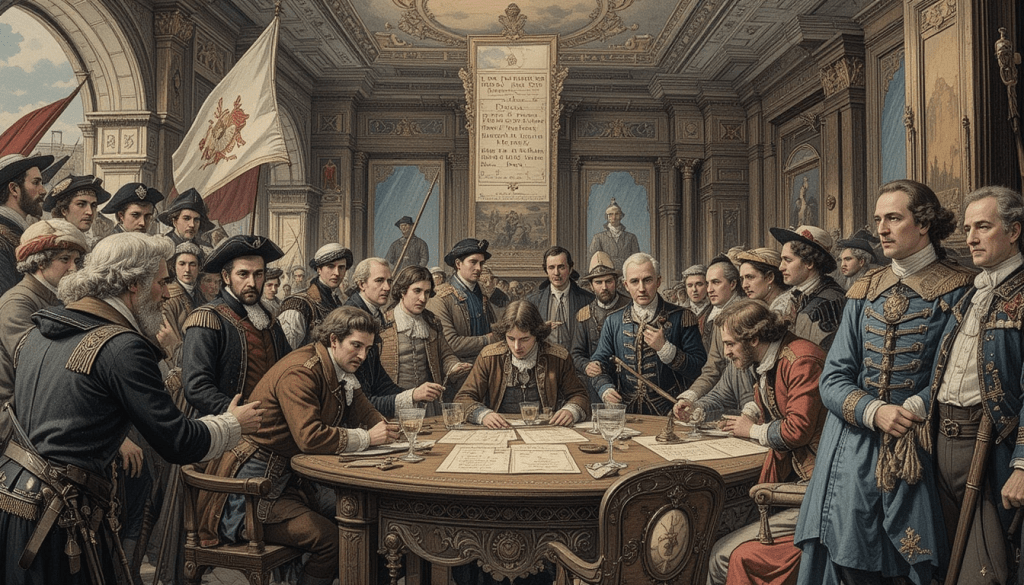
On February 10, 1763, the Treaty of Paris was signed, formally ending the Seven Years’ War (1756–1763)—a conflict often referred to as the first global war due to its vast reach across Europe, North America, the Caribbean, Africa, and India. The treaty marked a dramatic shift in world power, with Britain emerging as the dominant colonial empire at the expense of France and Spain.
The realignment of territories and the expansion of British rule had a profound linguistic impact, particularly in North America, the Caribbean, and India. English began to supplant French, Spanish, and indigenous languages in many regions, laying the groundwork for the spread of English as a global language. Additionally, the political and diplomatic consequences of the war introduced and popularized key terms in English discourse, many of which remain in use today.
1. Linguistic Impact of the Treaty of Paris on the English Language
The treaty reshaped political vocabulary and introduced new terms into diplomatic and legal discourse, particularly in the areas of territorial negotiations, colonial administration, and military strategy. Some of the most significant phrases and words that gained prominence include:
- “Ceded territory” – The treaty required France and Spain to cede (surrender) various territories to Britain. The term “cede” became widely used in political discussions about land transfers and sovereignty.
- “Balance of power” – The realignment of colonial holdings emphasized the importance of maintaining a “balance of power” between European nations, a concept that remains central in geopolitical strategy.
- “Colonial administration” – As Britain took control of vast new territories, it developed new systems of colonial administration, leading to increased use of bureaucratic terms such as “governor-general,” “protectorate,” and “imperial rule.”
- “Treaty negotiations” – The complex diplomatic process of crafting the Treaty of Paris helped standardize phrases like “peace terms,” “treaty enforcement,” “diplomatic immunity,” and “ratification of agreements.”
- “Annexation” – The expansion of the British Empire led to the increased use of “annexation” (the act of adding new territories), a term that remains significant in discussions of international relations.
The treaty also brought English into contact with new languages and cultures, leading to the adoption of foreign words, particularly from French, Spanish, and indigenous languages.
2. Expansion of English Through Colonization
North America and the Caribbean
- Britain gained control over Canada from France, making English the dominant language in regions that had previously been French-speaking. While French remained in use in Quebec, English influence grew significantly in administration, trade, and law.
- Florida was ceded from Spain to Britain, introducing English governance and terminology into the region before it was later returned to Spain in 1783.
- The Caribbean, particularly Grenada, Dominica, St. Vincent, and Tobago, came under British control, leading to the introduction of English legal and mercantile language in these territories.
India and the Spread of Anglo-Indian Vocabulary
- While the British East India Company had already established a presence in India, the treaty confirmed British dominance in Bengal and other territories, expanding English influence in trade, administration, and law.
- English began absorbing Indian words into its vocabulary, such as “bungalow” (from Hindi “bangla”), “pajamas” (from Persian), and “jungle” (from Sanskrit via Hindi).
Africa and Global Trade
- Britain’s enhanced naval power after the treaty led to greater control over maritime trade routes, reinforcing English as the dominant language in commerce.
- Increased British involvement in West Africa and the Atlantic slave trade contributed to the exchange of words from African languages into English, particularly in the areas of food, music, and culture.
3. Political and Military Phrases That Became Common
The Seven Years’ War and its aftermath introduced a range of military, strategic, and political phrases into common English usage:
- “War of attrition” – The prolonged and resource-draining nature of the war made this phrase popular in describing conflicts where both sides suffer heavy losses over time.
- “Diplomatic corps” – As Britain, France, and Spain engaged in complex negotiations, the concept of an organized group of diplomats became more widely recognized in English.
- “Treaty enforcement” – The need to implement and uphold agreements gave rise to legal and diplomatic discussions about how treaties should be enforced and monitored.
- “Imperial expansion” – The treaty solidified Britain’s dominance as an empire, further embedding the phrase “imperial expansion” into English discourse.
4. Lasting Cultural and Linguistic Effects
The Treaty of Paris played a key role in shaping global English, as British rule expanded across North America, the Caribbean, and India. This laid the groundwork for English becoming a dominant world language, influencing trade, governance, and diplomacy.
Additionally, the treaty set the stage for future conflicts, including:
- The American Revolution (1775–1783) – Many American colonists were frustrated with British rule after the war, leading to phrases like “taxation without representation” and “colonial unrest” becoming common.
- Continued Anglo-French rivalry – Tensions between Britain and France remained high, with the Napoleonic Wars (1803–1815) later shaping military and strategic language.
The treaty’s linguistic legacy endures, as many terms introduced during this period continue to influence political, diplomatic, and historical discourse today.
A Treaty That Shaped Language, Power, and Global Influence
The Treaty of Paris of 1763 was far more than a diplomatic agreement—it was a turning point in world history that reshaped political and linguistic landscapes. By cementing Britain’s global dominance, the treaty expanded the reach of English, integrating new words, phrases, and diplomatic terminology into everyday use.
From “ceded territory” and “balance of power” to the linguistic exchanges between English, French, Spanish, and indigenous languages, the impact of the treaty is still visible in modern English vocabulary. More than 250 years later, the words and concepts born from this historic agreement continue to influence how we discuss war, diplomacy, and empire—a powerful testament to its enduring legacy.
One treaty, one empire, one language—February 10, 1763, set the stage for English’s global rise!
Originally published on February 10, 2025, on The-English-Nook.com.
Visit my page to find out ‘What Happened on this Day?‘ and learn ‘The Word of the Day‘—you’ll find it here first and all in one place!
If you’re a language enthusiast, you’ll have access to a variety of resources, including short stories in English and Spanish, interesting readings, vocabulary, and much more—not just for English, but also for Spanish. Come check it out!
 What Happened on This Day?
Leave a comment