

February 13, 1689
The Glorious Revolution’s Lasting Impact on Language and Law
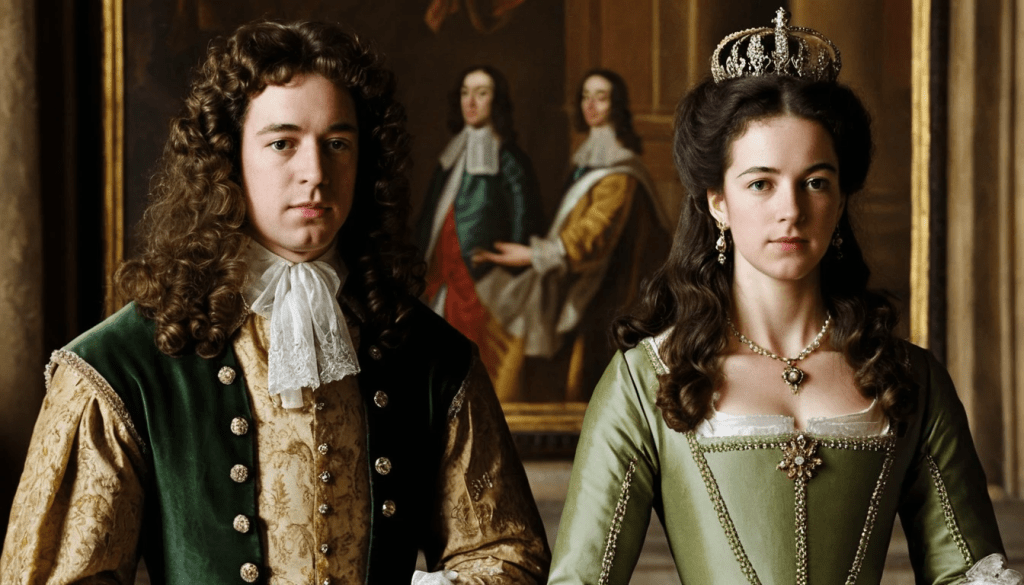
On February 13, 1689, William III and Mary II were officially proclaimed joint monarchs of England, Scotland, and Ireland, marking a decisive moment in British history. This event, known as the Glorious Revolution, led to the transformation of the English monarchy from an absolute to a constitutional system, fundamentally altering the political and legal vocabulary of the English-speaking world.
The establishment of William and Mary as co-rulers, along with the adoption of the English Bill of Rights (1689), introduced and popularized numerous political, legal, and philosophical terms, many of which remain central to discussions on governance, democracy, and human rights today.
1. The Rise of “Constitutional Monarchy” and the Evolution of Political Terminology
One of the most lasting impacts of William and Mary’s ascension was the establishment of a constitutional monarchy, a system in which a king or queen’s powers are limited by law and shared with Parliament. This political transformation cemented key terms into English discourse, including:
- “Constitutional monarchy” – A government in which the monarch acts as head of state within the parameters of a constitution, rather than ruling by divine right.
- “Limited monarchy” – Another phrase describing the restricted powers of the sovereign after the Glorious Revolution.
- “Parliamentary sovereignty” – The principle that Parliament holds supreme power, reducing the monarch’s ability to rule by decree.
- “Legitimate rule” – The idea that a ruler’s authority must be based on law, consent, or constitutional principles, rather than purely hereditary claims.
The shift in monarchy also changed how people spoke about rulership and governance, reinforcing ideas of shared power, checks and balances, and popular representation.
2. The English Bill of Rights: A Legal Milestone in Language and Governance
One of the greatest legacies of the Glorious Revolution was the English Bill of Rights, passed in December 1689. This landmark document laid the foundation for modern democracy and constitutional law, introducing terms that would shape political discourse in England and beyond. Many of these terms later influenced the United States Bill of Rights (1791) and similar legal frameworks in other democratic nations.
Key legal and political phrases originating or reinforced by this document include:
- “Bill of Rights” – A formal statement listing fundamental rights and liberties protected by law.
- “Due process” – The idea that legal proceedings must follow fair and established rules, limiting arbitrary rule by the monarchy.
- “Free elections” – The concept that elections must be conducted without undue influence or corruption, a principle that became central to democratic governance.
- “Right to petition” – The guarantee that citizens can formally express grievances to the government without fear of punishment.
- “Standing army” – A permanent military force; the English Bill of Rights restricted the king’s ability to maintain a standing army without parliamentary approval, introducing debates on military power in civil society.
- “No taxation without representation” – Though this phrase became famous in the American Revolution, the English Bill of Rights established that taxes could not be levied without parliamentary approval, laying the groundwork for later resistance to unjust taxation.
These principles and phrases became foundational in English-speaking political philosophy, influencing constitutional debates well into the 18th and 19th centuries.
3. The Religious and Ideological Impact: Shaping the Language of Rights and Tolerance
William and Mary’s reign also marked a shift in religious and ideological tolerance, influencing how freedom of religion and governance were discussed in English.
- “Protestant succession” – The concept that only Protestants could inherit the English throne was enshrined in law to prevent a return to Catholic rule.
- “Divine right of kings” (weakened) – Before the Glorious Revolution, kings were believed to rule by God’s will. However, William and Mary’s ascension, supported by Parliament, challenged the idea of absolute monarchy, leading to a decline in this belief.
- “Toleration Act” (1689) – Passed alongside the Bill of Rights, this act granted limited religious freedom to Protestants, further embedding the term “religious toleration” in English discourse.
These changes cemented England’s identity as a Protestant nation, while also introducing more secular and parliamentary principles into political language.
4. “Glorious Revolution” and the Evolution of Political Revolutions
The events of 1688-1689 came to be known as the Glorious Revolution, a term that shaped how political overthrows were described in English. Unlike earlier revolts, this one was largely bloodless, leading to the adoption of terms that emphasized its orderly and legal nature.
- “Glorious Revolution” – The phrase itself became a model for describing non-violent transitions of power, later applied to other political changes in history.
- “Bloodless coup” – While not entirely accurate (some fighting occurred in Ireland and Scotland), the term described the relatively peaceful replacement of James II.
- “Right of revolution” – The philosophical idea that people have the right to overthrow an unjust government, which gained traction following 1689.
These concepts later influenced political movements across Europe and the American colonies, reinforcing English as the dominant language of political change.
5. The Royal Couple: A New Model of Monarchical Rule and Gender Roles
The joint rule of William and Mary was also unprecedented in English history, reshaping ideas about monarchy, marriage, and shared governance. Their co-rule introduced:
- “Co-monarchs” – A term used to describe two rulers who share equal authority, a rare arrangement in European history.
- “Queen regnant” vs. “Queen consort” – Mary II was a queen regnant (a reigning queen with full sovereignty), unlike traditional queens consort, who were merely the wives of kings.
- “Williamite” – A term for supporters of William III, particularly in Ireland, where conflicts between “Williamites” and “Jacobites” (supporters of James II) shaped political discourse.
These changes altered how monarchy was understood in England, setting precedents for future queens like Victoria and Elizabeth II.
A Lasting Linguistic and Political Revolution
The proclamation of William III and Mary II as joint rulers on February 13, 1689, was more than a political milestone—it was a linguistic and ideological turning point in the history of the English-speaking world.
Their ascension and the constitutional reforms that followed introduced new words, concepts, and principles into political and legal discourse, many of which remain at the heart of modern democracy and governance.
From “constitutional monarchy” and “Bill of Rights” to “free elections” and “parliamentary sovereignty,” the legacy of the Glorious Revolution continues to shape how power, rights, and government are discussed in English-speaking nations today.
A revolution not just of power, but of words—1689 redefined the language of democracy.
Originally published on February 13, 2025, on The-English-Nook.com.
Visit my page to find out ‘What Happened on this Day?‘ and learn ‘The Word of the Day‘—you’ll find it here first and all in one place!
If you’re a language enthusiast, you’ll have access to a variety of resources, including short stories in English and Spanish, interesting readings, vocabulary, and much more—not just for English, but also for Spanish. Come check it out!
 What Happened on This Day?
Leave a comment