
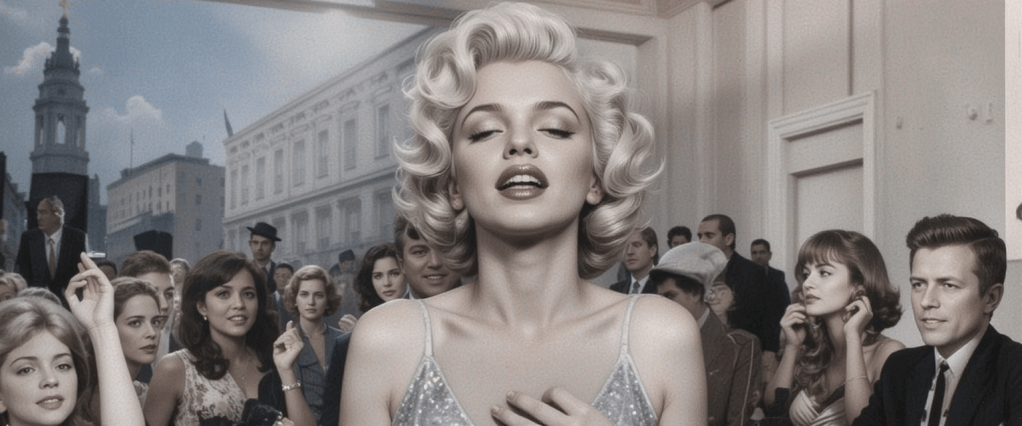
May 19, 1962
Marilyn Monroe Sings to President John F. Kennedy
A Televised Moment Turned Cultural Lexicon
On May 19, 1962, at a Democratic fundraiser and early birthday celebration for President John F. Kennedy at Madison Square Garden, Marilyn Monroe stepped onto the stage in a shimmering, skin-tight gown and delivered her now-iconic sultry rendition of “Happy Birthday.” The performance lasted under a minute, but it instantly became one of the most memorable moments in 20th-century American pop culture—immortalized through media, mimicry, and language.
While the event is remembered for its glamour and controversy, it also introduced enduring phrases, idioms, and linguistic cues into the English-speaking world’s cultural consciousness.
Shaping Expressions of Fame, Politics, and Performance
Monroe’s performance didn’t just captivate audiences—it influenced how language encapsulates celebrity, charisma, and ambiguity in public life.
- “Happy Birthday, Mr. President” – This phrase became instantly recognizable and has since been used ironically or nostalgically in English media to refer to flirtation, political spectacle, or a blending of public and private personas.
- “Breathy” or “Monroe-style” delivery – The style of Monroe’s performance gave rise to a linguistic shorthand describing a kind of sensual, stylized speech, referenced in critiques of vocal performance, impersonations, and even AI voice design.
- Iconic moment – The term “iconic” in its modern use—as shorthand for instantly recognizable cultural references—was reinforced by media coverage of this performance and others like it.
Influence on Media Language and Visual Narratives
This event helped cement a mode of talking about fame and performance in both journalistic and casual English:
- “Stage-managed spectacle” – The performance was later described using terms that now often apply to political theater or celebrity branding, helping formalize expressions around image management.
- “Performance politics” – Monroe’s act blurred the lines between entertainment and political ritual, contributing to the growing lexicon used to describe modern political theater.
- Tabloid idiom – Sensational media surrounding Monroe and Kennedy contributed to the rise of phrases like “media circus,” “sex symbol,” and “scandalous whisper”—all common in English-language entertainment journalism today.
Cultural Legacy in Idioms, Parody, and Imitation
- Monroe’s “Happy Birthday” has been endlessly parodied, referenced, and quoted, embedding it in the English-speaking world’s collective memory.
- Its influence extends to phrases like:
- “Channeling Monroe” – used to describe someone embodying or mimicking her sensual style.
- “Birthday serenade” – now evokes more than just a song; it connotes flirtation or intimacy in a public setting.
- “Celebrity moment” – popularized in media discussions of fleeting but high-impact cultural events.
A Linguistic Echo of Glamour and Power
What might have been a fleeting musical moment became a linguistic and cultural touchstone. Marilyn Monroe’s performance on May 19, 1962, transformed “Happy Birthday” into more than just a celebratory song—it became a stylized, loaded phrase used across decades of English-language media to evoke themes of power, allure, and spectacle.
In doing so, Monroe not only performed for a president—she helped script a new vocabulary for discussing fame and performance in the modern era.
When Marilyn whispered, the English language listened.
Originally published on May 19, 2025, on The-English-Nook.com.
Visit my page to find out ‘What Happened on this Day?‘ and learn ‘The Word of the Day‘—you’ll find it here first and all in one place!
If you’re a language enthusiast, you’ll have access to a variety of resources, including short stories in English and Spanish, interesting readings, vocabulary, and much more—not just for English, but also for Spanish. Come check it out!
 What Happened on This Day?
Leave a comment