
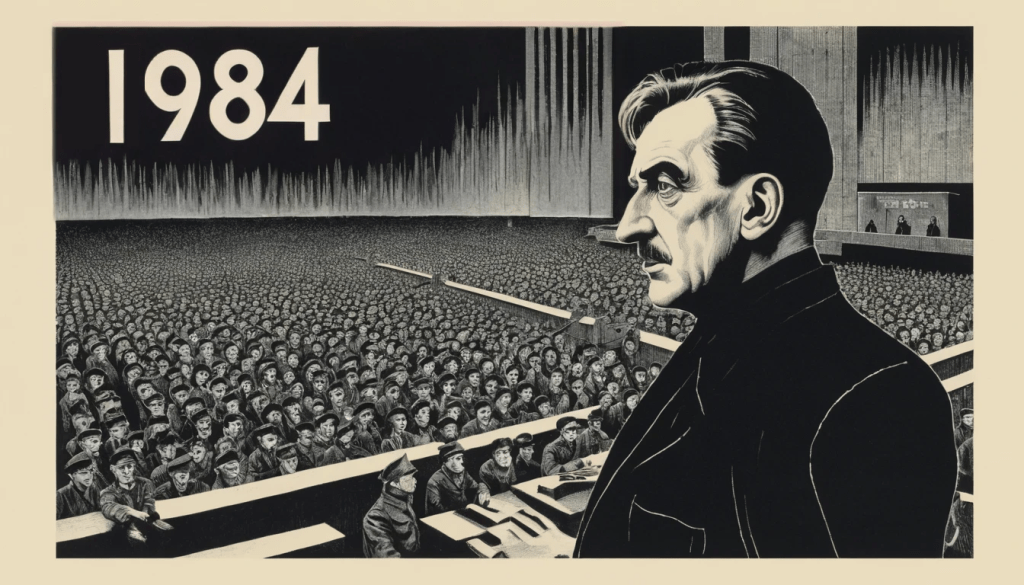
June 8, 1949
Publication of Nineteen Eighty-Four by George Orwell
A Seminal Work, Shaping the English Political and Cultural Imagination
Published on June 8, 1949, George Orwell’s Nineteen Eighty-Four quickly became one of the most influential English-language novels of the 20th century. Its unflinching depiction of totalitarianism and linguistic manipulation resonated globally, embedding itself deeply into the English lexicon and cultural consciousness.
From Postwar England to a Global Political Lexicon
Orwell’s final novel – Written against the backdrop of postwar Europe, Nineteen Eighty-Four distilled the fears and anxieties of the time into a stark narrative that transcended national boundaries. Its English prose—plain yet piercing—gave voice to the political and moral crises of the modern age.
Universal themes – The novel’s exploration of surveillance, censorship, and psychological control resonated across political and cultural contexts, making it a touchstone for English-speaking readers grappling with issues of power and truth.
Introducing New English Vocabulary: Orwell’s Linguistic Legacy
Iconic terms – Orwell’s novel coined and popularized words and phrases that have since entered common English usage, including:
- “Big Brother” – A symbol of authoritarian oversight, now synonymous with surveillance in English discourse.
- “Doublethink” – The act of simultaneously holding two contradictory beliefs, enriching English vocabulary for cognitive dissonance and ideological manipulation.
- “Thoughtcrime” – A chilling phrase for the policing of ideas, capturing the anxiety around freedom of speech and conscience in the English-speaking world.
The power of neologism – By inventing these terms, Orwell demonstrated the ability of English to evolve and respond to new political realities, embedding his fictional world into the real-world English language.
Enriching English Discourse: Political and Cultural Impact
Political vocabulary – Orwell’s concepts became tools for critiquing real-world regimes, giving English a sharper vocabulary for discussing propaganda, totalitarianism, and state control.
Cultural resonance – Terms like “Orwellian” now describe a wide array of phenomena beyond the novel itself—highlighting how English has absorbed and extended Orwell’s warnings into daily political commentary.
Psychological nuance – Orwell’s English prose captured the psychological terror of living under constant scrutiny, influencing how English-speaking writers approach themes of identity, self-censorship, and dissent.
A Legacy in English Literature and Criticism
1984’s impact – The novel’s critical reception in English literary circles was immediate and profound, with its dystopian imagery and political themes shaping generations of English-language novelists and essayists.
Critical frameworks – Orwell’s work provided new frameworks for English-language literary criticism, enriching the discussion of political fiction, language manipulation, and the ethical responsibilities of the writer.
English as a Medium of Global Dissent
Through Nineteen Eighty-Four, English became a global language of dissent, carrying Orwell’s prophetic warnings far beyond the UK. His stark, accessible style ensured that English itself became a vehicle for resistance and political skepticism.
The novel’s translations into countless other languages only deepened its reach—but its core message was first and most powerfully articulated in English, making the language a carrier of both artistic subtlety and moral urgency.
Enduring Echoes in the English Language
Today, Orwell’s Nineteen Eighty-Four remains a staple in English classrooms and political discourse alike. Words and ideas like “Newspeak”, “Room 101”, and “memory hole” continue to challenge and inspire English speakers, providing a vocabulary to critique and resist forms of social and political control.
Its English phrases have become more than literary devices—they are living elements of the English-speaking world’s cultural and political self-awareness.
Orwell’s English Voice, Forever Relevant
George Orwell’s Nineteen Eighty-Four stands as a testament to the power of English prose to name and resist the forces of oppression. Through its neologisms and stark warnings, the novel permanently expanded English vocabulary and political imagination.
He wrote in English—but his vision has become a universal moral language, forever embedded in how English speakers name and confront the threats to freedom and truth.
He didn’t just write a novel—he rewired the English language for resistance.
 What Happened on This Day?
Leave a comment