
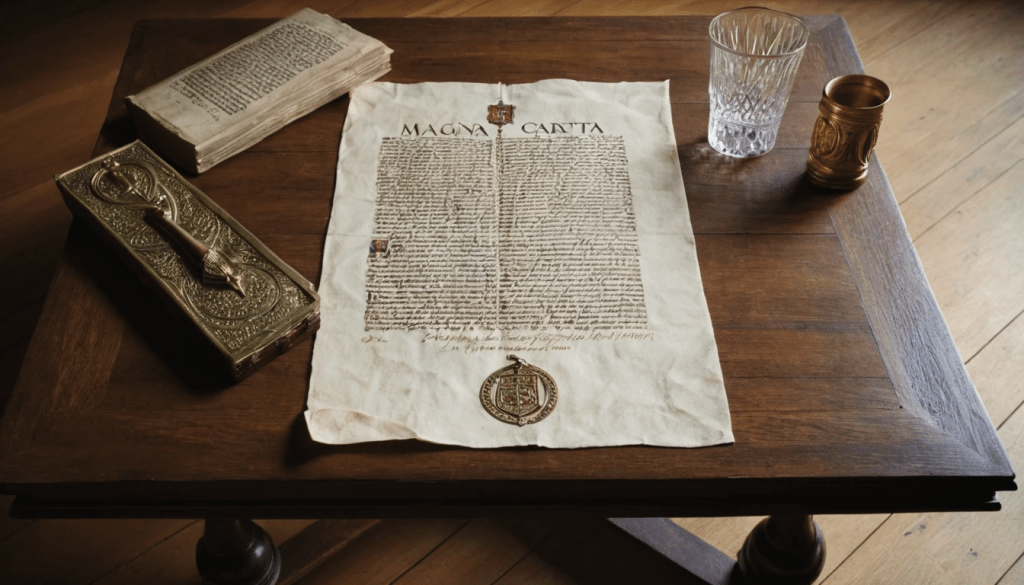
June 15, 1215
The Sealing of Magna Carta at Runnymede
A Medieval Moment with a Modern Voice
On June 15, 1215, beside the Thames at Runnymede, King John of England affixed his seal to the Magna Carta—a charter that, while born of medieval baronial politics, became one of the most influential documents in the history of the English language and legal thought.
Though written in Latin, the Magna Carta’s principles—translated, debated, and absorbed into English over centuries—formed the bedrock of Anglo-American legal and constitutional language. Its legacy resonates in terms like:
- “Due process of law”
- “Habeas corpus”
- “The rule of law”
- “No man is above the law”
These phrases—so central to modern legal English—trace their lineage to this 13th-century document.
From Latin Charter to English Common Law
The Magna Carta was not originally meant to be a democratic declaration. It was a practical settlement between a rebellious nobility and an unpopular king. Yet over time, its clauses—especially Article 39, protecting individuals from arbitrary imprisonment—were:
- Translated into Middle and Early Modern English, as English replaced French and Latin in legal contexts.
- Quoted in legal treatises, parliamentary debates, and trial records, embedding its vocabulary into English jurisprudence.
- Reinterpreted by legal thinkers such as Sir Edward Coke, who reimagined the document as a timeless statement of individual liberties.
Birth of English Legal and Political Terminology
Magna Carta gave rise to some of the most enduring conceptual and lexical frameworks in English law:
- “Lawful judgment of his equals” → the foundation of trial by jury.
- “Liberties of the realm” → a recurring phrase in English petitions and statutes from the 13th century to the English Civil War.
- “Justice delayed is justice denied” → a paraphrased concept rooted in Magna Carta’s call for swift and fair judgment.
The language of the charter introduced not just legal protections, but a moral vocabulary of governance, in which “liberty,” “right,” and “justice” became central to English political speech.
From England to America: The Charter’s Transatlantic English
In later centuries, Magna Carta was revived as a symbol of resistance to tyranny:
- In 17th-century England, it fueled opposition to absolute monarchy during the struggle between Parliament and the Crown.
- In 18th-century America, colonists cited Magna Carta in resisting British authority—helping embed its principles in English-language documents like the Declaration of Independence and the U.S. Constitution.
- Phrases such as “inalienable rights” and “constitutional government”, though not in the original Latin, are conceptual descendants of Magna Carta’s legacy in English thought.
A Living Document in English Legal Culture
Magna Carta’s endurance lies not only in its historical significance but in how its language was adapted and reused:
- Judges and lawmakers quote its core phrases in modern courts.
- Activists and educators invoke it as a symbol of freedom, giving its terms rhetorical power beyond the legal sphere.
- It has become a foundational myth of English-speaking constitutionalism, referenced in civic education across Britain, the U.S., Canada, Australia, and beyond.
Magna Carta’s Lingua Franca of Liberty
Though composed in the political language of medieval barons, Magna Carta evolved into a universal idiom of rights and restraints on power—a linguistic cornerstone of how English speakers talk about law, justice, and governance.
Its phrases are etched not only in constitutions and law books but in the English vocabulary of fairness and accountability.
In Magna Carta, English found the voice of liberty.
And the world has been speaking its words ever since.
 What Happened on This Day?
Leave a comment