
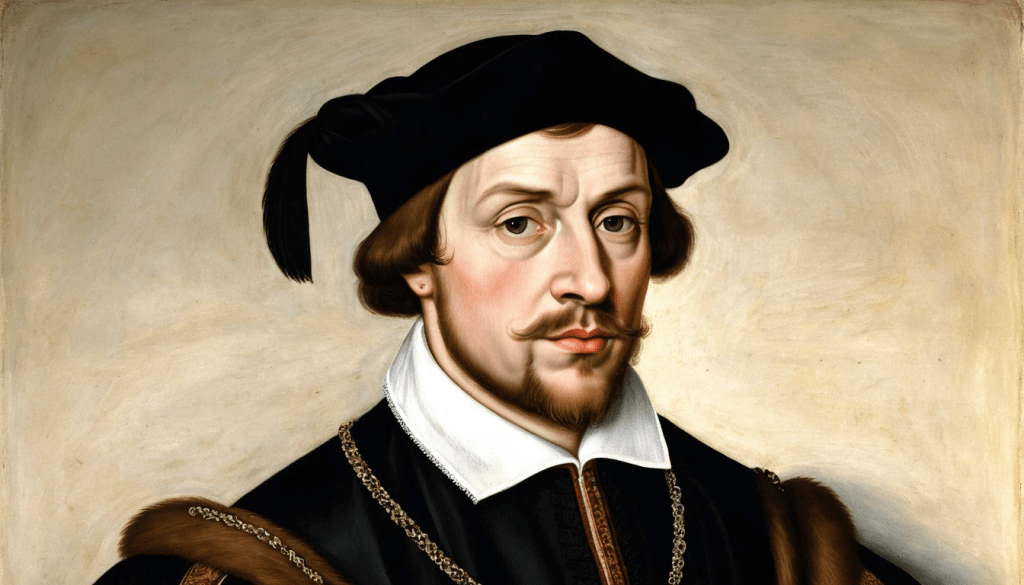
June 21, 1529
Skeltonics and Satire: The Sharp Tongue of Tudor Poetry
On June 21, 1529, John Skelton, a singular voice in early Tudor England, died—leaving behind a poetic legacy as biting as it was rhythmically radical. As court poet to Henry VIII, tutor to the future king, and an ordained priest, Skelton occupied a unique cultural position. His poetry, laced with satire, invective, and moral critique, broke with the stately meters of Chaucerian tradition to forge a form all his own.
His name would later give rise to a distinctive, eccentric poetic style: “Skeltonics”.
Skeltonics: The Birth of a Rhythmic Rebellion
Unlike the iambic pentameter that came to dominate English verse, Skeltonic meter is:
- Short-lined, often 3–6 syllables
- Rhymed in rapid succession, frequently with multiple short rhymes in a row
- Marked by irregular rhythm and a piling-on of ideas, images, and jabs
This form gave his verse a breathless, energetic, almost spoken quality, allowing him to mirror the tumbling pace of thought and speech. It was well-suited for:
- Satire
- Political commentary
- Mockery of church and court figures
Example from Speke, Parott:
With hey troly loly lo!
Where is the gret Skott of Galoway go?
Out of the Fryth, like a scottysshe jay,
The deuyl he go with them for to play.
His deliberately unpolished tone gave Skeltonics a rough music, a resistance to literary elitism. It was a middle-English performance style that both mocked and engaged power.
Language of Court and Critique
Skelton’s poetry was linguistically rich, fusing:
- Latinisms and vernacular English
- Colloquialisms, dialect, and double entendre
- Religious and legal jargon, twisted to subversive ends
He often attacked powerful figures, such as Cardinal Wolsey, with wordplay that blurred poetry, propaganda, and polemic. His verse pushed English toward:
- More flexible syntax
- Faster-paced rhythmic effects
- Satirical vocabulary that paved the way for later writers like Ben Jonson, John Dryden, and even Alexander Pope
Skelton’s fearless irreverence helped shape a mode of English poetic satire that would reappear again and again—most notably in the Restoration and Augustan periods.
A Poet of Tension and Transition
Living during the volatile years of late medieval and early Renaissance England, Skelton’s work sits on the cusp of literary epochs:
- Medieval allegory meets Renaissance individualism
- Latin authority is challenged by vernacular audacity
- Courtly decorum gives way to poetic insurrection
He remains a transitional figure in English letters—bridging the Gothic and the modern, anticipating both the anti-heroic mockery of satire and the rhythmic experimentation of modernist poetry.
The Passing of a Verbal Maverick
John Skelton’s death marked the end of a voice both prophetic and profane, a poet who dared to bend English rhythm and wield language with a razor’s edge.
Though later eclipsed by more decorous poets of the Elizabethan age, his influence lingers in:
- The rapidity of modern comedic verse
- The fearless targeting of power through poetry
- The very idea that English poetry could be earthy, erratic, and alive with fire
He wrote with fury, rhythm, and rebellion—
And English poetry never fully recovered its calm.
 What Happened on This Day?
Leave a comment