
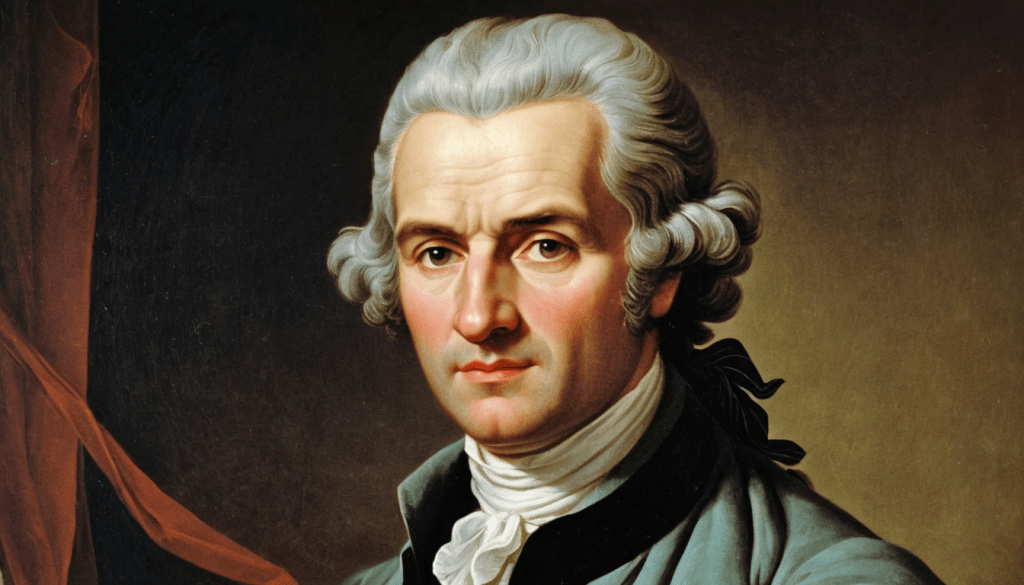
June 28, 1712
Birth of Jean-Jacques Rousseau (1712–1778)
Born on June 28, 1712, in Geneva, Jean-Jacques Rousseau would become one of the most influential thinkers of the Enlightenment. Though he wrote in French, his works—especially The Social Contract (1762) and Émile (1762)—profoundly shaped the English-language vocabulary of democracy, education, selfhood, and society.
Rousseau’s ideas helped expand how English speakers understood and discussed freedom, authority, civic responsibility, and human nature, and his influence continues to echo through political philosophy, pedagogy, and literature in English today.
The Social Contract and the English Political Lexicon
Rousseau’s Du contrat social (The Social Contract) was swiftly translated into English and became foundational in shaping modern democratic vocabulary:
- Phrases such as “general will,” “popular sovereignty,” “social contract,” and “civil liberty” entered English political theory and public discourse largely through Rousseau.
- His critique of inequality, inherited privilege, and arbitrary power influenced English-language debates during the American Revolution, French Revolution, and beyond.
- The phrase “man is born free, and everywhere he is in chains” became a rallying cry in English for liberty movements, quoted and echoed in everything from abolitionist speeches to civil rights manifestos.
Émile and the Language of Education
In Émile, or On Education, Rousseau revolutionized how English speakers would come to think—and speak—about childhood, learning, and human development:
- Introduced and popularized educational ideas in English such as “natural education,” “learning by doing,” and the importance of early childhood experience.
- He helped bring into English the idea of the “noble savage” or “natural man”—a romanticized notion of uncorrupted humanity, which shaped both educational theory and literary characterization.
- Inspired English-language educators and reformers from Mary Wollstonecraft to John Dewey, who adopted Rousseau’s terminology of freedom in education, autonomy, and moral development.
Cross-Cultural Impact on English Thought
Though Swiss-French, Rousseau’s writings deeply penetrated Anglophone intellectual culture:
- His works were widely read and quoted in 18th- and 19th-century English essays, sermons, speeches, and political treatises.
- His influence is evident in the language of constitutional democracy, especially in English-speaking nations, where terms like “the will of the people” and “social contract theory” remain active parts of legal and civic vocabulary.
- The Romantic movement in English literature—Wordsworth, Shelley, and Blake—adopted Rousseau’s emphasis on emotion, nature, and individual freedom, expanding English poetic vocabulary around the self and society.
Key Terms and Expressions Introduced or Popularized in English Through Rousseau:
- General will – The collective will of the people, distinct from individual desires.
- Natural man – A concept of humanity in its pre-social, uncorrupted state.
- Social contract – A foundational idea in English political theory about the agreement between individuals and the state.
- Civil society – The organized, lawful society created by the social contract.
- Moral liberty – Freedom through self-governance, not mere license.
- Authenticity – A Rousseauian emphasis on genuine selfhood that later influenced English-language discussions of identity and alienation.
Legacy in English Political and Literary Discourse
Rousseau’s vocabulary and conceptual frameworks remain alive in English:
- His ideas echo in modern English discussions about individual rights vs. collective good, education reform, environmentalism, and the nature of democracy.
- Contemporary English-language critiques of alienation, inequality, and institutionalized power often trace rhetorical roots to Rousseauian principles.
- The term “Rousseauian” itself has become part of English intellectual shorthand—evoking a complex blend of idealism, critique of modernity, and radical reimagining of society.
A French Mind, an English Echo
Though Rousseau wrote in another tongue, the English language absorbed, debated, and evolved with his ideas. His terms and theories became part of the common rhetorical fabric of Enlightenment and post-Enlightenment English thought. His vision of a freer, more just, more natural society gave English not just new words, but new ideals to articulate.
He wrote in French—but rewrote English thinking.
 What Happened on This Day?
Leave a comment