
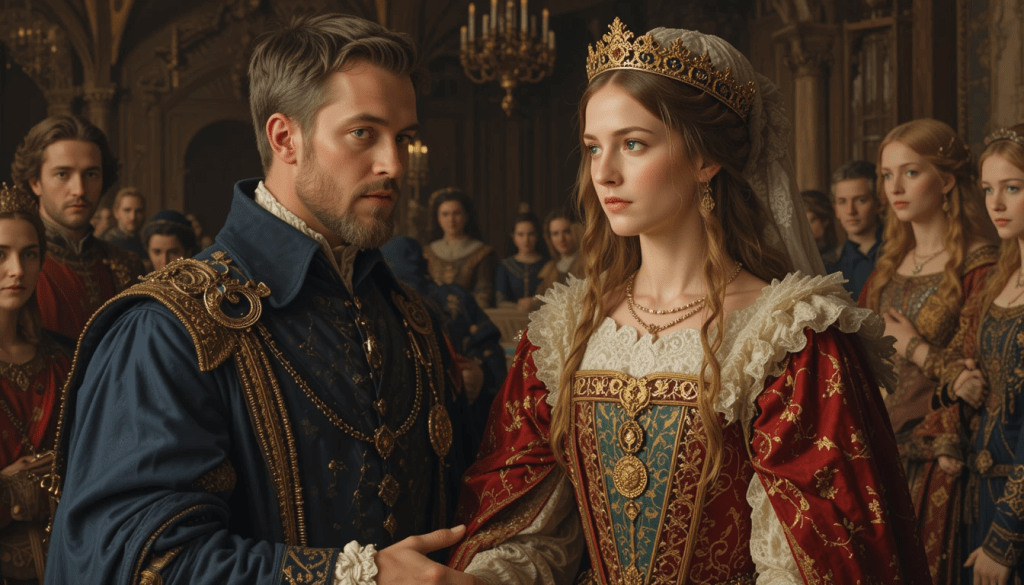
July 25, 1137 CE
(Note: Louis became King Louis VII later that year, not Louis VIII.)
This landmark marriage between Eleanor of Aquitaine—heiress to one of the wealthiest duchies in medieval Europe—and Louis, heir to the French throne, was far more than a royal union. It was a turning point that introduced and embedded numerous Anglo-French legal, political, and cultural terms into English high-register vocabulary, particularly in law, courtly literature, and diplomacy.
Historical Context
Eleanor was the Duchess of Aquitaine, a vast region in southwestern France, and her marriage to Louis on July 25, 1137 brought her territories under French royal control. Although the union was later annulled (in 1152), the cultural and linguistic implications of her role as queen consort of both France and, later, England (through her second marriage to Henry II) had lasting effects on the English language, particularly during the Anglo-Norman period.
Linguistic & Terminological Influence
The Eleanor–Louis marriage—and the web of continental politics it wove—helped enrich English with vocabulary that continues to influence legal, literary, and diplomatic registers.
“Aquitaine”
- Entered English historical and legal usage as a geopolitical term, referring to a powerful duchy with contested sovereignty.
- The name was used frequently in English diplomatic correspondence and literature—especially during the Hundred Years’ War, when England and France fought over lands Eleanor once controlled.
“Dower Rights”
- Eleanor’s marriage highlighted dower and dowry customs, terms formalized in English through Anglo-French legal discourse.
- “Dower” refers to the portion of a husband’s estate designated for his wife’s use after his death—this became a core concept in English common law.
- The visibility of Eleanor’s wealth and landholdings introduced and normalized terms like:
- “dower entitlement”
- “feudal inheritance”
- “marriage alliance”
“Continental Alliance”
- The term and concept of a continental alliance emerged from such royal marriages, and Eleanor’s union became a key model.
- English chroniclers used this vocabulary when describing dynastic unions between English and European nobility.
- Later political documents would borrow phrasing such as:
- “Anglo-French alliance”
- “strategic union”
- “Franco-royal pact”
“Queen Consort”
- Eleanor helped popularize the term “queen consort” in English texts—denoting a queen by marriage rather than sovereign right.
- Her exceptional influence challenged the typical use of the word, eventually contributing to expanded English descriptions of female power, such as:
- “regal authority by marriage”
- “sovereign duchess”
- “matriarchal diplomacy”
Courtly and Legal Registers
- The cultural sophistication of Eleanor’s Aquitaine—famous for troubadours, courtly love, and chivalric codes—gave English literature and legal rhetoric a French polish.
- Vocabulary that entered English via this Franco-Aquitanian influence includes:
- “chivalry”
- “courtoisie” (courtesy)
- “vassal”
- “liege”
- “suzerain”
Broader Influence on English
The implications of Eleanor’s marriage (and later remarriage to Henry II of England) contributed directly to:
- The spread of Anglo-Norman French as the language of the English court and legal system.
- The blending of continental legal and diplomatic terminology with evolving Middle English.
- Long-term linguistic effects that still echo in terms like:
- “heir presumptive”
- “claims of succession”
- “noble lineage”
Key Terms Popularized or Cemented in English
| Term / Phrase | Function in English Usage |
|---|---|
| Aquitaine | Feudal geopolitical term; symbol of contested land |
| Dower rights | Legal terminology embedded in English common law |
| Continental alliance | Dynastic diplomacy term in political history |
| Queen consort | Clarified role of royal wives in governance |
| Chivalry / Vassal / Liege | Brought from French into English through court culture |
Conclusion
Eleanor of Aquitaine’s marriage to Louis VII in 1137 shaped not only European geopolitics, but also enriched the English language with enduring terms from legal French, feudal law, and courtly culture. Her life bridged linguistic spheres, embedding the vocabulary of diplomacy, nobility, and legal rights into the growing fabric of Middle and Early Modern English.
When Eleanor wed Louis, English eloped with French.
 What Happened on This Day?
Leave a comment