
July 27, 1949
The De Havilland Comet’s maiden flight revolutionizes English aviation vocabulary and global discourse on modern air travel
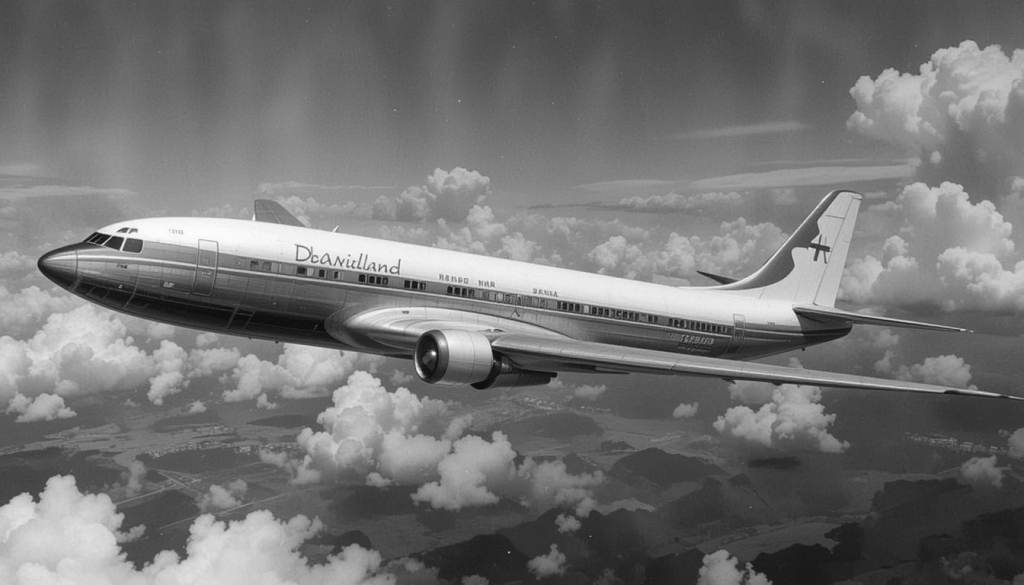
On July 27, 1949, the De Havilland Comet became the world’s first commercial jet airliner to take flight. This groundbreaking event not only marked the beginning of the jet age, but also introduced and popularized a host of new terms, idioms, and expressions into aviation English and broader public language.
Aviation Vocabulary Revolutionized
The introduction of the Comet required a new lexicon to describe unprecedented speed, altitude, and aircraft technology. Among the notable terms and expressions that entered English from this era:
- “Jet airliner” – Differentiated from older propeller aircraft, it emphasized the use of jet engines for faster, smoother, and more efficient commercial travel.
- “Jet set” – A term that soon emerged in the 1950s and 60s, describing wealthy, cosmopolitan travelers who used jet travel regularly. This phrase is now embedded in English idiom and cultural conversation.
- “Jet lag” – A new phenomenon for the body crossing time zones so rapidly that English needed a new word to describe it.
- “Commercial jet travel” – Signaled the start of mass, long-distance air transport for civilians, a major linguistic shift from military to consumer aviation contexts.
Shaping Global English Discourse
This first flight symbolized a global shrinking of distance, reflected in how English began to conceptualize and describe travel:
- Phrases such as “intercontinental flight”, “non-stop service”, and “transatlantic jetliner” began to populate English advertising, travel literature, and media.
- The concept of “civil aviation” took on new prominence, now clearly distinct from military or private flying.
- The idea of “airspace” gained more relevance in legal, navigational, and diplomatic English discourse, especially as commercial routes expanded.
Impact on Journalism and Business Language
The maiden Comet flight led to new business and media terminology around the airline industry:
- “Jet economy” – Referring to new economic models based on speed and global reach.
- “Flag carrier” – Used for national airlines like BOAC (British Overseas Airways Corporation), which operated the Comet. This term became embedded in international aviation reporting.
- “Jet engine failure,” “pressurization,” “fuselage fatigue” – Technical terms that emerged especially after early Comet accidents, becoming standard in English-language safety discussions.
Lasting Linguistic Legacy in English
| Term / Phrase | Context / Contribution |
|---|---|
| Jet airliner | Standard term for commercial jet-powered aircraft |
| Jet set | Now an idiom for cosmopolitan, elite travelers |
| Jet lag | Common English term for time-zone-related fatigue |
| Jet age | Era-defining phrase signaling postwar aviation progress |
| Cabin pressurization | Technical term made mainstream in safety language |
| Flight corridor | Term for regulated airspace routes in civilian travel |
Summary
The July 27, 1949 flight of the De Havilland Comet marked not just a leap in aviation technology but also a linguistic shift in how English speakers talked about travel, technology, and globalization. It ushered in the jet age and embedded a wide range of terms—technical, cultural, and idiomatic—into modern English, still used today in conversations about flying, distance, luxury, and speed.
It didn’t just take off—it redefined how we speak about the skies.
 What Happened on This Day?
Leave a comment