
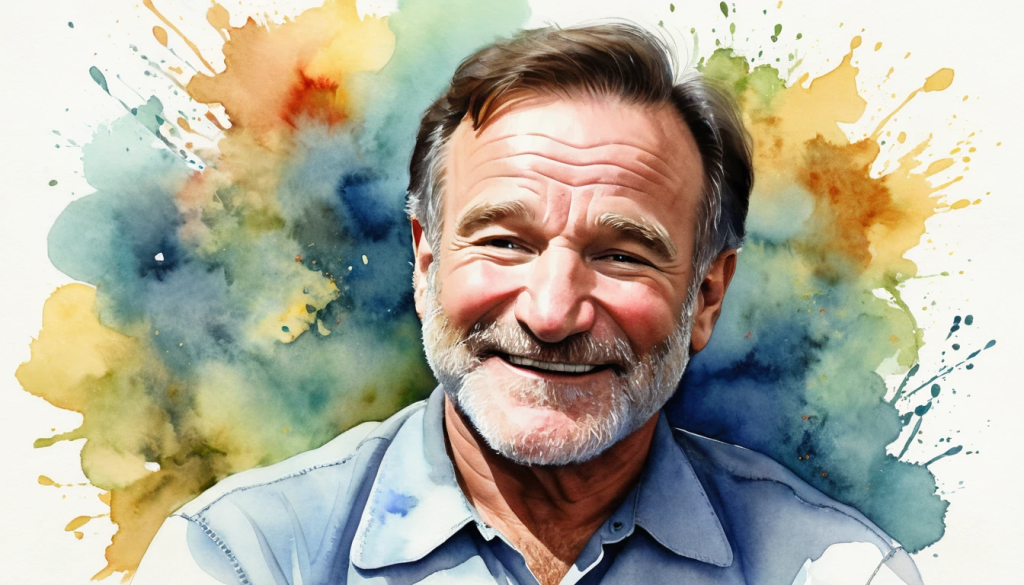
August 11, 2014
How One Comedian Rewired the English of Humor and Emotion
On August 11, 2014, the world lost Robin McLaurin Williams (1951 – 2014), the American actor, comedian, and improviser whose linguistic agility and emotional range altered how English speakers describe and experience comedy. His work generated new critical adjectives, helped popularize performance jargon outside specialist circles, and shaped the metaphors, idioms, and descriptors that entertainment journalists and audiences use to this day.
Williams’ on-stage and on-screen presence was inseparable from language — not only the words in his scripts, but the improvised, rapid-fire, character-shifting monologues that expanded English comedic discourse.
1. Key Adjectives and Eponyms in English
- Williamsian manic energy – Adopted by critics as shorthand for an unstoppable torrent of quick wit, sudden character changes, and free-associative verbal play. Comparable to “Chaplinesque” or “Hitchcockian,” this eponym became a label for a whole mode of performance.
- Improvisational brilliance – Though the phrase existed earlier, Williams’ career made it a common accolade in mainstream English reviews, reinforcing improv as everyday vocabulary beyond theater contexts.
- Genie-esque – From his role in Aladdin (1992), now applied metaphorically in English to describe humor that is both magical and anarchic.
- Mork-speak – Informal label for the quirky alien slang and verbal inversions from Mork & Mindy, which contributed playful neologisms to pop culture English.
- Comic shapeshifting – Term for switching between multiple distinct voices, personas, and emotional registers mid-performance.
2. Performance Jargon Popularized in General English
Williams’ style helped cement or spread several specialist terms into mainstream English:
- Riffing – Originally a jazz term, in comedy it means running with an idea through spontaneous variations; Williams brought this to wide recognition.
- Stream-of-consciousness comedy – Borrowed from literary criticism, applied to his associative, tangential, high-velocity delivery.
- Fourth-wall play – A theater term describing direct address to the audience; Williams’ frequent self-aware asides made this phrase more visible in comedy criticism.
- Character flip – Performance slang for sudden persona changes mid-routine.
3. Hyphenated Descriptors in English Entertainment Journalism
Williams’ kinetic delivery inspired a wave of compound adjectives and hyphenated modifiers in reviews and tributes:
- Rapid-fire
- Voice-hopping
- Emotion-laced
- Whiplash-speed humor
These modifiers, once reserved for niche theater criticism, entered everyday English descriptions of energetic personalities.
4. Metaphor and Figurative Language Influences
Williams’ work led to figurative uses of his name in English:
- “Doing a Robin Williams” — meaning to pivot unexpectedly between comedic and heartfelt.
- “Williams-style monologue” — shorthand for a free-form, improvisational, multi-character riff.
- “Genie-level energy” — evoking boundless, almost supernatural comic stamina.
5. Cultural and Lexical Impact
- Comedy Criticism – English reviewers adopted a vocabulary that blended performance terminology with emotional descriptors, influenced by the duality of Williams’ humor and pathos.
- Global English – Through films and televised performances, American comedic slang reached international audiences, making terms like riff, improv, and bit part of everyday English abroad.
- Eponymic Adjectives – “Williamsian” joined the ranks of English adjectives used to signal not just a person’s work, but an entire style, much as “Kafkaesque” or “Orwellian” does.
6. Enduring English-Language Legacy
Williams’ passing on August 11, 2014, triggered a global wave of tributes in English that crystallized his role as a linguistic as well as comedic innovator. Words used to describe him — unpredictable, kaleidoscopic, mercurial — became shorthand in the cultural lexicon for limitless verbal creativity combined with deep humanity.
Even a decade later, critics, comedians, and fans still reach for Williamsian as a descriptor when ordinary English feels insufficient for that mix of linguistic virtuosity, lightning-fast improvisation, and emotional resonance that only he seemed able to produce.
When words couldn’t keep up, Robin invented new ones.
Curious about what happened today in history? Want to learn a new word every day?
You’ll find it all—first and in one place—at The-English-Nook.com!
If you love languages, this is your space.
Enjoy bilingual short stories, fun readings, useful vocabulary, and so much more in both English and Spanish.
Come explore!


 What Happened on This Day?
Leave a reply to The English Nook Cancel reply