
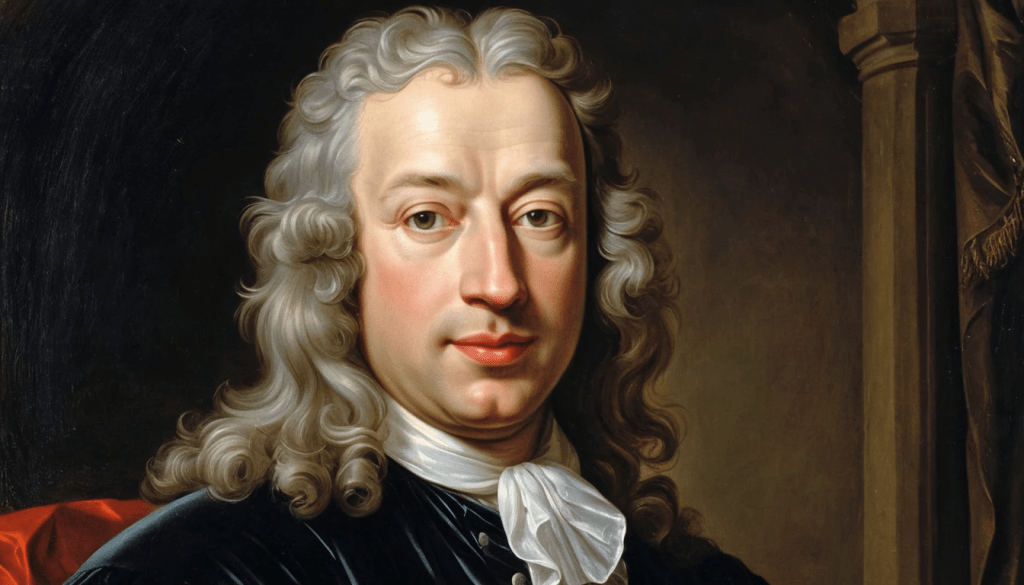
August 12, 1631
How the First Poet Laureate Standardized and Elevated English Literary Expression
On August 12, 1631, John Dryden was born in Aldwincle, Northamptonshire. Known as the first official Poet Laureate of England (appointed in 1668) and a towering figure of the Restoration period, Dryden’s influence on English went far beyond verse. His plays, poems, translations, and essays shaped the vocabulary of literary criticism, codified certain stylistic norms, and refined poetic diction for generations of writers.
1. Establishing the Role of the Poet Laureate in English
Dryden’s appointment introduced “Poet Laureate” as a formal title in English political and cultural discourse, lending prestige to the role and embedding it in the national vocabulary. This term became a recognized institutional label in both British and later American English, carrying connotations of official cultural authority.
2. Shaping Literary Criticism Terminology
In essays such as Of Dramatic Poesy (1668), Dryden helped bring critical vocabulary from Continental criticism into polished English prose. Phrases and concepts he popularized or refined include:
- “Heroic couplet” – a term he standardized through his mastery of iambic pentameter rhymed pairs, which became a benchmark for Restoration poetry.
- “Decorum” – from Latin decorum, refined in his criticism to mean the proper fitting of style to subject.
- “Unity of action” – adapted from Aristotelian poetics, given lasting English phrasing through Dryden’s essays.
- “Critical exactness” – his own phrase for precision in form and argument, now a staple of English literary appraisal.
3. Elevating Poetic Diction
Dryden’s verse introduced a measured, idiomatic elegance to English poetry, balancing clarity with musicality. His refinements included:
- Preference for plain yet elevated phrasing, avoiding the dense metaphysical conceits of earlier poets.
- Adaptation of Latinate syntax into fluent, accessible English structures.
- Coinage or naturalization of terms from French and classical sources that are still in poetic circulation.
4. Translation and Enrichment of the English Lexicon
His translations of Virgil, Juvenal, and Ovid brought into English a host of classical idioms, metaphors, and technical terms, many of which retained their imported flavor while becoming part of English literary vocabulary. Notable contributions:
- Making classical military and political terms such as consul, triumph, and augury familiar to English readers in their Roman sense.
- Introducing mythological epithets (e.g., rosy-fingered dawn, winged messenger) in English phrasing that persisted in poetic diction long after.
5. Restoration Stage Vocabulary
As a dramatist, Dryden reinforced English theatrical terminology:
- “Prologue” and “epilogue” in their modern theatrical sense gained prestige through his polished examples.
- Popularized “tragicomedy” in English dramatic theory, influencing later playwrights’ self-classifications.
- His stage prefaces helped standardize words like “audience expectation” and “dramatic unity” in theater discourse.
6. Enduring Legacy in English Style
Dryden’s style came to be described by later critics as “Augustan clarity” — a term that itself became part of English literary studies vocabulary. His name also generated the eponym “Drydenian”, still used to describe verse that combines metrical regularity with urbane wit.
Why August 12 Matters for English Language History
The birth of John Dryden on August 12 marks the arrival of a writer who codified much of the critical, poetic, and theatrical terminology we now take for granted. He not only set stylistic standards but also gave English a lexicon for talking about style itself — ensuring that phrases like heroic couplet, decorum, and poetic diction would be permanent fixtures in English literary analysis.
He didn’t just write the rules of poetry — he wrote the language to talk about them.
Curious about what happened today in history? Want to learn a new word every day?
You’ll find it all—first and in one place—at The-English-Nook.com!
If you love languages, this is your space.
Enjoy bilingual short stories, fun readings, useful vocabulary, and so much more in both English and Spanish.
Come explore!
 What Happened on This Day?
Leave a comment