
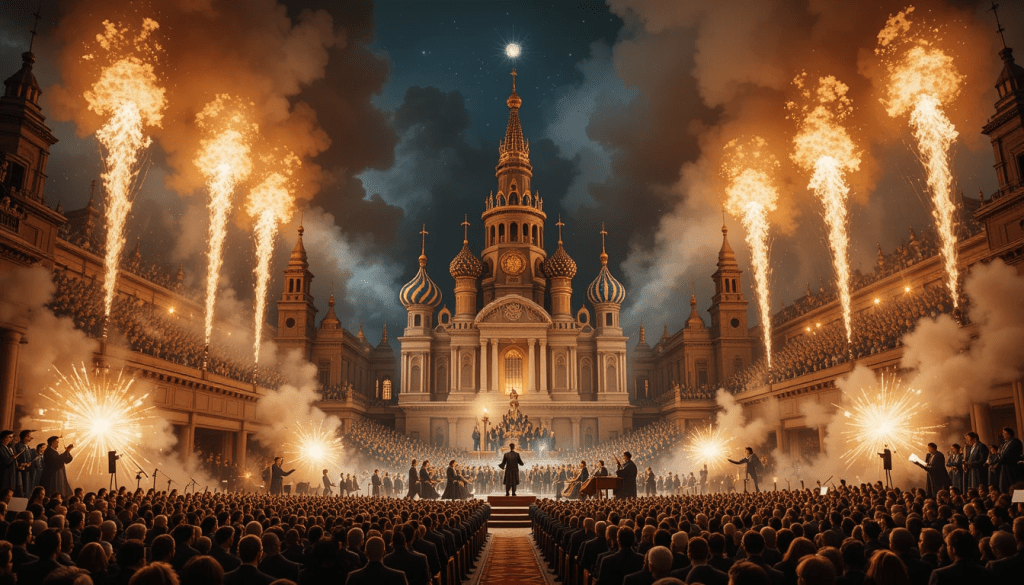
August 20, 1882
Explosive Music and the Vocabulary of Celebration
On August 20, 1882, at the Cathedral of Christ the Saviour in Moscow, Pyotr Ilyich Tchaikovsky’s Overture 1812 received its first performance. Originally composed to commemorate Russia’s defense against Napoleon during the 1812 campaign, the piece immediately acquired a reputation for its grandiosity, martial color, and celebratory scale. While conceived in a Russian nationalist context, its international reception transformed it into a universal emblem of triumph and festivity—and with this transformation, the English language absorbed new musical and cultural vocabulary.
By the late 19th and 20th centuries, English critics, audiences, and musicians adopted terms such as “overture for celebration,” “bombastic grandeur,” “sonic spectacle,” and “musical nationalism.” The very phrase “1812 Overture” itself became shorthand in English not just for Tchaikovsky’s composition but for any performance associated with explosive force, cannons, and massed celebration. In doing so, the premiere helped fix a cluster of idiomatic expressions and descriptive markers in English musical commentary.
1. The Vocabulary of the Overture Itself
- “1812 Overture” became a title transformed into idiom, standing in English for the piece itself but also metaphorically for overwhelming, celebratory performance.
- Critics in English adopted descriptors such as “martial overture” and “battle music,” emphasizing the composition’s military imagery.
- Phrases like “celebratory overture,” “festival piece,” and “grandiose symphonic gesture” became part of standard critical language.
2. Sonic Imagery and Terminology
The work’s scoring introduced unusual elements into musical vocabulary:
- “Cannon fire in music” – the piece’s signature effect gave rise to this phrase in English criticism, a shorthand for overwhelming volume or spectacular climax.
- “Church bells and brass fanfares” – became symbols in descriptive English writing for both religious solemnity and civic triumph.
- “Orchestral spectacle” and “musical pageantry” were reinforced as terms for performances blending music with public ritual.
3. Cross-Cultural Vocabulary in English Reception
Although Russian in origin, the 1812 Overture left a mark on Anglophone cultural registers:
- “Patriotic music” and “nationalist composition” entered discussions of the work’s programmatic function.
- In 20th-century English concert culture, the piece became tied to phrases like “Independence Day fireworks,” especially in the U.S., where it became standard patriotic repertoire.
- The term “Tchaikovskian bombast” emerged in English-language reviews, denoting music of lush orchestration and overwhelming force.
4. Metaphorical and Popular Usage
The piece’s reputation also shaped English idioms beyond concert halls:
- “1812 effect” – used metaphorically in journalistic English to describe anything that builds slowly and culminates in an explosive climax.
- “Cannon-blast finale” – a descriptive phrase for grand conclusions in both musical and non-musical contexts.
- “Overture of celebration” – generalized in English cultural vocabulary to describe the opening of great public events or ceremonies.
5. Enduring Vocabulary from the 1882 Premiere
From its first performance, the 1812 Overture established or reinforced a cluster of memorable terms in English-language writing:
- “1812 Overture” – a stand-in for overwhelming, triumphant performance.
- “Cannon fire in music” – shorthand for spectacular sonic effects.
- “Overture for celebration” – idiom of festival and public ritual.
- “Musical nationalism” – critical category reinforced by the piece.
- “Tchaikovskian bombast” – English critical term for grandeur and excess.
Language Legacy of August 20, 1882
The premiere of Tchaikovsky’s 1812 Overture was not only a milestone in music but also a milestone in vocabulary. In English, it fixed the title “1812 Overture” as a cultural shorthand for explosiveness, pageantry, and patriotic display. Terms such as “overture for celebration,” “cannon-blast finale,” and “musical spectacle” entered critical writing, while broader concepts like “patriotic overture” and “musical nationalism” gained permanence in Anglophone discourse.
Today, whether invoked literally in the concert hall or metaphorically in journalism and popular culture, the vocabulary born from August 20, 1882 continues to shape how English speakers describe grandeur, festivity, and sonic drama. The 1812 Overture thus stands as a rare work whose language legacy is as explosive as its music.
When cannons roared in 1882, English found new words for musical thunder.
Curious about what happened today in history? Want to learn a new word every day?
You’ll find it all—first and in one place—at The-English-Nook.com!
If you love languages, this is your space.
Enjoy bilingual short stories, fun readings, useful vocabulary, and so much more in both English and Spanish.
Come explore!
 What Happened on This Day?
Leave a comment