
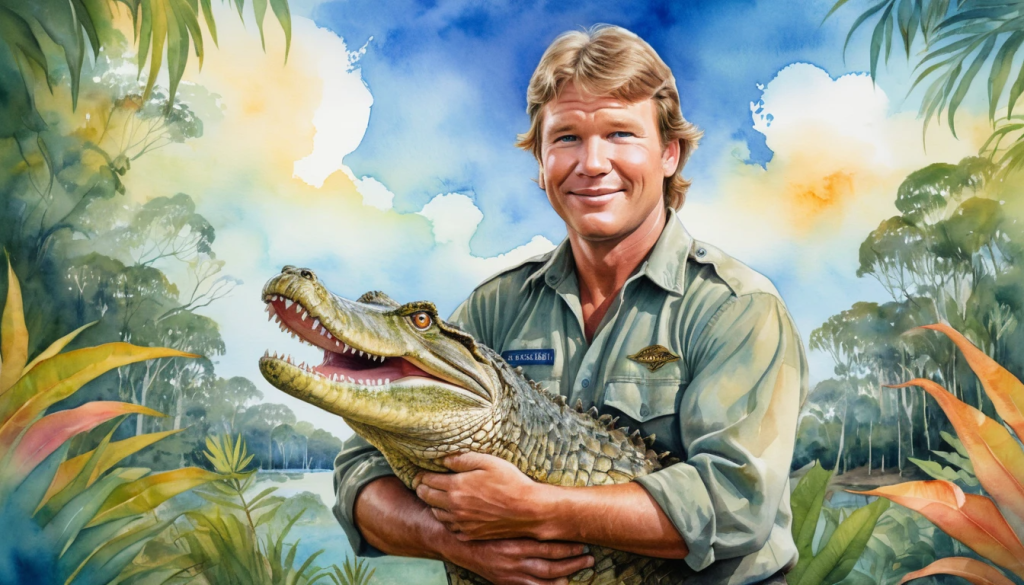
September 4, 2006
The Linguistic Legacy of the Crocodile Hunter
On September 4, 2006, the world lost Steve Irwin (1962–2006), the exuberant Australian wildlife conservationist, television personality, and cultural icon universally known as “The Crocodile Hunter.” His untimely death left millions grieving, but his legacy continues to live in language. Few figures in popular culture have left such a vivid mark on English vocabulary, idiom, and global media discourse, blending colloquial enthusiasm with scientific terminology in a way that reached classrooms, living rooms, and conservation campaigns across the world.
1. Linguistic Signature and Catchphrases
Irwin’s on-screen energy was inseparable from his speech, and his words themselves became cultural markers:
- “Crikey!”
A quintessentially Australian exclamation, revived and globalized by Irwin. Though used in Australia long before him, his dramatic, affectionate delivery made it instantly associated with his persona. In English, “Crikey!” has since become shorthand for surprise, wonder, or admiration delivered in an Irwin-esque manner. - “Isn’t she a beauty?” / “What a little ripper!”
These affectionate turns of phrase for animals—whether deadly snakes or harmless marsupials—shifted how wildlife was presented in English media. They framed creatures not as threats but as characters with charm and value, embedding anthropomorphic warmth into zoological storytelling. - “The Croc Hunter” / “Croc wrangler”
Irwin reinforced adventure vocabulary in English, merging outback slang with heroic imagery. The phrase “croc hunter” has since been used metaphorically in journalism to describe anyone who takes on an impossible, dangerous task with bravado.
2. Conservation Vocabulary Made Popular
Irwin’s linguistic genius was in translating technical ecological terms into engaging, everyday English, thus democratizing conservation discourse:
- “Wildlife warrior” – a phrase popularized by Irwin, still used today in conservation and environmental activism across English.
- “Endangered species,” “habitat destruction,” “ecosystem” – though not invented by Irwin, his enthusiastic repetition in a mass-media context familiarized these words for non-scientific audiences, making them household terms in English-speaking homes.
- His framing of animals with emotive descriptors (“grumpy croc,” “cheeky little snake”) humanized ecological science in ways that shaped how English speakers now talk about animals and conservation.
3. Cultural and Media Linguistic Impact
Irwin also generated new metaphors, idioms, and critical shorthand in English:
- “Irwin-esque enthusiasm” – used in media and criticism to describe boundless, infectious passion for a subject, far beyond wildlife.
- “Crikey factor” – sometimes invoked in journalism to capture over-the-top excitement or sensational storytelling.
- “The Crocodile Hunter approach” – a phrase adopted in management, media, and politics to describe tackling a problem with fearless, hands-on daring.
- Parody and homage – Irwin’s speech style became so distinct that English parody culture (cartoons, comedy sketches, late-night shows) developed “Irwin-speak” as a recognizable comedic register.
4. Vocabulary List: Steve Irwin’s English Legacy
- Crikey – revived Australianism, now globally understood.
- Ripper / little ripper – exuberant term of praise, made internationally familiar.
- Beauty / “Isn’t she a beauty?” – affectionate labeling of animals, making conservation warmer in tone.
- Wildlife warrior – slogan-turned-lexicon of environmental activism.
- Irwin-esque – a critical and cultural adjective describing exuberance, risk-taking, and linguistic flamboyance.
Wrap-Up
The death of Steve Irwin on September 4, 2006, marked the end of a singular life, but it also froze into memory a linguistic phenomenon that still reverberates. His words, catchphrases, and style of speech became more than quirks—they reshaped how English-speaking audiences engage with nature, science, and enthusiasm itself. From the global revival of “Crikey!” to the embedding of “Irwin-esque” in journalistic shorthand, his legacy is not only ecological but also linguistic, demonstrating the power of personality to reshape English idiom and global media vocabulary.
Curious about what happened today in history? Want to learn a new word every day?
You’ll find it all—first and in one place—at The-English-Nook.com!
If you love languages, this is your space.
Enjoy bilingual short stories, fun readings, useful vocabulary, and so much more in both English and Spanish.
Come explore!
 What Happened on This Day?
Leave a comment