
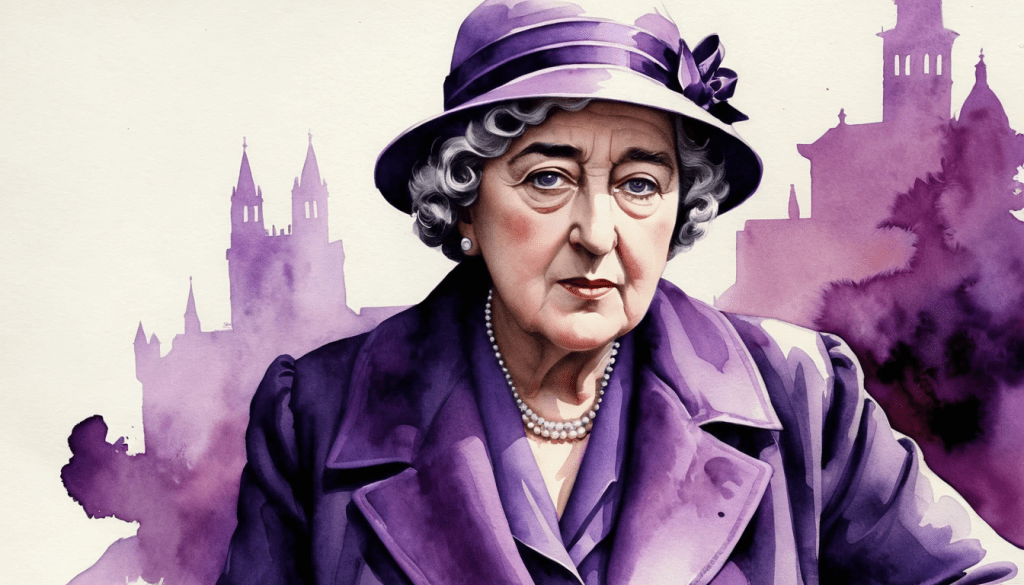
September 15, 1890
The Queen of Crime Who Enriched English with the Vocabulary of Mystery and Suspense
On September 15, 1890, Agatha Christie was born in Torquay, England. Over the course of her long career, she became the best-selling novelist in world history, with her works translated into more than 100 languages. Best known for creating detectives like Hercule Poirot and Miss Marple, Christie not only entertained readers but also forged the modern lexicon of detective fiction in English.
Her novels, plays, and characters introduced words, phrases, and archetypes that became central to English-language storytelling. From the “whodunit” to the “locked-room mystery,” Christie’s influence on the vocabulary of suspense, crime, and human psychology is unmatched.
1. “Whodunit” and the Language of Plot
Christie’s work helped popularize the now-standard English term “whodunit.”
- This compact word—fusing who + done it—became shorthand for a detective novel centered on solving a crime.
- Critics first applied it to Christie’s stories, and it quickly spread into newspapers, book reviews, and popular speech.
- Today, “whodunit” is universal English slang for a mystery, from novels to films.
Christie’s mastery of plot twists cemented the language of suspense: “red herring,” “the twist ending,” “the final reveal,” and “the unmasking” became fixed phrases in English criticism of crime fiction.
2. Poirot’s “Little Grey Cells” and Character Vocabulary
Christie’s detectives themselves shaped English idiom.
- Hercule Poirot coined the phrase “little grey cells” to describe the mind at work. It became a stock English expression for clever reasoning.
- Poirot’s fastidiousness inspired the adjective “Poirot-esque”—denoting meticulous order and psychological precision.
- Miss Marple added the vocabulary of intuition and small-town wisdom, with critics coining “Marplean deduction” to describe her subtle unraveling of mysteries.
These expressions remain part of English literary criticism and fan discourse today.
3. The Lexicon of Setting and Atmosphere
Christie’s novels also enriched English with a specific vocabulary of crime and suspenseful settings:
- “The country house mystery” — Christie perfected this subgenre, giving English a stock phrase for a closed, upper-class murder setting.
- “The Orient Express” — after her novel Murder on the Orient Express, the name itself became a metaphor for intrigue, secrecy, and cosmopolitan suspense in English.
- “The Mousetrap” — her record-breaking play gave English the phrase as shorthand for elaborate traps or setups in both fiction and politics.
Her locations and titles transformed into metaphors, embedding themselves in wider English vocabulary.
4. Critical Vocabulary: The “Christie-esque” Formula
In literary criticism, Christie’s style produced enduring descriptors:
- “Christie-esque” — a phrase now used to describe any carefully plotted, clue-driven mystery.
- “Closed-circle mystery” — English critics coined this to describe Christie’s tight, self-contained murder scenarios where the culprit must be among a small group.
- “Inverted detective story” — a term attached to some of her experiments with form, where the criminal is revealed first and the suspense lies in discovery.
Christie’s success turned technical terminology into living English expressions for writers, critics, and readers alike.
5. Global English and Cultural Resonance
Because Christie remains the most-translated author in the world, her phrasing entered global English and was reinforced internationally.
- “The Queen of Crime” — a title universally recognized in English and synonymous with her name.
- Her works made words like “clues,” “suspect,” and “alibi” everyday English, even for readers outside detective fiction.
- The “Christie puzzle” became shorthand for any situation requiring step-by-step logical unraveling.
Her storytelling style not only enriched English crime vocabulary but also set the template for detective fiction in nearly every language.
Glossary of Enduring Expressions from Agatha Christie
- Whodunit — detective mystery focused on discovering the criminal.
- Little grey cells — metaphor for human intellect and reasoning.
- Christie-esque — carefully constructed, twist-driven mystery.
- Closed-circle mystery — crime limited to a small set of suspects.
- Country house mystery — archetypal setting for classic crime stories.
- King’s ransom (adapted in her works) — extraordinary value or motive tied to wealth and crime.
- The Mousetrap — shorthand metaphor for elaborate entrapments.
Christie’s Lingering English Legacy
Agatha Christie did not just entertain with her plots—she invented a vocabulary that English speakers still rely on to talk about mystery, crime, and suspense. From the everyday use of whodunit to the critical shorthand Christie-esque, her contributions endure as part of English cultural and literary language.
Every time a critic calls a film “a whodunit,” or a reader praises “Christie-like twists,” they are speaking a language Christie herself helped to shape. Born on this day in 1890, Agatha Christie remains not only the best-selling novelist of all time but also one of the most important wordsmiths of the English imagination.
Agatha Christie didn’t just write mysteries—she gave English the words to describe them.
Curious about what happened today in history? Want to learn a new word every day?
You’ll find it all—first and in one place—at The-English-Nook.com!
If you love languages, this is your space.
Enjoy bilingual short stories, fun readings, useful vocabulary, and so much more in both English and Spanish.
Come explore!
 What Happened on This Day?
Leave a comment