
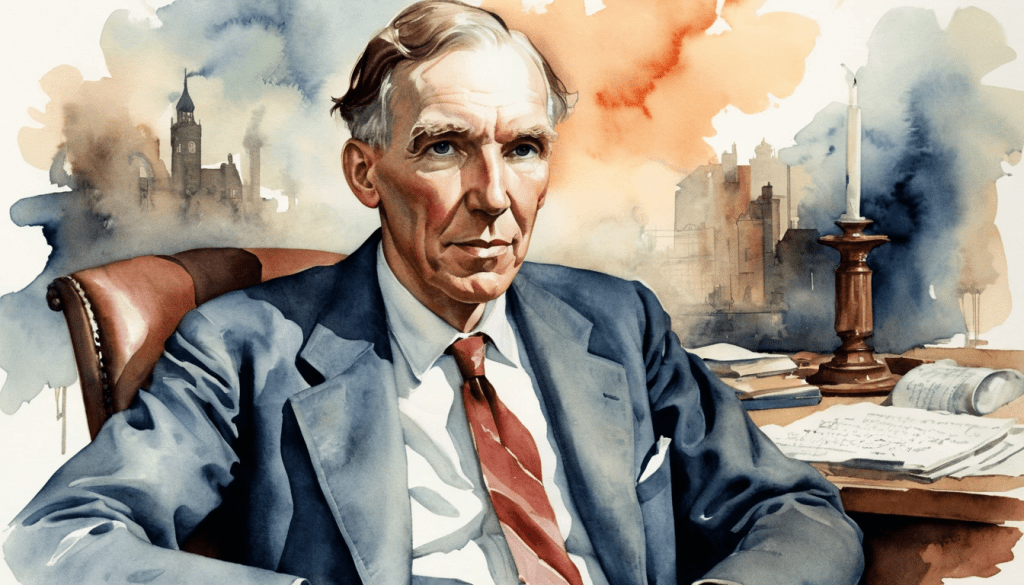
September 20, 1878
The Writer Who Armed English with the Vocabulary of Exposé, Reform, and the “Jungle” of Industry
On September 20, 1878, Upton Beall Sinclair Jr. was born in Baltimore, Maryland. A prolific novelist, journalist, and political activist, Sinclair became one of the most influential American voices of the early twentieth century. His landmark novel The Jungle (1906) shocked readers with its brutal depictions of unsafe and unsanitary conditions in the U.S. meatpacking industry, spurring food safety reforms and reshaping public debate.
Beyond The Jungle, Sinclair also attacked corrupt journalism in The Brass Check and ran for office as a reformer, leaving English with enduring phrases, metaphors, and idioms of critique that shaped political and cultural discourse.
1. “The Jungle” as a Metaphor of Exploitation
Sinclair’s most famous title entered English as a metaphorical shorthand.
- “In the jungle” became a way of describing chaotic, unregulated, or predatory systems, particularly in labor and industry.
- The phrase carried over into political speeches and journalism as a symbol of unchecked capitalism.
- Even outside economics, “the jungle” remains a metaphor for spaces where human beings are reduced to mere survival.
2. Muckraking and the Language of Exposure
Although Theodore Roosevelt coined “muckraker”, Sinclair popularized the style.
- “Muckraking journalism” became the idiom for fearless exposés of corruption, exploitation, or hidden truths.
- Sinclair’s work solidified “exposé” as a recognized journalistic genre in English.
- Today, to “rake the muck” remains shorthand for investigative journalism challenging entrenched power.
3. “The Brass Check” and Critiques of Media
In The Brass Check (1919), Sinclair attacked the press for its corruption and bias.
- “Brass check” entered English critical vocabulary as a symbol of journalism bought and paid for, echoing through media criticism.
- His book helped legitimize terms like “press barons” and “yellow journalism” in English public discourse.
4. Reformist Idioms in English Political Rhetoric
Sinclair’s activism gave political English a sharper reformist edge.
- “Sinclairian” or “Sinclair-esque” is used in criticism to describe works or rhetoric exposing systemic corruption.
- His writing contributed to the embedding of “meat inspection” and “pure food laws” as cultural-political shorthand for consumer protection.
- The phrase “I aimed at the public’s heart, and by accident hit it in the stomach” became one of English’s most quoted remarks on unintended impact.
5. Legacy in English and Public Discourse
Sinclair’s linguistic impact spread beyond literature into politics, education, and media.
- Journalists continue to invoke “the jungle” when writing about unregulated markets or brutal working conditions.
- Media critics cite The Brass Check as an early foundation for debates about journalistic integrity.
- The label “muckraker” remains a badge of honor in English for those exposing injustice.
Glossary of Enduring Expressions from Sinclair
- The Jungle — metaphor for chaos, exploitation, unregulated survival.
- Muckraking — fearless investigative journalism exposing corruption.
- The Brass Check — critique of paid, biased media.
- “Hit it in the stomach” — phrase for unintended consequences of reform writing.
- Sinclairian — exposing systemic exploitation and corruption.
Sinclair’s Reformist Language
Born on September 20, 1878, Upton Sinclair reshaped English by arming it with the vocabulary of exposé, corruption, and reform. Through The Jungle, he gave English a metaphor for unchecked capitalism and survivalist exploitation. Through The Brass Check, he enriched media criticism with a lasting idiom for press corruption. And through his muckraking style, he strengthened English’s tradition of investigative, reformist discourse. Sinclair’s words remain a touchstone in English for the power of writing to challenge injustice and shape reform.
One jungle, one brass check, one lasting legacy — Sinclair gave English its language of exposure and reform.
Curious about what happened today in history? Want to learn a new word every day?
You’ll find it all—first and in one place—at The-English-Nook.com!
If you love languages, this is your space.
Enjoy bilingual short stories, fun readings, useful vocabulary, and so much more in both English and Spanish.
Come explore!
 What Happened on This Day?
Leave a comment