
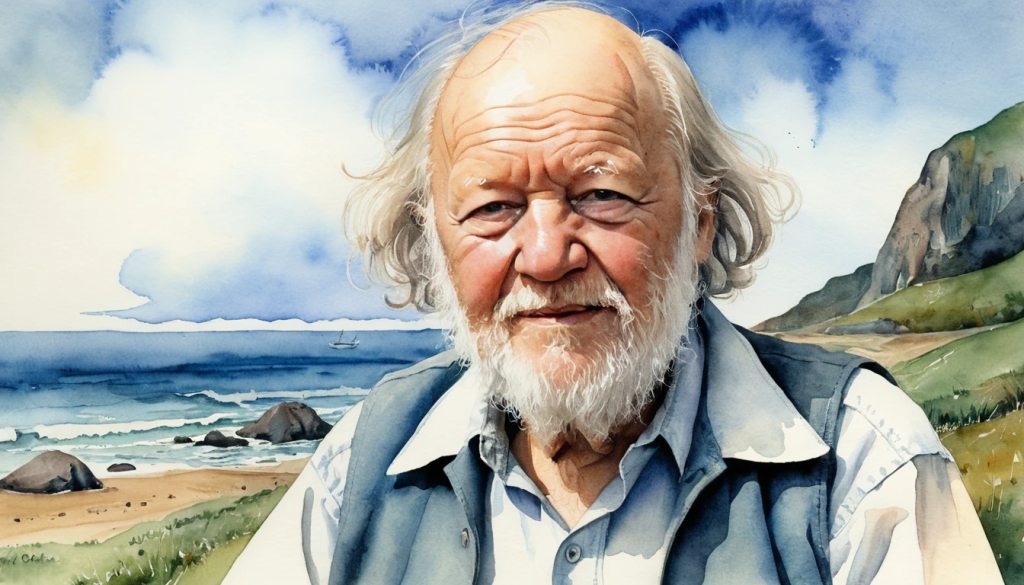
September 19, 1911
The Nobel Laureate Who Gave English a Modern Mythology of Civilization and Savagery
On September 19, 1911, William Golding was born in Cornwall, England. A schoolteacher turned novelist, Golding became one of the most important literary voices of the twentieth century, ultimately awarded the Nobel Prize in Literature in 1983. His most famous work, Lord of the Flies (1954), not only reshaped the novel of ideas but also introduced a symbolic vocabulary that remains embedded in English cultural and critical discourse.
Though he wrote other important novels (The Inheritors, Pincher Martin, Rites of Passage), it is Lord of the Flies that most profoundly enriched the English lexicon of symbolism, morality, and political allegory.
1. The Conch and the Vocabulary of Order
One of Golding’s most enduring contributions to English metaphor comes from the conch shell that the boys use as a symbol of authority.
- “The conch” entered critical English as shorthand for democratic order, collective governance, and fragile civility.
- In classrooms and political writing, references to “losing the conch” symbolize the collapse of rules or respect for shared authority.
- This single object gave English a durable metaphor for the tension between consensus and chaos.
2. Lord of the Flies as a Phrase of Savagery
The title itself, Lord of the Flies (a translation of Beelzebub), became an enduring phrase in English.
- “Lord of the Flies” is now shorthand for ungoverned violence, tribalism, and regression into barbarism.
- It appears in journalism, politics, and cultural criticism whenever describing situations where order breaks down into mob rule.
- The phrase embodies Golding’s central theme: civilization as a fragile mask over primal instincts.
3. Symbolic Characters and Archetypal Vocabulary
Golding’s characters became archetypes in the English literary imagination.
- Piggy — shorthand for vulnerable intelligence or marginalized rationality.
- Ralph — the figure of attempted order, often used in literary criticism as an archetype of democratic but fragile leadership.
- Jack — the embodiment of authoritarian charisma and violent will-to-power.
These names moved beyond mere characters and entered English literary vocabulary as symbolic types.
4. Critical and Philosophical Idioms
Golding’s work also gave rise to critical phrases and interpretive frameworks.
- “Goldingesque allegory” — used in literary studies to describe allegories of civilization, morality, and the collapse of social order.
- “The darkness of man’s heart” — a phrase from the novel, now an idiom for innate human capacity for cruelty.
- “Civilization versus savagery” — a critical pairing that became standard in English-language discussions of political philosophy and literature.
Through these expressions, Golding provided English with a vocabulary of existential morality.
5. Legacy in English and World Culture
Golding’s influence extended far beyond literary studies into journalism, education, and political rhetoric.
- Politicians and commentators often use “Lord of the Flies scenario” to describe failed states or violent youth culture.
- The “conch” metaphor recurs in debates about democracy, consensus, and legitimacy.
- His Nobel citation celebrated him for illuminating “the human condition of the modern world” — phrasing that entered literary English as a marker of Golding’s enduring cultural authority.
Glossary of Enduring Expressions from Golding
- The conch — symbol of fragile order and democracy.
- Lord of the Flies — shorthand for savagery, mob rule, and regression.
- Darkness of man’s heart — phrase for innate human cruelty.
- Goldingesque allegory — moral-political allegory of civilization collapsing.
- Piggy / Ralph / Jack — archetypal figures of intellect, order, and violence.
Golding’s Mythic Language
Born on September 19, 1911, William Golding transformed the English literary imagination by giving it new myths and metaphors. With Lord of the Flies, he provided a modern vocabulary of civilization and savagery: the conch for order, the Lord of the Flies for chaos, and archetypal characters for humanity’s eternal struggle between reason and instinct. His phrases live on in English as critical shorthand, journalistic metaphors, and political warnings. Golding’s linguistic legacy is not only literary but mythopoeic, ensuring that his words continue to shape how English speakers describe the balance — and fragility — of civilization itself.
One conch, one island, one lasting myth — Golding gave English its language of chaos and order.
Curious about what happened today in history? Want to learn a new word every day?
You’ll find it all—first and in one place—at The-English-Nook.com!
If you love languages, this is your space.
Enjoy bilingual short stories, fun readings, useful vocabulary, and so much more in both English and Spanish.
Come explore!
 What Happened on This Day?
Leave a comment