
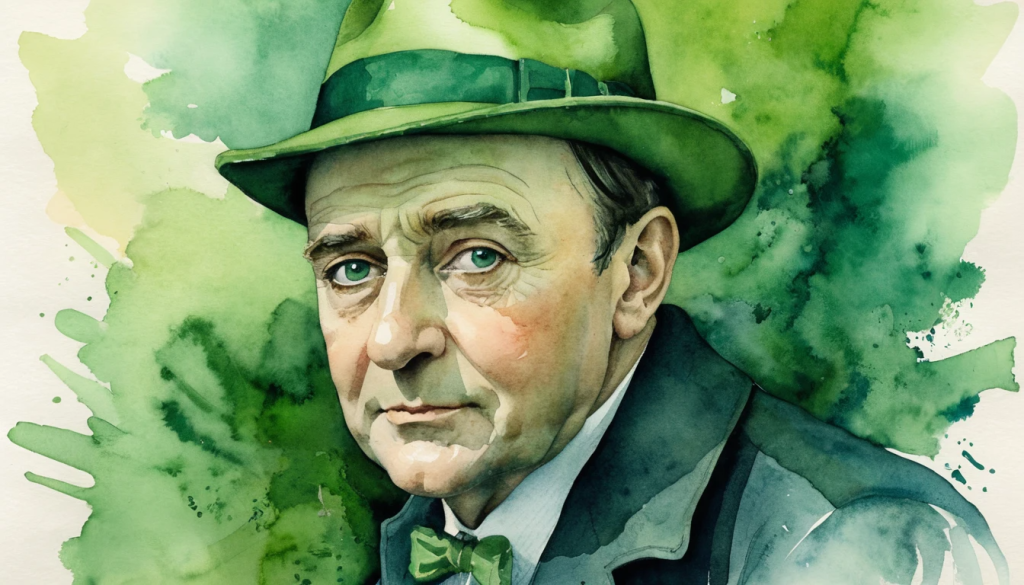
October 5, 1911
The Irish Voice Who Turned English Inside Out
On October 5, 1911, Brian O’Nolan, better known by his pen name Flann O’Brien, was born in Strabane, County Tyrone, Ireland. Novelist, humorist, satirist, and civil servant, O’Brien wrote both in English and Irish, becoming one of the most inventive prose stylists of the twentieth century.
His masterpieces — At Swim-Two-Birds (1939) and the posthumously published The Third Policeman (1967) — transformed English narrative form through their metafictional play, absurdist humor, and linguistic ingenuity. O’Brien’s writing dismantled the boundaries between author and character, story and commentary, high art and comic farce. In doing so, he gave English literature a new vocabulary of self-awareness and parody, anticipating the postmodern imagination.
1. The Playful Metafiction of English
Flann O’Brien’s fiction challenged the authority of the author and the coherence of narrative itself.
- In At Swim-Two-Birds, he introduced the idea that fictional characters could rebel against their creator — a concept that later became a hallmark of postmodern English writing.
- His layering of narrative voices gave English a comic, self-conscious syntax, where narration mocked itself even as it unfolded.
- The novel’s title itself became shorthand for metatextual playfulness — a touchstone in English literary theory.
2. The Third Policeman and the Logic of the Absurd
In The Third Policeman, O’Brien fused philosophical absurdity with deadpan English prose.
- The novel’s surreal world — with bicycles and humans exchanging atoms — expanded English’s comic range of metaphysical speculation.
- His use of circular reasoning, mock-academic tone, and pseudo-scientific jargon gave English a new mode of logical nonsense.
- The phrase “O’Brienian absurdity” now describes a distinctly Irish strain of existential humor in English literature.
3. Language, Identity, and the Anglo-Irish Voice
O’Brien’s bilingual mastery allowed him to twist English from within, infusing it with Irish wit, rhythm, and irony.
- His prose parodied both bureaucratic English and literary pretension, turning colonial language into a tool of comic rebellion.
- He expanded English’s expressive range by letting Irish idiom and cadence animate its surface.
- In English literature, he remains a key figure in demonstrating how linguistic hybridity produces both comedy and critique.
4. Legacy in English Postmodernism
O’Brien’s innovations prefigured and influenced postmodern English writers such as John Barth, Thomas Pynchon, Salman Rushdie, and Martin Amis.
- His novels gave English the template for self-reflexive narrative, where storytelling itself becomes the subject.
- Critics use the term “Flannian irony” to describe prose that mocks both itself and the world with equal delight.
- His blend of nonsense, satire, and metaphysics remains a touchstone for writers exploring the absurd structures of modern life.
5. Enduring Wit and Linguistic Freedom
Beyond theory and influence, O’Brien gave English readers permission to laugh at language itself.
- His humor taught that English could be both instrument and target of its own cleverness.
- He expanded the possibilities of style, showing that even bureaucratic English could sparkle with comic subversion.
- His works remain vital because they celebrate English’s elasticity — its power to parody, self-reflect, and reinvent.
Glossary of Enduring Expressions from O’Brien
- Flannian irony — playful, self-aware humor that dissolves narrative certainty.
- O’Brienian absurdity — logical nonsense blending wit and existential dread.
- At Swim-Two-Birds — idiom for metafictional complexity and narrative rebellion.
- The Third Policeman — symbol of circular reasoning and cosmic absurdity.
- Metafictional English — narrative style aware of its own artifice.
O’Brien’s Enduring Voice
Born on October 5, 1911, Flann O’Brien gave English a new consciousness — one that could mock itself, multiply itself, and survive its own absurdities. His linguistic daring made English both mirror and joke, both laboratory and laughter.
One pen, two tongues, infinite voices — O’Brien gave English its language of comic self-awareness.
Curious about what happened today in history? Want to learn a new word every day?
You’ll find it all—first and in one place—at The-English-Nook.com!
If you love languages, this is your space.
Enjoy bilingual short stories, fun readings, useful vocabulary, and so much more in both English and Spanish.
Come explore!
 What Happened on This Day?
Leave a comment