
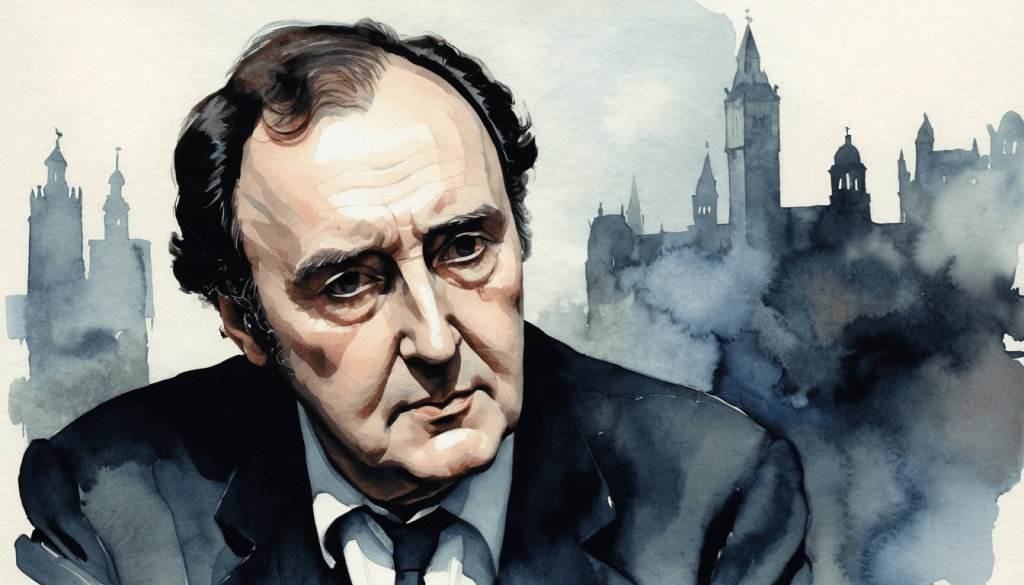
October 10, 1930
The Dramatist Who Taught English the Power of What Is Not Said
On October 10, 1930, Harold Pinter was born in Hackney, London. A playwright, screenwriter, actor, and political voice of conscience, Pinter became one of the defining figures of twentieth-century English drama. His works — including The Birthday Party (1958), The Caretaker (1960), and Betrayal (1978) — reshaped English dialogue, creating a theatre where silence spoke louder than speech, and subtext became the true action.
Pinter’s unique idiom, often described as “Pinteresque,” gave English a new dramatic texture: tense, elliptical, and alive with menace beneath the mundane. His art transformed not only the sound of the stage but also the psychological possibilities of English itself.
1. The Pinter Pause – Silence as Language
Perhaps no single innovation changed English drama more than Pinter’s use of silence.
- His signature “pause” and “silence” became integral parts of the script — deliberate gaps where meaning gathers and speech fails.
- These silences taught audiences that English communication is as much about hesitation and evasion as articulation.
- The “Pinter pause” entered both theatre and criticism as shorthand for emotional tension, threat, and unspoken truth.
2. Everyday English Turned Inside Out
Pinter drew his power from the ordinary language of conversation — but he stripped it of comfort.
- His characters speak in banal English, yet their words conceal violence, fear, and desire.
- He revealed how English — so often a language of politeness — could become a mask for power and psychological warfare.
- Through repetition, interruption, and understatement, Pinter transformed casual English into a weapon of ambiguity and control.
3. Pinteresque Tension and the Language of Subtext
“Pinteresque” entered English to describe a style of ominous normality and hidden threat.
- It denotes situations where what is not said defines what is felt.
- The word itself has become an adjective in English cultural vocabulary, used for everything from political interviews to domestic quarrels.
- This legacy ensured that English speakers would forever associate stillness with danger, and silence with revelation.
4. Political Speech and the Moral Voice of English
Beyond the stage, Pinter became one of the most outspoken political voices in English letters.
- His speeches and essays — notably his 2005 Nobel Lecture, “Art, Truth and Politics” — used English with razor-sharp irony to expose hypocrisy and abuse of power.
- He turned the language of protest into moral theatre, blending rhetorical precision with righteous anger.
- His example reaffirmed English as a medium of moral confrontation and intellectual courage.
5. Legacy in English Drama and Beyond
Pinter changed how English sounds — on stage, on screen, and in the human ear.
- His plays gave English a grammar of silence and a syntax of fear.
- Later playwrights — from David Mamet to Caryl Churchill — owe much to his clipped, charged dialogue.
- The adjective “Pinteresque” remains one of the few stylistic epithets in English literature to denote an entire psychology of speech.
Glossary of Enduring Expressions from Pinter
- Pinteresque — tense realism marked by silence, menace, and subtext.
- The Pinter pause — silence as a form of speech; unspoken meaning.
- Language of menace — everyday English charged with threat and ambiguity.
- Pinterian realism — dialogue revealing power through understatement.
- Art, Truth, and Politics — phrase symbolizing moral responsibility in language.
Pinter’s Enduring Voice
Born on October 10, 1930, Harold Pinter taught English that what matters most may lie between words. His pauses became punctuation marks of fear and feeling; his silences, mirrors of truth. Through him, English learned that speech conceals as much as it reveals, and that the smallest word — or none at all — can hold the weight of power.
One voice, one pause, one enduring echo — Pinter gave English its language of silence and tension.
Curious about what happened today in history? Want to learn a new word every day?
You’ll find it all—first and in one place—at The-English-Nook.com!
If you love languages, this is your space.
Enjoy bilingual short stories, fun readings, useful vocabulary, and so much more in both English and Spanish.
Come explore!
 What Happened on This Day?
Leave a comment