
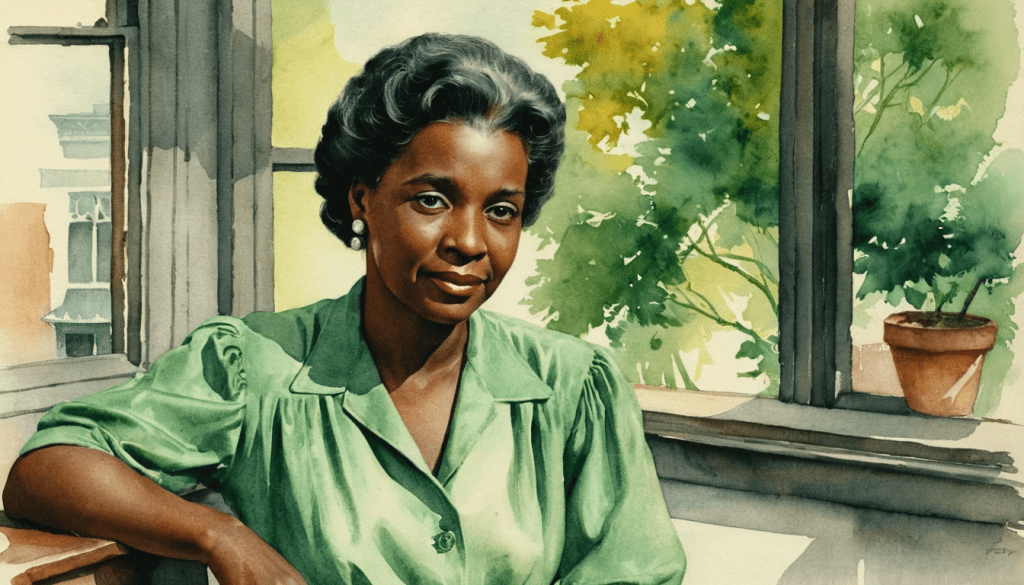
October 12, 1908
The Novelist Who Gave English the Voice of Harlem’s Streets
On October 12, 1908, Ann Petry was born in Old Saybrook, Connecticut. A novelist, journalist, and short-story writer, she became one of the most important voices of mid-twentieth-century American literature. Her groundbreaking novel, The Street (1946), was the first book by an African-American woman to sell over a million copies, bringing the realities of urban Black life into the center of English-language fiction.
With a style that combined social realism, psychological depth, and lyrical precision, Petry gave English a new urban rhythm — a prose that could carry both the weight of injustice and the pulse of survival.
1. The Street and the Language of the City
In The Street, Petry transformed the English novel by giving it a new geography and a new voice.
- Her descriptions of Harlem’s tenements and bustling streets introduced urban realism into the English literary imagination.
- Through the struggles of her protagonist, Lutie Johnson, she showed that English could bear the music and tension of Black speech and thought without distortion or stereotype.
- Her novel became a model for English prose charged with social conscience, where setting and syntax mirrored oppression and resilience alike.
2. English as a Medium of Resistance
Petry used English not as the language of authority, but as the language of exposure and defiance.
- Her prose exposed racial and gender inequities embedded in the American dream, using calm precision to reveal systemic violence.
- By giving interior voice to marginalized lives, she expanded the moral and expressive boundaries of English fiction.
- Her style — unflinching yet compassionate — proved that clarity could be a form of power.
3. The Female Perspective and the Moral Interior
Petry’s women were not symbols, but full psychological beings.
- Through their voices, she brought to English literature a Black feminist realism before the term existed.
- She explored the intersection of race, gender, and class in an idiom both intimate and unsparing.
- Her sentences — taut, rhythmic, unsentimental — made English a vehicle for both empathy and indictment.
4. Legacy in English and American Literature
Petry’s influence reshaped how English could narrate social truth.
- Later writers — Toni Morrison, Alice Walker, and James Baldwin among them — followed her in giving English new cadences of African-American life.
- Her essays and stories also expanded the journalistic English of social observation, blending reportage with artistry.
- Through her, English learned to hear the voices of Harlem, of women, of the working poor, not as background, but as central music.
Glossary of Enduring Expressions from Petry
- Urban realism — the literary portrayal of city life as lived experience and social critique.
- Black feminist realism — Petry’s moral and psychological representation of race and gender.
- The Street — symbol of struggle, survival, and social entrapment in modern English fiction.
- Petryesque clarity — prose of precision, empathy, and unflinching truth.
- Language of resistance — English used to expose inequality and affirm dignity.
Petry’s Enduring Voice
Born on October 12, 1908, Ann Petry gave English fiction a new moral register — one that could speak the truth of race, poverty, and endurance in the city’s unrelenting light. Her voice made English more just, more musical, and more complete in its humanity.
One woman, one street, one million readers — Petry gave English its language of struggle and strength.
Curious about what happened today in history? Want to learn a new word every day?
You’ll find it all—first and in one place—at The-English-Nook.com!
If you love languages, this is your space.
Enjoy bilingual short stories, fun readings, useful vocabulary, and so much more in both English and Spanish.
Come explore!
 What Happened on This Day?
Leave a comment