
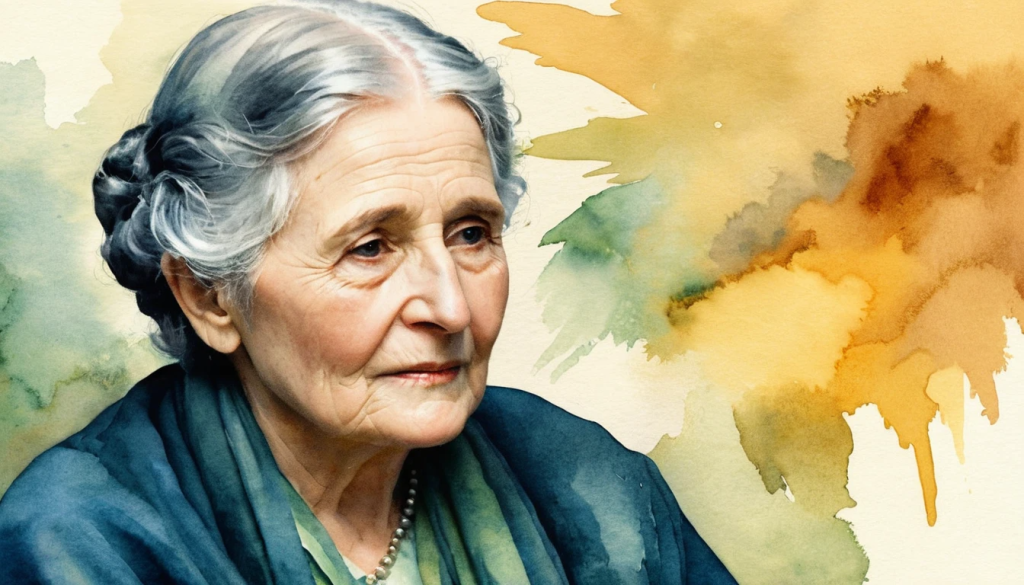
October 22, 1919
The Nobel Voice Who Made English a Language of Liberation and Inner Truth
On October 22, 1919, Doris Lessing was born in Kermanshah, Persia (now Iran), to British parents. Across a long and fearless career, she became one of the most important and challenging figures in twentieth-century English literature — a novelist, essayist, and social critic whose work expanded the moral, psychological, and political capacities of the English novel.
Awarded the Nobel Prize in Literature in 2007, Lessing was celebrated for her “skepticism, fire, and visionary power.” Her fiction — notably The Golden Notebook (1962)* — explored female consciousness, political idealism, and the fragmentation of modern identity, reshaping how English could express the intersections of gender, intellect, and emotion.
1. The English of Liberation and Inner Life
Lessing gave English fiction a new psychological depth and feminist awareness.
- In The Golden Notebook, she created a formally experimental structure, breaking narrative into notebooks of different colors to mirror the fragmented self of modern womanhood.
- Her prose fused intellectual clarity with emotional candor, allowing English to speak more openly about desire, politics, and mental struggle.
- The novel’s polyphonic voice — shifting between realism, memoir, and metafiction — influenced later generations of postmodern and feminist writers, from Margaret Atwood to Zadie Smith.
Through her fearless honesty, Lessing made English a language of psychological inquiry and gendered self-definition, turning private consciousness into public discourse.
2. Political Conscience and Global English
Lessing’s political vision extended beyond Britain.
- Having grown up in Southern Rhodesia (now Zimbabwe), she wrote with a rare awareness of empire, race, and colonial injustice.
- Her African stories, collected in This Was the Old Chief’s Country and The Grass Is Singing, gave English colonial fiction a new moral perspective — sympathetic, critical, and deeply humane.
- Her engagement with Marxism, anti-colonialism, and human rights turned English prose into a forum for global ethical debate.
In her hands, English was no longer the language of empire alone but a medium of critique and compassion, capable of confronting its own history.
3. Expanding the Vocabulary of Gender and Consciousness
Lessing’s writing altered the idiom of gender and identity in English.
- Terms like “free woman” and “the golden notebook” became shorthand for female self-assertion and artistic integrity.
- Her explorations of madness, fragmentation, and renewal enriched the English lexicon of psychological realism.
- Her later works — including the Canopus in Argos science-fiction series — proved that English could bridge the visionary and the political, the domestic and the cosmic.
She expanded what could be thought — and said — in English about the inner architecture of human freedom.
4. Style and Legacy in English Letters
Lessing’s prose style is marked by lucid intelligence, moral gravity, and unflinching realism.
- She wrote with a direct, uncompromising English, stripped of ornament yet rich in resonance.
- Her tone blends didactic clarity with psychological nuance, giving voice to thought itself — restless, probing, alive.
- In English criticism and education, the term “Lessingesque” now denotes fiction that combines intellectual seriousness with emotional vulnerability.
Her influence can be felt wherever English fiction grapples with truth, autonomy, and conscience.
Glossary of Enduring Ideas from Lessing
- The Golden Notebook — emblem of fragmented identity and creative wholeness.
- Free woman — symbol of feminist independence and moral courage.
- Lessingesque realism — psychological precision fused with ethical vision.
- Global English conscience — literature as critique of power and empire.
- Inner revolution — the struggle for authenticity through self-awareness.
Lessing’s Enduring Voice
Born on October 22, 1919, Doris Lessing transformed English prose into an instrument of liberation — linguistic, emotional, and political. Her sentences balance intellect with empathy; her ideas continue to animate debates about truth, freedom, and equality.
One woman, one notebook, one uncompromising voice — Lessing gave English its language of consciousness and rebellion.
Curious about what happened today in history? Want to learn a new word every day?
You’ll find it all—first and in one place—at The-English-Nook.com!
If you love languages, this is your space.
Enjoy bilingual short stories, fun readings, useful vocabulary, and so much more in both English and Spanish.
Come explore!

 What Happened on This Day?
Leave a comment