
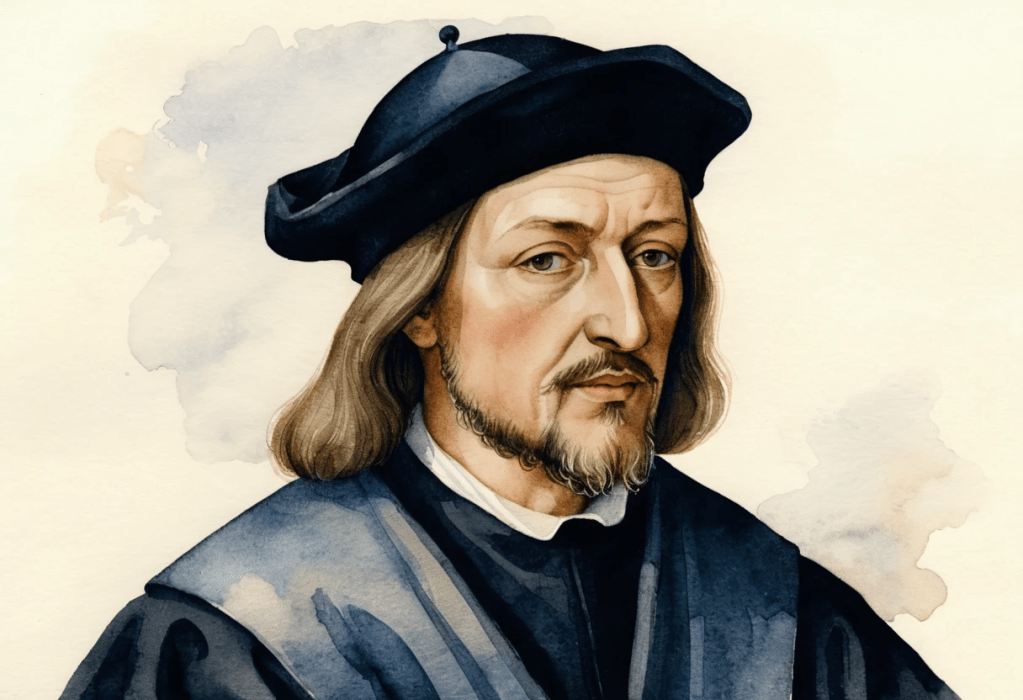
October 25, 1400
The Poet Who Gave English Its Literary Voice
On October 25, 1400, Geoffrey Chaucer—poet, courtier, and civil servant—died in London. Known above all for The Canterbury Tales, he is often called “the father of English literature”, for he was among the first major writers to prove that English, not Latin or French, could carry the weight of art, intellect, and human complexity.
At a time when most serious writing in England was done in French or Latin, Chaucer’s choice to write in Middle English was revolutionary. He did not merely use the vernacular; he refined and dignified it, helping to establish English as a literary language capable of subtle thought, emotional depth, and social realism.
1. The Birth of Literary English
Through works such as The Book of the Duchess, Troilus and Criseyde, and The Canterbury Tales, Chaucer transformed Middle English from a spoken dialect into a medium of poetry and philosophy.
- His vivid portraits of pilgrims from all walks of life created a national mirror in English, giving voice to every social class.
- His use of the iambic pentameter laid the rhythmic foundation for English verse, influencing generations from Shakespeare to Dryden.
- He expanded English vocabulary through his exposure to French, Italian, and Latin, enriching its expressive power.
Chaucer’s decision to write in English was not only artistic but cultural — a declaration that English could stand beside any learned tongue.
2. English as a Human Language
Chaucer’s writing made English deeply human.
- His pilgrims in The Canterbury Tales spoke in living English, full of wit, irony, prayer, and complaint.
- He captured the rhythms of real speech, blending high rhetoric with colloquial humor.
- In doing so, he forged a new moral and emotional vocabulary that allowed English to express love, desire, hypocrisy, and faith with unprecedented subtlety.
Through Chaucer, English learned how to speak itself — in all its social and spiritual registers.
3. Linguistic and Cultural Legacy
Chaucer’s influence on the English language is immeasurable:
- He helped standardize English during a period of regional variation.
- Thousands of words first appear in his works, making him one of the most lexically inventive authors in English history.
- His blend of realism and irony shaped the tone of English narrative, balancing moral seriousness with humor.
- Later poets and critics—from Spenser to Eliot—acknowledged him as the origin of English poetic tradition.
His language bridged medieval and modern, preparing English for the Renaissance and beyond.
4. The Enduring Voice
Even six centuries later, Chaucer’s rhythms, humor, and humanity remain alive in English.
- The Canterbury Tales continues to define the storytelling spirit of English literature, where diverse voices share one journey.
- The phrase “father of English poetry” is not mere praise—it reflects his role in shaping the very identity of English letters.
- His burial in Westminster Abbey’s Poets’ Corner was the first of its kind, marking his death as the symbolic birth of English literary tradition.
Glossary of Enduring Ideas from Chaucer
- Father of English literature — pioneer of vernacular art.
- Middle English — elevated into a literary language.
- Iambic pentameter — foundation of English poetic rhythm.
- Pilgrimage as narrative — metaphor for shared human experience.
- Vernacular dignity — proving English could be both beautiful and wise.
Chaucer’s Living Legacy
On October 25, 1400, Geoffrey Chaucer died, but English was reborn. Through his pen, the language of the common people became the language of art and humanity. His pilgrims still travel in every reader’s imagination, speaking a tongue that he helped to shape — earthy, musical, and eternal.
One poet, one pilgrimage, one language — Chaucer gave English its soul.
Curious about what happened today in history? Want to learn a new word every day?
You’ll find it all—first and in one place—at The-English-Nook.com!
If you love languages, this is your space.
Enjoy bilingual short stories, fun readings, useful vocabulary, and so much more in both English and Spanish.
Come explore!
 What Happened on This Day?
Leave a comment