
October 31
The Festival of Shadows, Language, and Storytelling
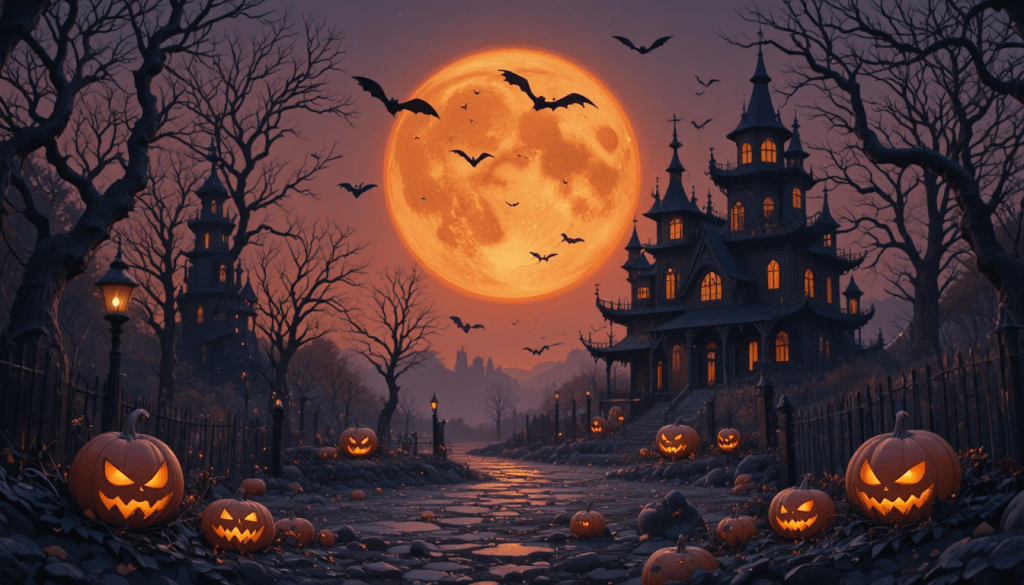
On October 31, the world observes Halloween, or All Hallows’ Eve — a night that bridges the sacred and the spectral, the seasonal and the supernatural.
Though not a publishing milestone, Halloween has become a recurring presence in English literary history, inspiring generations of poets, novelists, and dramatists to explore what lies between fear and fascination, death and renewal.
Rooted in ancient Celtic festival traditions such as Samhain and later absorbed into Christian observance as the vigil of All Saints’ Day, the night came to symbolize the boundary between the living and the dead.
From that threshold, English literature inherited not only its imagery of ghosts, masks, and midnight wanderers, but also an enduring lexicon of the uncanny — a language through which English continues to speak of fear, mystery, and imagination.
1. The Origins of a Haunted Vocabulary
The English word Halloween evolved from Hallowe’en — a contraction of All Hallows’ Even (the evening before All Hallows’ Day).
By the early modern period, this evening of spirits had become a rich source of metaphor and superstition.
Writers of the Elizabethan and Jacobean eras, from William Shakespeare to Thomas Middleton, filled their English with spectral imagery — witches, charms, apparitions, and omens — whose roots trace back to the seasonal fears and rituals of autumn’s end.
In this way, Halloween helped shape the emotional landscape of early modern English literature, where language itself became a vessel for the unseen.
Terms like ghostly, bewitched, phantasm, and haunted entered common usage, their meanings shifting from theology to psychology — from spirits of the afterlife to the inner hauntings of the mind.
Through Halloween, English gained a vocabulary of dread and enchantment, equally suited to tragedy, lyric, and tale.
2. From the Gothic to the Modern: A Night That Never Ended
By the late eighteenth century, the Gothic movement had transformed Halloween’s folklore into literary architecture.
Horace Walpole’s The Castle of Otranto, Ann Radcliffe’s The Mysteries of Udolpho, and later Mary Shelley’s Frankenstein gave English readers a new thrill: terror as art.
The supernatural became a mirror for human transgression, while the haunted house replaced the churchyard as the site of revelation.
In the nineteenth century, the tradition expanded through Charles Dickens’s A Christmas Carol, Bram Stoker’s Dracula, and Oscar Wilde’s The Picture of Dorian Gray.
Even when not set on Halloween, these works drew upon its atmosphere — fog, masks, twilight, and moral reckoning — making the festival an unspoken cornerstone of English Gothic literature.
By the twentieth century, writers such as M. R. James, H. P. Lovecraft, and Shirley Jackson carried Halloween’s essence into modern horror, linking old superstition to new psychology.
Each transformed English prose into a medium for the anxieties of modern life — alienation, guilt, repression — all of them descendants of the same haunted evening.
3. Language of the Unseen
Halloween’s lasting influence on English lies not only in story but in speech itself.
The English tongue absorbed its spirit of disguise and inversion: eerie, spooky, ghastly, sinister, macabre.
Such words migrated from folklore into idiom, allowing speakers to describe everything from political foreboding to personal unease.
Even idioms like a ghost of a chance or haunting beauty bear the festival’s echo — metaphors where darkness becomes a measure of depth.
In literature, this vocabulary became central to exploring the limits of rationality and the persistence of wonder.
The haunted night thus shaped how English expresses the inexpressible: grief, guilt, memory, and the fragile boundary between self and shadow.
4. The Modern Revival: Storytelling and the Cultural Imagination
In the twentieth and twenty-first centuries, Halloween has continued to inspire writers in English across the world.
Ray Bradbury’s The Halloween Tree celebrated the festival as a map of human myth, while Neil Gaiman’s The Graveyard Book reimagined the coming-of-age tale through ghostly mentorship.
Authors like Susan Hill, Stephen King, and Angela Carter extended the tradition of Gothic introspection, showing how the night of masks and metamorphosis remains a potent allegory for modern identity and fear.
Even children’s literature — from R. L. Stine’s Goosebumps series to J. K. Rowling’s wizarding world — owes part of its charm to Halloween’s theatrical mix of play and peril, where imagination safely explores the darker half of experience.
5. A Night Written into English Memory
Though October 31 marks no single author’s birth or death, it stands as one of the most literary dates on the calendar, a night that has written itself into English as both myth and metaphor.
Halloween remains a reminder of language’s oldest function — to name what frightens us, to tell stories that turn fear into understanding.
It bridges the fireside tale and the psychological novel, the superstition of the village and the subtle terror of modern life.
The Eternal Evening of English Storytelling
Across centuries, All Hallows’ Eve has haunted the English imagination — not as a day of horror alone, but as a mirror of creativity itself.
It reminds writers and readers alike that English thrives on its shadows: that every ghost, every whisper, every word half-spoken in fear or longing is part of its living heritage.
Halloween gave English its language of haunting — the words to speak of what is gone, and yet not gone.
In every age, that voice returns on this autumn night, when the veil between story and silence grows thin, and the language itself seems to listen in the dark.
Where shadows speak, English listens — Halloween is the night language comes alive.
Curious about what happened today in history? Want to learn a new word every day?
You’ll find it all—first and in one place—at The-English-Nook.com!
If you love languages, this is your space.
Enjoy bilingual short stories, fun readings, useful vocabulary, and so much more in both English and Spanish.
Come explore!
 What Happened on This Day?
Leave a comment