
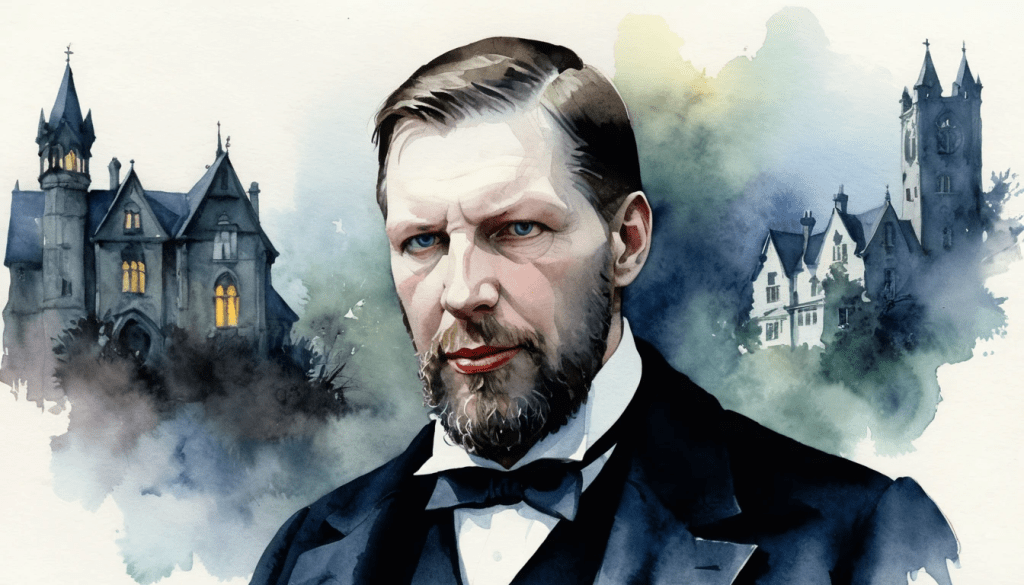
November 8, 1847
The Irish Novelist Who Gave English Its Most Enduring Monster and a Vocabulary of Fear
On November 8, 1847, Abraham “Bram” Stoker was born in Clontarf, near Dublin, Ireland. Though he spent much of his career as a theatre manager in London, his literary legacy rests on a single extraordinary work — Dracula (1897) — a novel that reshaped the boundaries of English Gothic fiction and permanently altered the vocabulary of horror and the supernatural in English. Stoker’s dark imagination gave the language new myths, archetypes, and metaphors — and his creation, Count Dracula, became one of the most recognizable figures in world literature.
1. The Language of Gothic Revival
At the fin de siècle, English fiction was haunted by themes of degeneration, duality, and forbidden knowledge. Stoker’s Dracula gathered these anxieties into a single mythic figure and expressed them through a polyphonic English narrative — diaries, letters, telegrams, and phonograph recordings.
This structure mirrored the fragmented modern world, while his diction — alternating between Victorian propriety and visceral terror — redefined how English could convey fear.
The word “vampire,” though older, gained its definitive cultural meaning through Stoker’s novel; English readers thereafter associated it not with folklore but with seduction, secrecy, and immortality.
Through Dracula, Stoker helped forge a new Gothic idiom in English — one where scientific rationality clashes with ancient superstition, and where language itself becomes the battleground of belief.
2. Dracula and the Birth of a Modern Myth
Few literary creations have influenced English-speaking culture as deeply as Count Dracula. The name itself became a symbolic shorthand — not merely for the vampire but for the monstrous other, the foreign, the forbidden, the eternal.
Expressions such as “vampiric,” “to drain one’s energy,” or “bloodsucker” all gained metaphorical power from Stoker’s imagery. His novel’s vocabulary — “undead,” “stake through the heart,” “Nosferatu” — entered the lexicon of both horror and everyday English metaphor.
By transforming Eastern European legend into a distinctly English narrative, Stoker turned myth into modern mythopoesis, proving how English could absorb folklore and render it psychologically and linguistically immortal.
3. The Victorian Mind and the Modern Imagination
Stoker’s prose captures the tensions of late-Victorian English society — between faith and science, empire and decay, masculinity and fear. His careful blending of formal, educated English with moments of panic and passion allowed the Gothic to evolve from the melodramatic to the psychological.
In doing so, he helped set the stage for 20th-century horror and fantasy writing in English, influencing authors from M. R. James and H. P. Lovecraft to Stephen King and Anne Rice.
The Gothic vocabulary Stoker codified — of shadows, thresholds, contagion, and forbidden desire — continues to inform English storytelling, journalism, and even political rhetoric.
4. The Afterlife of a Novel
In English popular culture, Dracula has never died. Adapted for stage, film, and television, its imagery and idioms became fixtures of the language itself: “a Dracula figure,” “to draw blood,” “fangs,” “daylight exposure,” and the symbolic “mirror.”
Through endless reinvention, Stoker’s Gothic English proved remarkably flexible and global, showing how a single work could create a shared cultural vocabulary.
The “Dracula myth” continues to serve as a metaphor in English for addiction, eroticism, exploitation, and even political corruption — proof that his linguistic influence extends far beyond literature.
The Shadow That Spoke English
Born on November 8, 1847, Bram Stoker gave English its most enduring modern myth and one of its most adaptable vocabularies.
In his novel, fear found a new grammar, desire a new syntax, and immortality a new metaphor.
Through Dracula, Stoker ensured that English itself would forever speak in Gothic tones — a language of shadows, longing, and the dark pulse of the imagination.
Bram Stoker: the man who taught English to speak in shadows.
Curious about what happened today in history? Want to learn a new word every day?
You’ll find it all—first and in one place—at The-English-Nook.com!
If you love languages, this is your space.
Enjoy bilingual short stories, fun readings, useful vocabulary, and so much more in both English and Spanish.
Come explore!
 What Happened on This Day?
Leave a comment